









These days I feel confident saying there are two things I can rely on: 1) the Hubble Space Telescope will continue to reveal amazing things about the Universe around us, and 2) Pluto will continue to surprise us. This week we had both!
Hubble released a new data analysis of two of Pluto’s five moons, Nix and Hydra, that show them to be wobbling all over the place. It might be surprising, but Hubble can’t actually *see* Pluto and its moons in the same way that it sees the brilliant galaxies and nebulae you are used to hearing about. This is because Pluto doesn’t produce any light itself, but rather only reflects what little of the Sun’s light reaches it. As a small, dark, rocky object at a great distance, that’s not much.
However, using the change in the light Hubble receives from the Pluto system over time, astronomers can begin to constrain their best estimates for the size, shape, and motion of Pluto’s moons. The latest data shows that Nix and Hydra are likely oblong, shaped like potatoes, and they are not rotating about an axis of symmetry. So as they orbit around Pluto, the light they reflect appears to change erratically.
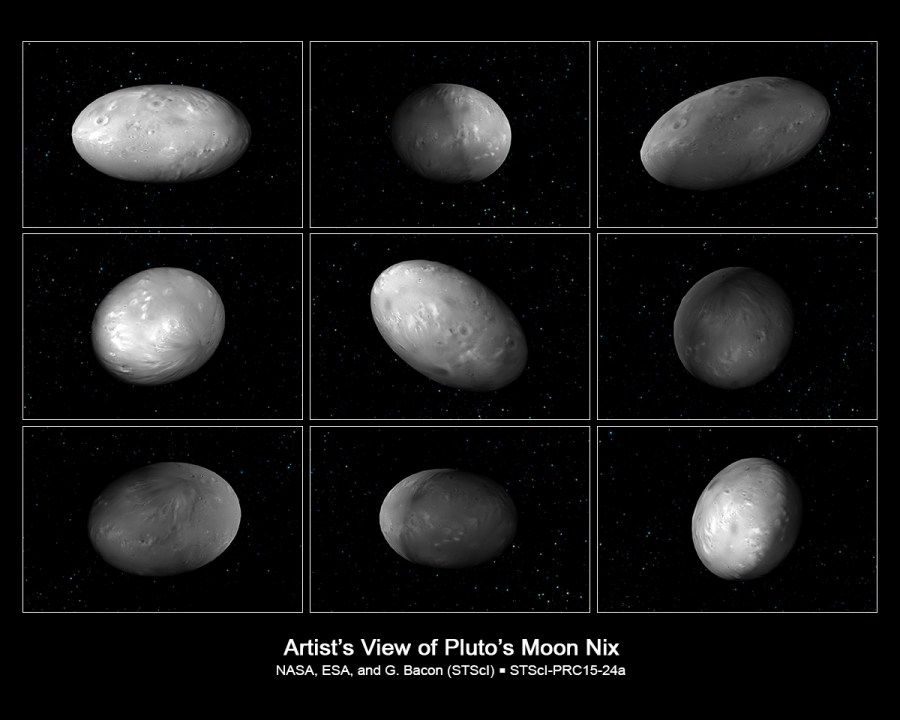
NASA’s New Horizons spacecraft is closing in on Pluto as we speak with its closest approach scheduled for July 14, 2015. If all goes well, we’ll know just how chaotic this system really is before the summer is out.
Here’s some more geek from the week: Keep on geeking! @Summer_Ash, In-house Astrophysicist
Summer Ash Recommended


