








In January 2014, then-President Barack Obama hosted a cabinet meeting, where he expressed optimism about working with lawmakers from both parties to advance the nation’s interests. He also seemed realistic. however, about whether Congress would get anything done.
“One of the things that I’ll be emphasizing in this meeting is the fact that we are not just going to be waiting for a legislation in order to make sure that we’re providing Americans the kind of help that they need. I’ve got a pen and I’ve got a phone,” Obama said. The pen referred to executive actions, including executive orders, and the phone referred to Obama’s willingness to reach out to people beyond the Beltway — “non-profits, businesses, the private sector, universities” — to help work on his priorities.
Almost immediately, Republicans were outraged, suggesting Obama’s “pen and phone” rhetoric was proof that the Democratic president intended to ignore our system of government and make major policy changes without congressional input. The “pen and phone” framing quickly became a GOP shorthand for the party’s impression that Obama saw himself as a dictator.
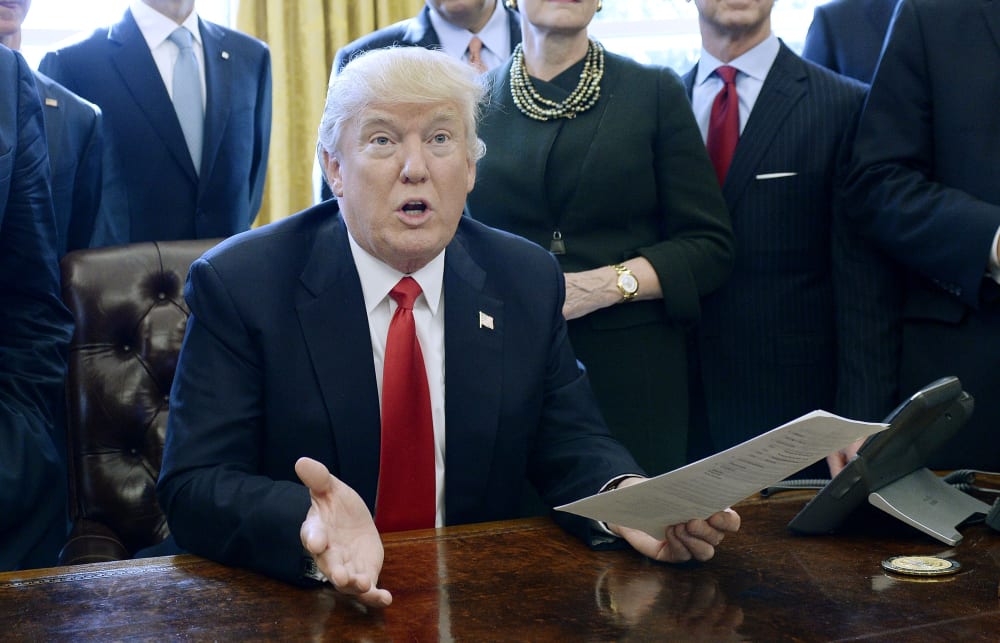
And yet, there was Donald Trump last week, arguing that in response to the Republican Congress’ ineptitude, “I will be using the power of the pen” to tackle health care policy unilaterally — which is awfully similar to the kinds of actions GOP lawmakers condemned when Obama was in the Oval Office.
The New York Times had a piece on this over the weekend:
The president was frustrated. Lawmakers were not passing what he wanted. They were “obstructionists,” he complained. So he took out his pen, signed his name to an order and took action on his own. “We’re taking a little different route than we had hoped because getting Congress — they forgot what their pledges were,” he said.
The chief executive attacking Congress was President Trump, but his words might have been spoken by President Barack Obama. Mr. Trump has concluded that he cannot wait for a polarized Congress to act, so he is turning to executive power to accomplish what lawmakers will not, in this case erasing the legacy of the Obama years.
As is always the case, the substantive details matter, and there’s no denying the fact that Obama was far more ambitious when it came to using executive power, at least given what we’ve seen from Trump thus far.
But at the same time, Obama didn’t run on a platform predicated on avoiding executive orders — and Trump did.
I’m reminded of an Associated Press piece from April:
White House aides said that Trump will have signed 32 executive orders by Friday, the most of any president in their first 100 days since World War II. That’s a far cry from Trump’s heated campaign rhetoric, in which he railed against his predecessor’s use of executive action late in his tenure as President Barack Obama sought to maneuver around a Republican Congress. Trump argued that he, the consummate deal maker, wouldn’t need to rely on the tool.
Recommended


“The country wasn’t based on executive orders,” said Trump at a town hall in South Carolina in February 2016. “Right now, Obama goes around signing executive orders. He can’t even get along with the Democrats, and he goes around signing all these executive orders. It’s a basic disaster. You can’t do it.”
And as we discussed at the time, that just scratches the surface. In January 2016, for example, Trump told Fox News, “[T]he problem with Washington, they don’t make deals. It’s all gridlock. And then you have a president that signs executive orders because he can’t get anything done. I’ll get everybody together.” In November 2015, in reference to Obama, Trump added, “He doesn’t work the system. That is why he signs executive orders all the time because he can’t get his own people to go along.” A month earlier, Trump said, “Look at Obama. He doesn’t get anything done…. You’ve got to close the door and get things done without signing your executive orders all the time. That’s the easy way out.”
This posture continued throughout his candidacy. As recently as late September 2016, Trump complained, “Right now, we have an executive-order president. He just keeps signing.”
In March 2016, with his hold on the GOP nomination nearly complete, Trump went so far as to declare, “I want to not use too many executive orders, folks. Executive orders sort of came about more recently. Nobody ever heard of an executive order. Then all of a sudden Obama, because he couldn’t get anybody to agree with him, he starts signing them like they’re butter. So I want to do away with executive orders for the most part.”
Perhaps the best quote of them all is from January 2016, when Trump told CNN his thoughts on the “executive-order concept.” He explained at the time, “You know, it’s supposed to be negotiated. You’re supposed to cajole, get people in a room, you have Republicans, Democrats, you’re supposed to get together and pass a law. [Obama] doesn’t want to do that because it’s too much work. So he doesn’t want to work too hard. He wants to go back and play golf.”
Nearly two years later, it appears Trump’s views on the “executive-order concept” have evolved.
Steve Benen is a producer for "The Rachel Maddow Show," the editor of MaddowBlog and an MS NOW political contributor. He's also the bestselling author of "Ministry of Truth: Democracy, Reality, and the Republicans' War on the Recent Past."
