








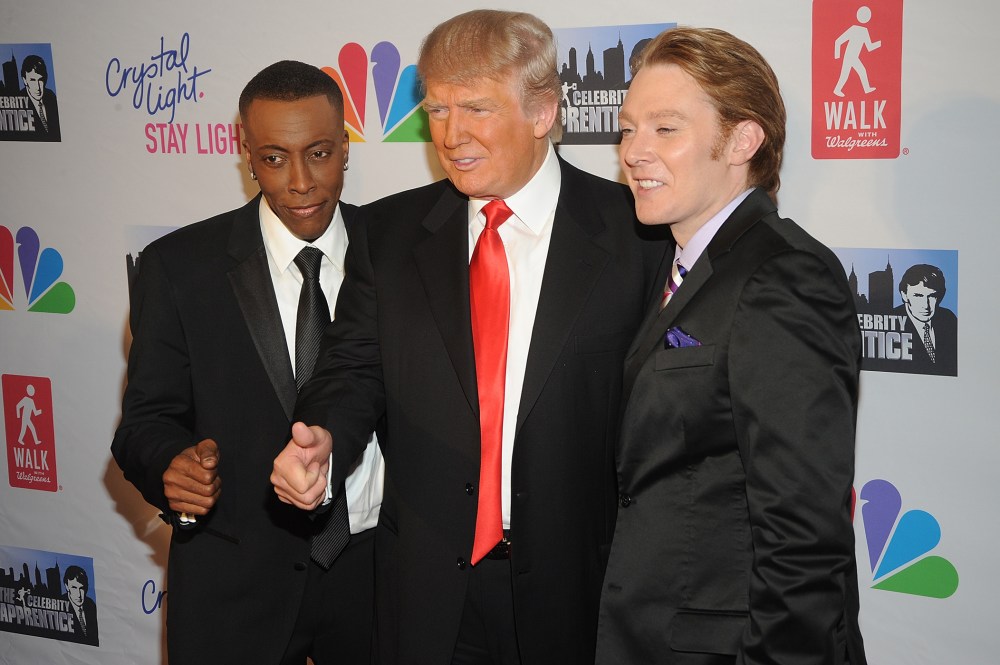
It’s difficult to imagine Donald Trump launching a credible presidential campaign without the benefits of his former reality television program, which ran for 14 seasons on NBC. The New Yorker published a fascinating new piece on its creation — producer Mark Burnett wanted to effectively create an urban version of “Survivor” set in a corporate environment — and the degree to which the future president was ill-suited for the role.
The show’s creators sought a “heavyweight tycoon” for the feature role and settled on Trump, which meant fooling the audience into taking Trump seriously.
“The Apprentice” portrayed Trump not as a skeezy hustler who huddles with local mobsters but as a plutocrat with impeccable business instincts and unparalleled wealth—a titan who always seemed to be climbing out of helicopters or into limousines. “Most of us knew he was a fake,” [Jonathon Braun, a multi-season editor on the show] told me.
“He had just gone through I don’t know how many bankruptcies. But we made him out to be the most important person in the world. It was like making the court jester the king.” Bill Pruitt, another producer, recalled, “We walked through the offices and saw chipped furniture. We saw a crumbling empire at every turn. Our job was to make it seem otherwise.”
It’s consistent with the series of frauds Trump has relied on throughout his adult life, but just as importantly, the way in which Trump’s reality-TV show functioned seems oddly familiar to those of us who take note of how his White House functions.
The New Yorker piece noted, for example, that on “The Apprentice,” contestants competed in weekly challenges, culminating in a firing at the end of every episode. In practice, Trump was “frequently unprepared” for the dramatic scenes, having little sense of which contestants had excelled and which had faltered during that week’s competition.
Trump, “on a whim,” would occasionally fire the wrong person, forcing editors to “reverse engineer” that week’s episode, scrambling to find footage of that contestant’s missteps, in the hopes of justifying the future president’s misplaced decision. It became necessary to create “an artificial version of history in which Trump’s shoot-from-the-hip decision made sense.”
If this sounds familiar, it should.
One of the show’s former editors told The New Yorker that White House staffers have been forced to learn the art of retroactive narrative construction, just as the staff at “The Apprentice” did. “I find it strangely validating to hear that they’re doing the same thing in the White House,” Jonathon Braun said.
Alas, that’s true. After Trump announced a massive new tax-policy initiative that existed only in his imagination, Republican officials scrambled to reverse engineer a plan to make the president appear less ridiculous. As the Washington Post noted in October, it was a familiar sight.
The mystery tax cut is only the latest instance of the federal government scrambling to reverse-engineer policies to meet Trump’s sudden public promises – or to search for evidence buttressing his conspiracy theories and falsehoods. The Pentagon leaped into action to both hold a military parade and launch a “Space Force” on the president’s whims. The Commerce Department moved to create a plan for auto tariffs after Trump angrily threatened to impose them. And just this week, Vice President Pence, the Department of Homeland Security and the White House all rushed to try to back up Trump’s unsupported claim that “unknown Middle Easterners” were part of a migrant caravan in Central America – only to have the president admit late Tuesday that there was no proof at all. “Virtually no one on the planet has the kind of power that a president of the United States has to scramble bureaucracies in the service of whim,” said Kathleen Hall Jamieson, director of the Annenberg Public Policy Center at the University of Pennsylvania. “Whatever Donald Trump wakes up and thinks about, or whatever comes to mind in the middle of a speech, actually has the reality in that it is actionable in some odd sense.” In May, Anne Applebaum wrote, “[E]veryone understands now that policy, in Trump’s Washington, is often made on a whim – the president’s whim.” The columnist was referring to foreign policy at the time, but it’s a sentiment with broad applicability. As regular readers know, in traditional administrations, officials do their due diligence first, and once the work is complete, the president makes an announcement. In Donald Trump’s White House, it’s reversed: the president blurts out a poorly constructed thought, which in turn sends officials scrambling to construct a framework in service of the amateur’s idea. What’s left is a model for 21st-century governing in a preeminent superpower that’s oddly reminiscent of a clumsy reality show.
Steve Benen is a producer for "The Rachel Maddow Show," the editor of MaddowBlog and an MS NOW political contributor. He's also the bestselling author of "Ministry of Truth: Democracy, Reality, and the Republicans' War on the Recent Past." Recommended


