








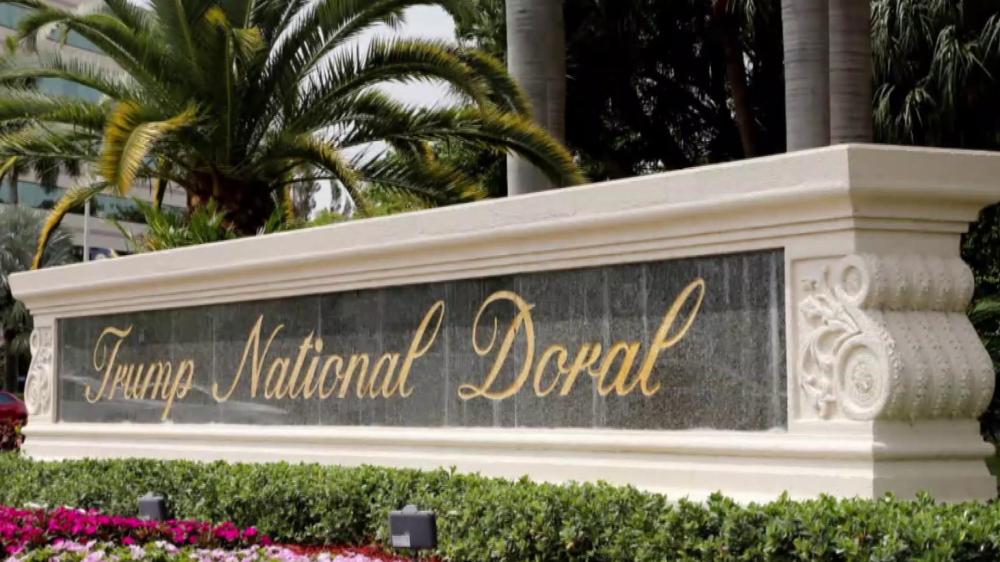
It’s safe to say Walter Shaub, the former director of the Office of Government Ethics, was not pleased when the White House announced yesterday that next year’s G7 summit would be held at one of Donald Trump’s struggling businesses. Consider what Shaub wrote via Twitter:
“In case it’s not clear from my freaking out, this G-7 thing is an escalation. It may look from the outside like it’s been corruption all along — because it has been — but participating in a contract award to yourself is different by orders of magnitude. This is a red line crossed.”
I strongly agree, though I also think it’s worth pausing to appreciate why this latest presidential gambit is considerably worse than the more mundane corruption that’s practically served as background noise for the Trump presidency.
At issue is a once-obscure provision of the U.S. Constitution known as the “Emoluments Clause.” As regular readers know, the clause prohibits U.S. officials from receiving payments from foreign governments. Traditionally, this hasn’t been much of a problem for sitting American presidents — but in the Trump era, things are a little different.
For example, the president owns a hotel that sits roughly a half-mile from the White House, which hosts international officials with some regularity. The result is a dynamic in which foreign governments have spent quite a bit of money at a Trump-owned property, to the benefit of the American president and his private-sector enterprise.
The result, not surprisingly, has been a series of court cases challenging the legality of Trump’s business practices.
One of the core defenses for the president has been the idea that the foreign officials are making a private decision on their own, without interference from Trump. In other words, if Saudi Arabian leaders are visiting the nation’s capital, and they happen to book rooms at a prominent D.C. hotel in a great location, that’s not the president’s fault. It’s not like Trump told them to do business at one of the facilities he owns.
There’s no shortage of problems with the defense, but the argument itself helps underscore why the new G7 scandal is qualitatively different.
We’re watching a passive-vs-active problem play out.
When Saudi Arabia books rooms at the Trump International Hotel in D.C., and some of the profits from the transaction end up in the American president’s pocket, Trump can defend the arrangement by saying it’s entirely passive: he played no role in the Saudis’ decision.
That defense disappears with the G7 summit: it’s all active corruption, not passive corruption. Trump, in no uncertain terms, is telling some of the world’s most powerful leaders if they wish to participate in next year’s international gathering, they will have to spend quite a bit of money at one of his struggling businesses.
It’s conscious. It’s deliberate. It’s direct. Trump knows the Constitution prevents him from receiving payments from foreign governments, but he’s brazenly trying to pull off this gambit anyway — not just welcoming foreign money, but also insisting upon it. Sen. Marco Rubio (R-Fla.), once again indifferent to presidential wrongdoing, was quoted yesterday saying, in response to the president awarding himself a lucrative contract, “I don’t think it changes anything. I just think it’s another day in the life of Washington, D.C., these days.” This made it sound as if Trump’s scheme were somehow common. The opposite is true: Americans have never seen anything like this. Rep. Jamie B. Raskin (D-Md.), a member of the House Oversight and Judiciary Committees, told the Washington Post‘s Paul Waldman and Greg Sargent yesterday that “he’s been discussing with other Democrats the prospect of holding a House vote on a resolution disapproving of Trump’s decision on Doral, as well as of his continued violation of the Constitution’s emoluments clauses via his acceptance of untold sums from foreign officials and governments, and the U.S. government.” In an interview, Raskin added. “It’s hard for me to imagine a comprehensive impeachment resolution that does not refer to the president’s repeated and continuing violations. The get-rich-quick scheme that the president has cooked up with the G-7 and Doral has the kind of alarming public clarity that the Ukraine shakedown does. The president is essentially writing his own impeachment articles.”
Steve Benen is a producer for "The Rachel Maddow Show," the editor of MaddowBlog and an MS NOW political contributor. He's also the bestselling author of "Ministry of Truth: Democracy, Reality, and the Republicans' War on the Recent Past." Recommended


