









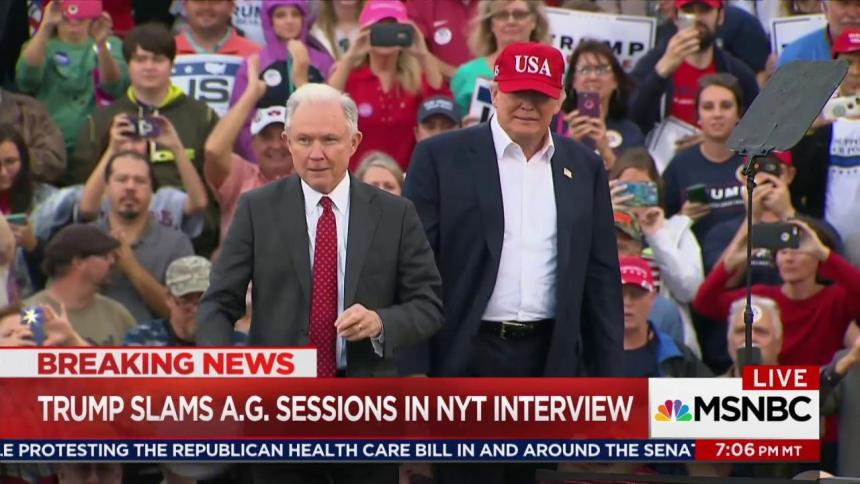
Just yesterday, while trashing the impudence of the Justice Department, Donald Trump told the New York Times that he believes the director of the FBI reports directly to the president. He called this “interesting,” before adding, “I think we’re going to have a great new FBI director.”
Matthew Miller, a former DOJ spokesperson, explained on the show last night that Trump badly misstated the facts, adding that Trump “wanted Jim Comey to operate as if he reported to him. He wanted Jim Comey to be loyal to him, and follow his whims. When [Comey] wasn’t, [Trump] fired him. And I think [the president is] making clear he wants his next FBI director to do what Jim Comey wouldn’t do.”
Given this, it might be worth pausing for a moment, taking a breath, and considering how best to proceed with the White House’s choice to lead the bureau. And yet, as Politico reported, the Senate doesn’t seem to agree.
Christopher Wray, President Donald Trump’s nominee to lead the FBI, easily cleared a key Senate committee Thursday — even following an explosive Trump interview in The New York Times that prompted Democrats to raise renewed concerns of political interference with the Department of Justice.
The Senate Judiciary Committee voted 20-0 in favor of Wray, a former Justice Department official who has been in private practice for the past dozen years. His nomination now goes to the Senate floor, where Majority Leader Mitch McConnell has indicated he intends to have Wray confirmed before the August recess.
What we’re witnessing is a process in which the Senate is treating Trump’s nominee as if these were normal circumstances — but they’re not.
In theory, there’s a vacancy atop the FBI; the White House has chosen a qualified nominee; and the Senate Judiciary Committee was pleased with how the confirmation hearing went. The next obvious step in the process was a favorable committee vote, to be followed by a floor vote.
But the current circumstances are anything but normal. The most recent head of the FBI was fired because Trump disapproved of an ongoing investigation the director was leading into the president and the election assistance he received from his foreign benefactors. By some accounts, Comey’s dismissal was itself evidence of obstruction of justice.
Trump then chose Wray — rolling out his nomination in a bizarre and highly disorganized way — before suggesting that the new FBI director would be more cooperative to the White House’s plans than the old FBI director.
I generally approve of the idea of the Senate considering a nomination on the individual’s merits, and if Wray is capable and qualified, it’s understandable to think that should effectively end the conversation. But there’s a context here that’s being overlooked: there shouldn’t be a vacancy in the FBI director’s office right now. Trump’s decision to fire Comey was an unprecedented abuse of dubious legality, and the president’s recent comments suggest his vision for Wray’s role falls far outside what should be acceptable.
The New Republic‘s Brian Beutler recently made the case that opposing Wray makes sense, not because of concerns about the nominee, but because of concerns about the president who nominated him. The problem is that because of what we know about Wray’s soon-to-be boss, there’s no way anyone in the Senate can have confidence that he’ll serve honorably. In fact, Wray himself can’t know whether he’ll serve honorably, even if he intends to. Trump tried to corrupt James Comey. He even made Comey go wobbly at a couple key junctures. But when Trump’s efforts to obstruct investigations failed, he fired Comey and lied about it. Would Wray put up Comey-levels of resistance? No one can honestly say, but the fact that Trump handpicked Wray should put everyone on alert. […] Again, it’s not Wray’s fault, necessarily, but it’s critical that Comey’s successor be someone that the next president doesn’t feel the need to fire. Wray may serve with distinction through Trump’s presidency and into his successor’s presidency. But the likelihood that anyone Trump selected will end up becoming compromised is so high that Democrats shouldn’t preemptively complicate efforts to remove him in the future by offering their support to him now. Vox’s Matthew Yglesias added, Wray “has one critically disqualifying attribute — he interviewed for the job with Trump, and Trump decided he wanted to appoint him. That means of all the reasonably well-qualified candidates out there, Wray is the one who struck Trump as having the least integrity and the most inclination to display personal loyalty to him.” By all appearances, senators are satisfied that Wray will be independent, and if Trump is counting on a different dynamic, they believe the president will be disappointed. Today’s committee vote is evidence that senators simply don’t perceive the stench of scandal surrounding this nomination. They are, in other words, treating Wray like a normal nominee. That’s almost certainly a mistake.
Steve Benen is a producer for "The Rachel Maddow Show," the editor of MaddowBlog and an MS NOW political contributor. He's also the bestselling author of "Ministry of Truth: Democracy, Reality, and the Republicans' War on the Recent Past." Recommended


