









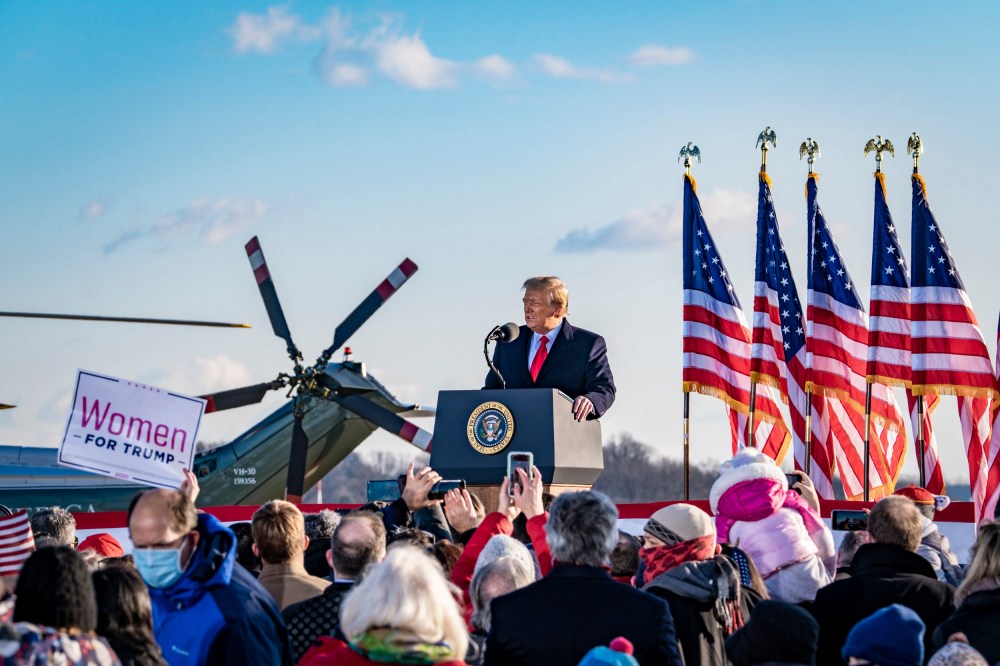

In his last public remarks before the end of his term, Donald Trump assured a modest group of supporters, “I will be watching. I will be listening…. We will be back in some form.”
And what form, pray tell, might that be? The Wall Street Journal reported a week ago today:
President Trump has talked in recent days with associates about forming a new political party, according to people familiar with the matter, an effort to exert continued influence after he leaves the White House. Mr. Trump discussed the matter with several aides and other people close to him last week, the people said. The president said he would want to call the new party the “Patriot Party,” the people said.
The idea quickly gained favor with one of Trump’s closest allies in conservative media.
At a superficial level, there’s a degree of logic to this: Trump isn’t at all pleased with congressional Republican leaders; he’s never really had any meaningful interest in the party or its principles; he has a group of followers who are more committed to him personally than the party as an institution; and one man creating a political party is the ultimate vanity project.
And Donald Trump loves vanity projects. If the Republican Party was merely a vehicle for him to advance his own interests, why wouldn’t Trump create a vehicle of his own, led entirely by those who will do nothing but glorify him?
That’s not necessarily a rhetorical question, and there are plenty of good answers. For one thing, political parties tend to have platforms and policy agendas, and Trump has no interest in such things. For another, creating parties requires an enormous amount of work and resources, and there’s little to suggest Trump cares enough to bother.
But perhaps most important is the obvious fact that a poorly named “Patriot Party” would compete with the two established major parties, split the right, and help Democratic candidates — which Trump is loath to do.
So what’s with all the scuttlebutt? The Washington Post had a good report along these lines this week. In recent weeks, Trump has entertained the idea of creating a third party, called the Patriot Party, and instructed his aides to prepare election challenges to lawmakers who crossed him in the final weeks in office…. Multiple people in Trump’s orbit, who spoke on the condition of anonymity to discuss private conversations, say Trump has told people that the third-party threat gives him leverage to prevent Republican senators from voting to convict him during the Senate impeachment trial. Trump advisers also say they plan to recruit opposing primary candidates and commission polling next week in districts of targeted lawmakers. Trump has more than $70 million in campaign cash banked to fund his political efforts, these people say. And that’s where this starts to make sense. Trump’s followers threw tens of millions of dollars at him, even after he’d lost, and he’s eager to put that money to use. There are a few legal limits about how those funds can be spent, but Trump can certainly spend it on “election challenges to lawmakers who crossed him” and “recruit opposing primary candidates.” In this sense, Trump’s so-called “Patriot Party” would be something along the lines of the “Tea Party” — which, of course, was never actually a political party, but rather, was a clumsy brand name for part of the GOP base. With this in mind, Trump appears less interested in creating a new party and more interested in controlling his old one.
Steve Benen is a producer for "The Rachel Maddow Show," the editor of MaddowBlog and an MS NOW political contributor. He's also the bestselling author of "Ministry of Truth: Democracy, Reality, and the Republicans' War on the Recent Past."
Latest Post
Recommended


