








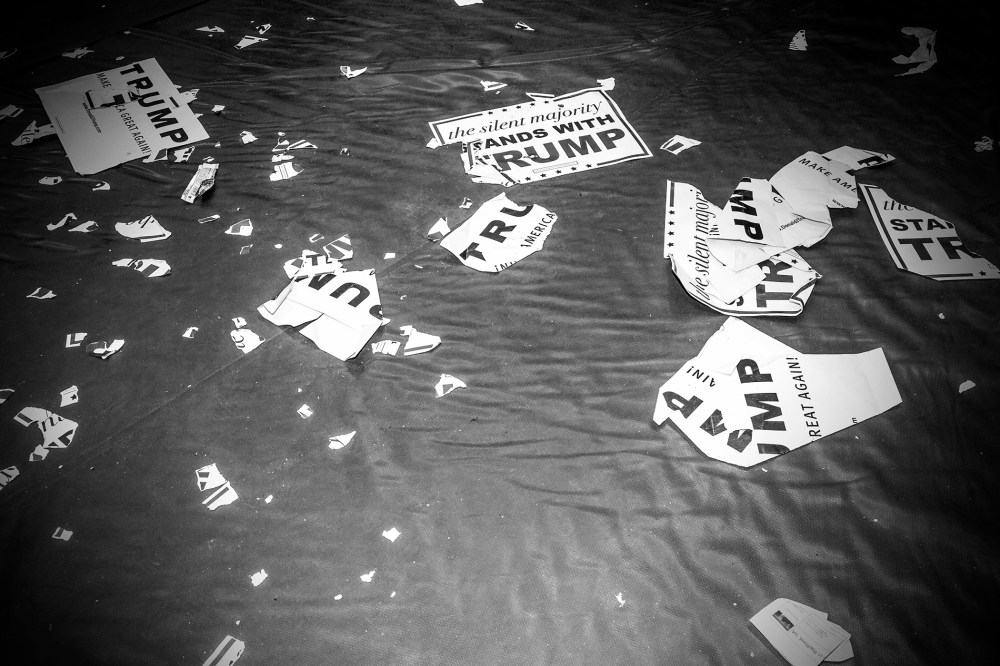
When a presidency collapses to the extent that Donald Trump’s has, just months into its first year, consequences are inevitable.
CNBC’s John Harwood noted last week, for example, “Increasingly, federal officials are deciding to simply ignore President Donald Trump.” Jack Goldsmith, a top Justice Department official in the Bush/Cheney administration, added, “What is most remarkable is the extent to which his senior officials act as if Trump were not the chief executive…. The President is a figurehead who barks out positions and desires, but his senior subordinates carry on with different commitments.”
The ripple effects of this dynamic have clearly reached Capitol Hill, where congressional Republicans are not only openly criticizing the president with increased vigor, but where GOP lawmakers are also comfortable ignoring Trump’s instructions.
And then there are the electoral questions to consider. The New York Times had an eyebrow-raising piece over the weekend on Republicans who appear to have their eyes on the 2020 presidential race — because of the perilous conditions Trump is facing.
Senators Tom Cotton and Ben Sasse have already been to Iowa this year, Gov. John Kasich is eyeing a return visit to New Hampshire, and Mike Pence’s schedule is so full of political events that Republicans joke that he is acting more like a second-term vice president hoping to clear the field than a No. 2 sworn in a little over six months ago.
President Trump’s first term is ostensibly just warming up, but luminaries in his own party have begun what amounts to a shadow campaign for 2020 — as if the current occupant of 1600 Pennsylvania Avenue weren’t involved.
The would-be candidates are cultivating some of the party’s most prominent donors, courting conservative interest groups and carefully enhancing their profiles.
The article, citing interviews with more than 75 Republicans at every level of the party, added that “elected officials, donors and strategists expressed widespread uncertainty about whether Mr. Trump would be on the ballot in 2020.”
Sen. John McCain (R-Ariz.) said plainly, “They see weakness in this president.”
To be sure, the bulk of this planning appears to be a group of Republicans who, in the face of volatile circumstances, want to be prepared. Maybe the Trump-Russia scandal will force the president from office, or devastate his standing to the level that he simply couldn’t compete in a national race. Perhaps the impulsive president will wake up one morning, publish a tweet that says “Bored now,” and simply walk away.
Sure, it’s unlikely, but if you were an ambitious GOP politician, these scenarios aren’t hard to imagine, to the point that a quiet, behind-the-scenes “shadow campaign” seems sensible.
But let’s also not forget that other possibility: a primary campaign against a sitting president. The Times’ article offered a fresh reminder that Ohio Gov. John Kasich (R), for example, clearly hasn’t ruled out this possibility, and if Trump’s standing continues to erode, others may start scheduling trips to New Hampshire, dipping their toes into the 2020 waters.
Trump would probably be favored to win such a contest, but every incumbent president seeking another term who’s faced a credible primary challenger — Ford, Carter, and H.W. Bush — defeated their intra-party rival before losing the general election. Meanwhile, keep an on the vice president’s schedule. From the NYT article: Though it is customary for vice presidents to keep a full political calendar, [Pence] has gone a step further, creating an independent power base, cementing his status as Mr. Trump’s heir apparent and promoting himself as the main conduit between the Republican donor class and the administration. The vice president created his own political fund-raising committee, Great America Committee, shrugging off warnings from some high-profile Republicans that it would create speculation about his intentions. The group, set up with help from Jack Oliver, a former fund-raiser for George W. Bush, has overshadowed Mr. Trump’s own primary outside political group, America First Action, even raising more in disclosed donations. […] In a June meeting with Al Hubbard, an Indiana Republican who was a top economic official in Mr. Bush’s White House, an aide to the vice president, Marty Obst, said that they wanted to be prepared to run in case there was an opening in 2020 and that Mr. Pence would need Mr. Hubbard’s help, according to a Republican briefed on the meeting. Pence issued a defensive statement yesterday, rejecting the reporting, and emphasizing his loyalty to Trump. As a matter of strategy, that’s no doubt wise: if the president believed the vice president was plotting behind his back, the consequences would likely be severe. But Pence also understands politics well enough to know he wants to be ready, just in case.
Steve Benen is a producer for "The Rachel Maddow Show," the editor of MaddowBlog and an MS NOW political contributor. He's also the bestselling author of "Ministry of Truth: Democracy, Reality, and the Republicans' War on the Recent Past." Recommended


