








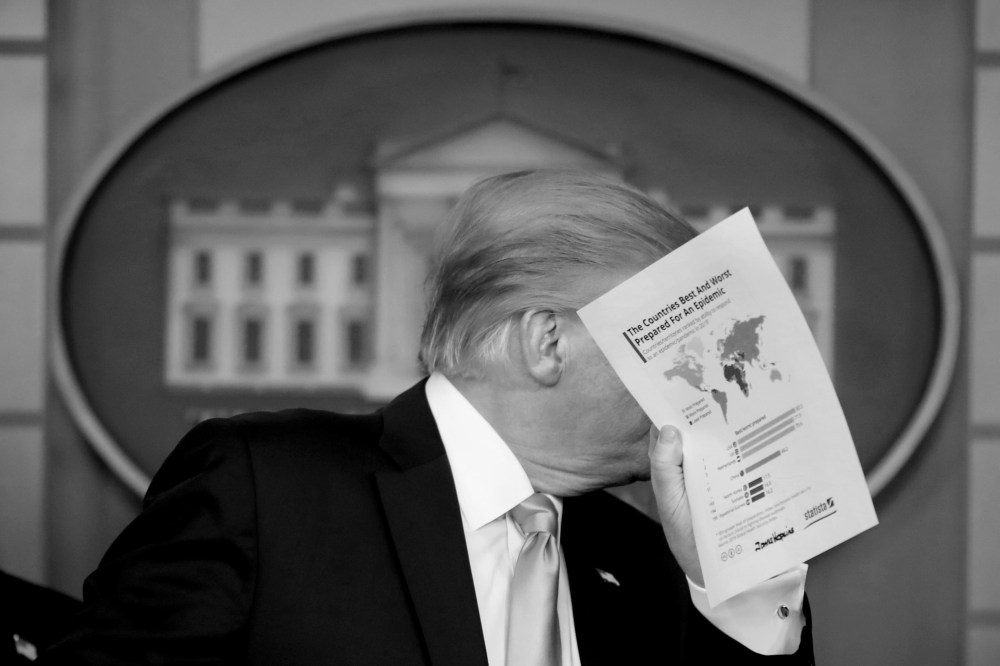

Shortly before the 2018 midterm elections, the Associated Press asked Donald Trump about the climate crisis and his indifference toward the evidence. “My uncle was a great professor at MIT for many years,” the president responded. “Dr. John Trump. And I didn’t talk to him about this particular subject, but I have a natural instinct for science.”
When it comes to climate change, Trump’s “natural instinct for science” has clearly not served him well. And as concerns grow about the coronavirus outbreak, the president’s affinity for science appears to be failing once more. As NBC News reported, Trump vacillated yesterday “between agreeing with and rejecting the stark warnings of a broader potential outbreak issued by government public health experts.”
Responding to a question about the likelihood of a U.S. outbreak, he said, “I don’t think it’s inevitable. It probably will. It possibly will,” he continued. “It could be at a very small level, or it could be at a larger level.” At another point, Trump said, “Nothing is inevitable.”
One day earlier, Dr. Nancy Messonnier, the head of the National Center for Immunization and Respiratory Diseases at the Centers for Disease Control and Prevention, said during a media briefing, “It’s not so much a question of if this will happen anymore but rather more a question of exactly when this will happen and how many people in this country will have severe illness.”
This was not the only area of concern. The president also boasted yesterday that U.S. officials will “essentially have a flu shot for this in a fairly quick manner,” which isn’t exactly true. Trump also misstated the number of documented coronavirus cases on American soil and used misleading rhetoric about the flu being more dangerous than COVID-19.
A Washington Post analysis added, in reference to the president, “He has generally sounded a very different tune than other health experts, including those in his own administration. He has also made dubious and outright false claims about the situation.” After Trump’s remarks from the White House press briefing room yesterday, Dr. Ezekiel Emanuel, a senior advisor to the Director General of the World Health Organization, told MSNBC, “I found most of what he said incoherent.” It’s as if Trump’s “natural instinct for science” is failing him — and us.
Steve Benen is a producer for "The Rachel Maddow Show," the editor of MaddowBlog and an MS NOW political contributor. He's also the bestselling author of "Ministry of Truth: Democracy, Reality, and the Republicans' War on the Recent Past."
Latest Post
Recommended


