








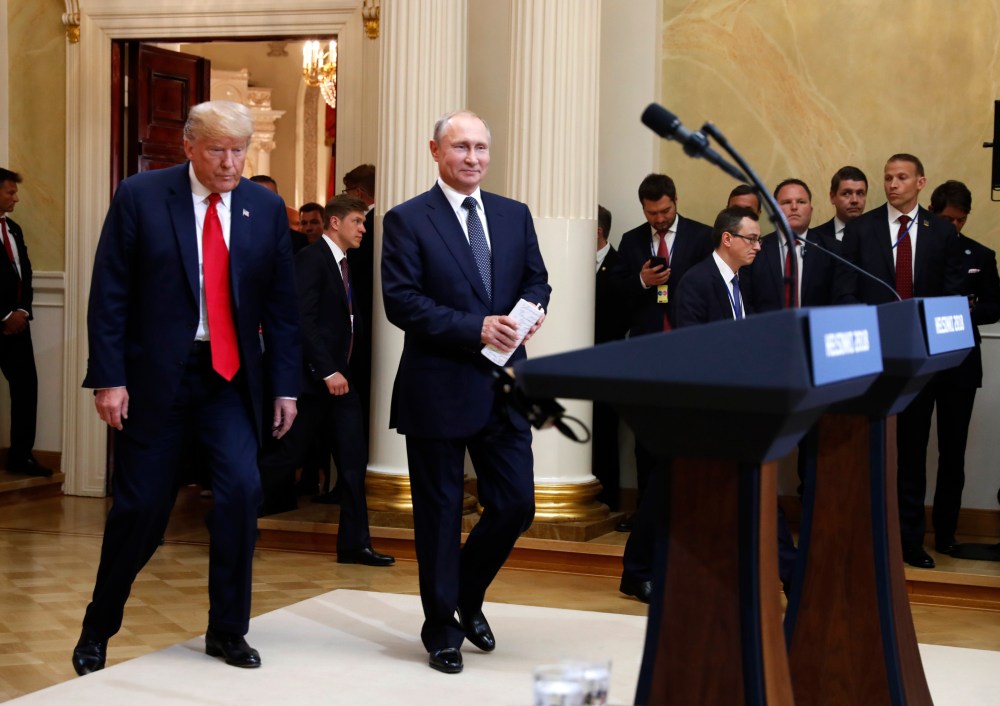
Ahead of his July 2018 summit with Russian President Vladimir Putin, Donald Trump insisted that the meeting be limited to a one-on-one discussion, with no other U.S. officials, even members of the Trump cabinet, participating. As regular readers know, the White House never exactly explained why, but the assumption throughout the government was that the American leader would brief U.S. officials on the details of the meeting afterwards.
That didn’t happen. White House officials, military leaders, and even Director of National Intelligence Dan Coats all conceded in the days following the summit that they didn’t fully know what transpired behind closed doors.
It wasn’t an isolated incident. The Washington Post reported a couple of months ago that Trump has “gone to extraordinary lengths to conceal details of his conversations” with the Russian autocrat who attacked our elections in 2016 in order to put the Republican in power — at one point even “talking possession” of his own interpreter’s notes after a conversation with Putin.
Soon after the article ran, Trump sat down for one of his many Fox News interviews and was asked whether he’d release information about his conversations with Putin. “I would,” Trump replied. “I don’t care…. I’m not keeping anything under wraps.”
Actually, he is. Politico reported this afternoon:
The White House on Thursday rejected congressional Democrats’ demands for documents relating to President Donald Trump’s private discussions with Russian President Vladimir Putin — escalating tensions between the Trump administration and Congress over a crucial piece of Democrats’ oversight ambitions. […]
In his letter to Intelligence Chairman Adam Schiff (D-Calif.), Foreign Affairs Chairman Eliot Engel (D-N.Y.), and Oversight and Reform Chairman Elijah Cummings (D-Md.), [White House Counsel Pat Cipollone] cited precedents going back to the George Washington and Bill Clinton administrations to assert Trump’s authority to conduct foreign affairs, and to argue that Congress has no right to information about one-on-one conversations between the president and a foreign leader.
In general, that principle may seem reasonable. But in the Trump era, it’s not quite that simple.
In this case, Congress didn’t just request information on random interactions between the American president and one of his foreign counterparts. Rather, lawmakers want to know about communications between Trump and the foreign adversary who attacked our democracy — and who, many officials fear, may have compromised the man in the Oval Office. The White House’s dismissal of the congressional request is probably not the final word on the subject. It’s likely House committee chairs will weigh issuing subpoenas, which may very well lead to some contentious court fights. If the president was telling the truth in January, and he’s “not keeping anything under wraps” with regard to his communications with Putin, shouldn’t the White House be only too pleased to err on the side of disclosure? Postscript: For more on Trump World stonewalling, I hope you saw last night’s A block.
Steve Benen is a producer for "The Rachel Maddow Show," the editor of MaddowBlog and an MS NOW political contributor. He's also the bestselling author of "Ministry of Truth: Democracy, Reality, and the Republicans' War on the Recent Past." Recommended


