








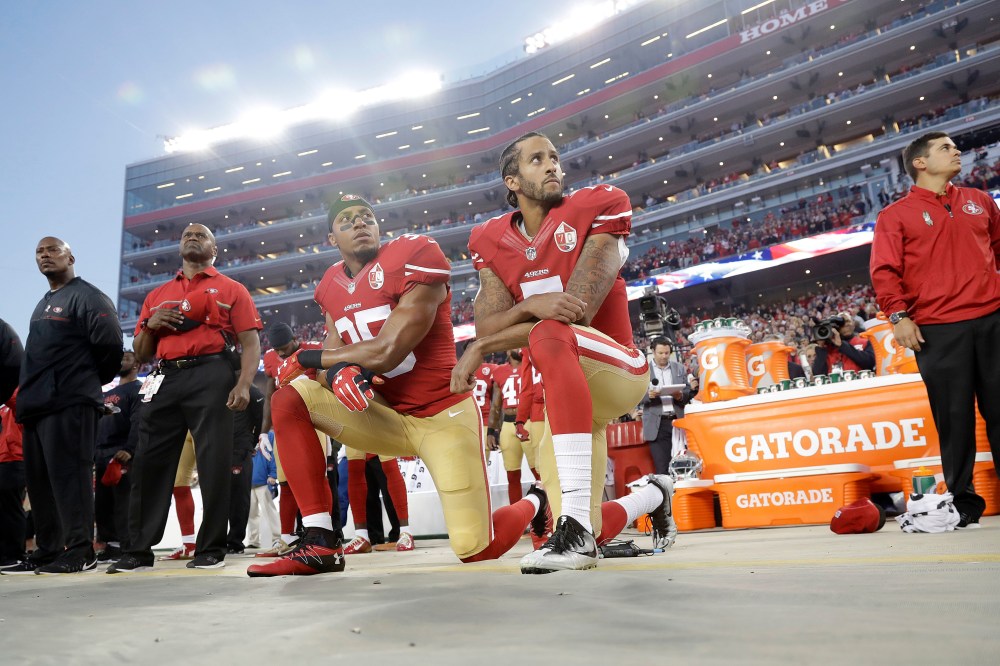
When many professional athletes protested against racial injustice last year, Donald Trump seized on the issue as a new front in a divisive culture war. As a practical matter, the president’s campaign worked: apparently eager to assuage the Republican, the NFL this week announced that players who engage in on-the-field protests would be penalized.
The problem with appeasement, of course, is that the intended target is rarely satisfied.
Taking a knee during the national anthem during a National Football League game should “maybe” be a deportable offense, President Donald Trump appeared to say in an interview that aired Thursday morning.
Speaking just moments after the NFL announced that all players who are on the field when the national anthem is heard before a game must stand and show respect — or can choose to remain in the locker room without penalty — Trump praised the new policy but also said it didn’t go far enough in punishing players who might continue to take a knee during the anthem.
In an interview that aired this morning, the president told Fox News the new NFL policy is “good,” but added, “I don’t think people should be staying in locker rooms…. You have to stand proudly for the national anthem, or you shouldn’t be playing, you shouldn’t be there. Maybe you shouldn’t be in the country.”
At face value, watching a sitting president attack the patriotism of Americans who take a knee in recognition of racial injustice is offensive. But for Trump and his aides, these kinds of criticisms have become unnervingly common.
Earlier this month, for example, the Republican told supporters, “We have laws written by people that truly do not love our country.” In March, he insisted that Democrats “don’t believe in” the U.S. military. In February, Trump whined that when Democrats failed to applaud his State of the Union address, “they certainly didn’t seem to love our country very much.” He then casually raised the prospect of “treason.”
In April, the Washington Post noted, “The Trump White House has turned questioning patriotism into a talking point.”
This isn’t just an unhealthy approach to the political discourse in a democracy; it’s also deeply ironic.
Trump seems to have convinced himself that he has the high ground on matters of patriotism, though it’s an open question as to whether he fully understands what patriotism even is.
The president’s approach to the issue is burdened by a degree of vacuity. For Trump, patriotism is about flags and rituals. He places great value in parades and symbols.
It is a patriotism lacking in any depth. On Tuesday afternoon, for example, the president hosted a NASCAR event on the White House’s South Lawn and declared with pride, “One thing I know about NASCAR, they do indeed stand for the playing of the National Anthem.” Just 30 minutes later, Trump was in the Oval Office giving orders to federal law enforcement officials, instructing them to subvert our system of justice to advance his political interests.
It never occurred to him to acknowledge the disconnect between the two events. For Trump, patriotism is about rituals, not honoring constitutional principles.
Making matters worse is just how bad a messenger the Republican is for this message. As regular readers know, two weeks after taking office, Trump sat down for an interview in which he was reminded that Russian President Vladimir Putin is “a killer.” Trump replied, “There are a lot of killers. We’ve got a lot of killers. What, do you think our country’s so innocent?” As we discussed at the time, Americans generally aren’t accustomed to hearing their president be quite this critical of the United States – out loud and in public. What’s more, the idea that the U.S. chief executive sees a moral equivalence between us and an autocratic thug came as a reminder that Trump doesn’t always hold his country in the highest regard. Indeed, the Republican hasn’t exactly been subtle on this point. In December 2015, for example, then-candidate Trump was asked about Putin’s habit of invading countries and killing critics. “He’s running his country, and at least he’s a leader,” Trump replied, “unlike what we have in this country.” Reminded that Putin has been accused of ordering the murder of critics and journalists, Trump added, “Well, I think our country does plenty of killing also.” In a July 2016 interview with the New York Times, the Republican went on to argue that the United States lacks the moral authority to lead, because we’re just not a good enough country to command respect abroad. “When the world looks at how bad the United States is, and then we go and talk about civil liberties, I don’t think we’re a very good messenger,” he said. There’s never been a president, from either party, who’s been so cavalier about America lacking in credibility. Sentiments such as “When the world looks at how bad the United States is…” are usually heard from America’s opponents, not America’s president. The Atlantic’s Jeffrey Goldberg noted during the campaign that Barack Obama “has never spoken as negatively about America as Donald Trump has.” This is the president who explicitly rejected the idea of “America exceptionalism,” questioning aloud whether the United States really is “more outstanding” than other nations. This is the president who’s mocked American prisoners of war, derided a Gold Star family, and insulted service members with PTSD. Perhaps Trump should leave lessons on the virtues of patriotism to others.
Steve Benen is a producer for "The Rachel Maddow Show," the editor of MaddowBlog and an MS NOW political contributor. He's also the bestselling author of "Ministry of Truth: Democracy, Reality, and the Republicans' War on the Recent Past." Recommended


