








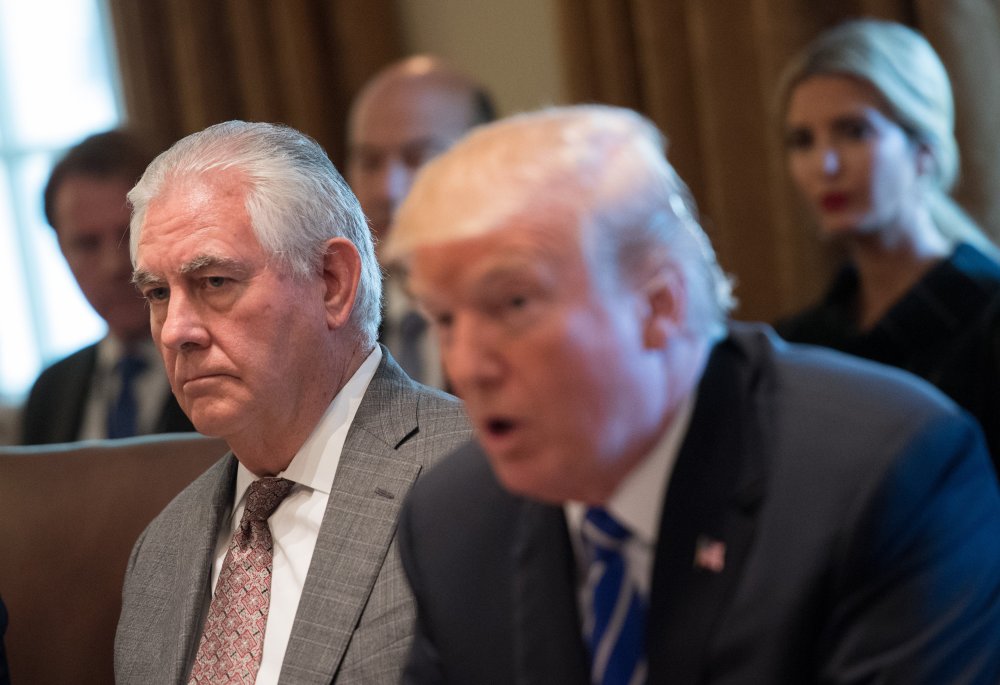
Throughout his tenure, Secretary of State Rex Tillerson has been on the periphery of the Trump administration’s foreign policy apparatus, routinely contradicting the White House line. At times, it’s seemed as if Donald Trump and his chief diplomat have had entirely different visions of the United States’ role in the world.
How would the administration reconcile the conflict? Apparently, by replacing Tillerson.
President Donald Trump asked Secretary of State Rex Tillerson to step aside, the White House confirmed Tuesday, replacing him with CIA Director Mike Pompeo.
In a tweet, Trump thanked Tillerson for his service and said Pompeo “will do a fantastic job.”
Gina Hapsel, the deputy director at the CIA, will reportedly succeed Pompeo at the intelligence agency. That’s rather alarming given her background in Bush-era torture policies.
Tillerson is the second cabinet secretary to leave the Trump administration, following former HHS Secretary Tom Price, who resigned last year in the wake of a controversy over his use of private jets.
While we didn’t know when this shake-up might happen, it doesn’t come as a complete surprise. Axios reported way back in October that the White House had roughly this plan in mind: Pompeo would move from the CIA to the State Department, while Tillerson would exit the administration. The New York Times had a related report around Thanksgiving.
But that forewarning doesn’t make the news any less dramatic.
I see this as a development with three core tracks. The first is the ongoing personnel turmoil on Team Trump, which has been dealing with a staffing crisis for months, and which continues to intensify.
The second is the tenure of Rex Tillerson, the former ExxonMobil chief and Vladimir Putin ally, who was made the nation’s chief diplomat despite having no diplomatic experience. He was an unwise choice: not only did Tillerson appear to disagree with his boss about several key international issues, but the secretary also spearheaded a months-long campaign that hollowed out his own cabinet agency, to the dismay of diplomats and other foreign service veterans.
Complicating matters, Tillerson also reportedly called the president a “moron” in private, while in public, after Trump’s praise for racist protesters in Charlottesville, he said the president “speaks for himself,” not the United States.
And finally, there’s Mike Pompeo, who was far too partisan to be a good fit at the Central Intelligence Agency, and who had an unfortunate habit of politicizing intelligence. So, is it fair to see the developments as good news? Probably not. Tillerson was an ineffective and misguided secretary of state, but he at least tried to have a moderating influence over the president. Pompeo, a former far-right congressman from Kansas, probably won’t. Indeed, The New Republic had an item several months ago making the compelling case that Pompeo would be “a disaster” at the State Department. A longtime Koch ally, Pompeo has described the War on Terror as a clash between Christianity and Islam and defended the National Security Agency’s warrantless wiretapping program. A foreign policy hawk, Pompeo has also advocated that Ed Snowden receive the death penalty. He weaves together two of the worst and most pervasive threads of the Trump administration: its coziness with corporate interests (he received more Koch money than any other Congressman in 2010) and its xenophobia. It’s true that Pompeo could bring more credibility to the State Department: unlike Tillerson, he has the president’s ear, and he is unlikely to lose it. But any proximity would come at an enormous cost: even grading on a Trumpian curve, Pompeo would be an enormously destructive force — far more hawkish than Tillerson, the risk for global conflict is too high for Secretary of State Mike Pompeo. The confirmation hearings are bound to be interesting.
Steve Benen is a producer for "The Rachel Maddow Show," the editor of MaddowBlog and an MS NOW political contributor. He's also the bestselling author of "Ministry of Truth: Democracy, Reality, and the Republicans' War on the Recent Past." Recommended


