








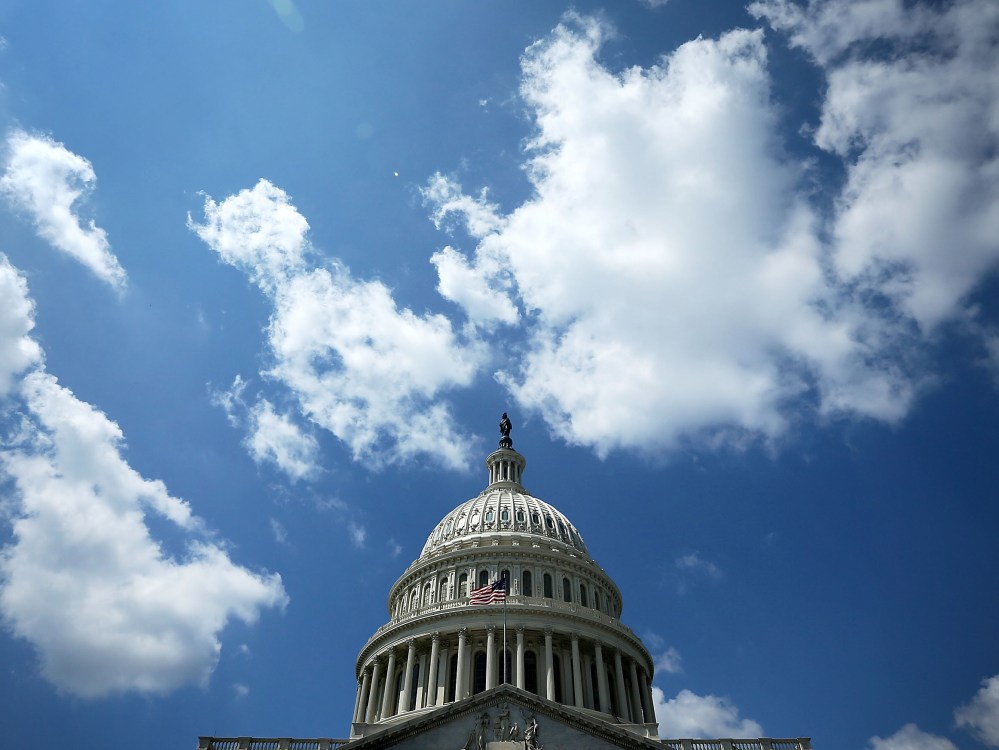
As government shutdowns go, this one was quite brief. The 2013 shutdown, for example, lasted 17 days. The one that started in December 1995 and ended in January 1996 took a month to resolve. The last three-day shutdown was way back in 1990.
That will apparently be the length of this one, too.
The three-day government shutdown is on the verge of ending after enough Senate Democrats joined Republicans to advance a three-week extension of funding in exchange for GOP assurances that Congress would take up a larger immigration bill in that time.
The stopgap funding measure, which needed 60 votes to clear a key procedural hurdle, was approved 81 to 18.
A pair of Republicans — Utah’s Mike Lee and Kentucky’s Rand Paul — joined 16 Democrats in opposing the measure. (Note, among the Democrats voting “no” were all of the senators rumored to be interested in a 2020 presidential campaign.)
It’s worth emphasizing that members didn’t vote for the exact same bill that passed the House on Friday. The bill that Congress is passing today reauthorizes for the Children’s Health Insurance Program (CHIP) for the next six years, and it also extends funding for the government until Feb. 8, instead of Feb. 16.
In other words, this is a three-week continuing resolution (CR), instead of a four-week measure.
The bill will still have to be approved by the House, where most Democrats are expected to balk, but the Republican majority is likely to pass it and send to Donald Trump for a signature. And at that point, we can basically start the clock on the next shutdown deadline.
So, what’s changed since before the shutdown?
As I understand it, Senate Majority Leader Mitch McConnell (R-Ky.) has agreed to a vote on an immigration bill, and unlike before, he won’t wait for Donald Trump’s guidance on the subject. If a comprehensive proposal isn’t ready by Feb. 8, today’s agreement says a DACA bill will get a vote on the Senate floor (though we don’t know precisely which DACA bill). If you’re thinking, “Won’t McConnell just betray Democrats and refuse to bring up the bill?” that’s certainly possible, though that would practically guarantee another shutdown, for which the Kentucky Republican would be solely responsible. Alternatively, if you’re thinking, “There’s no reason to assume a Senate-passed bill to protect Dreamers will pass the House,” you’re right to be concerned. But Democrats aren’t exactly negotiating from a position of strength right now, and they feel like they have no choice but to pursue incremental steps. In the meantime, they’re taking CHIP off the table for the next six years, securing a key progressive priority. If there’s another shutdown on the horizon — a distinct possibility — Republicans won’t be able to hold children’s health care hostage. Ultimately, we’re about to find out if GOP leaders’ rhetoric about protecting Dreamers is sincere.
Steve Benen is a producer for "The Rachel Maddow Show," the editor of MaddowBlog and an MS NOW political contributor. He's also the bestselling author of "Ministry of Truth: Democracy, Reality, and the Republicans' War on the Recent Past." Recommended


