








There are no meaningful talks underway, at least not yet, to avoid the deep sequestration cuts that are poised to begin tomorrow, so those hoping for an 11th-hour deal are likely to be disappointed. The parties aren’t close and they’re not even trying to get closer.
So, what should Americans expect in the hours and days ahead? For one thing, we should pause to note just how much time remains on the sequester clock. I’ve reported more than once that the deadline is midnight tonight, and I’ve since learned that this is mistaken.
By the way, when do the sequester cuts go into effect? As NBC’s Peter Alexander notes, we all know it happens this Friday, March 1. But when exactly does it take place? In simple terms, per Alexander, it doesn’t take place until the president signs the sequester order, which must happen any time before 11:59 pm ET on Friday, March 1.
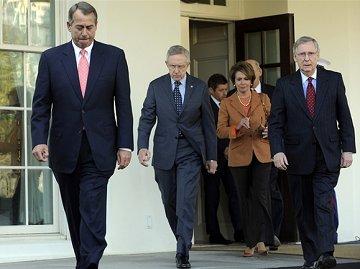
This is important to the extent that President Obama will hold talks with congressional leaders at the White House tomorrow morning, and their discussion will likely precede the literal deadline by a few hours. But since no one seriously believes the six participants — Obama, Vice President Biden, House Speaker John Boehner, Senate Majority Leader Harry Reid, House Minority Leader Nancy Pelosi, and Senate Minority Leader Mitch McConnell — will magically find a solution tomorrow, the question isn’t whether the president will sign the sequester order, but rather, what time.
As for why the White House meeting isn’t being held today, the president reportedly wants to wait until after the Senate considers its sequester alternatives, and votes are expected in the upper chamber today.
Do these alternatives have a credible shot? I’m glad you asked.
As of last night, there is, for the first time in this Congress, a Republican alternative to the sequester. It’s just not very good and it has roughly a 0% chance of becoming law.
Senate Republicans have offered legislation crafted by Sens. Pat Toomey (R-Pa.) and James Inhofe (R-Okla.) as their alternative to the sequester due to take effect Friday.
Some Republicans initially balked at the plan because they thought it gave too much power to President Obama and did not do enough to protect defense programs.
The bill grants the Office of Management and Budget flexibility to implement $85 billion worth of spending cuts scheduled for fiscal year 2013.
This is, of course, the plan we discussed yesterday. It only changes the sequester insofar as it takes away the automatic, across-the-board nature of the cuts — there would still be $85 billion in cuts, but under the GOP proposal, it would be dependent on the Obama administration to figure out where to make them. Congressional Democrats, not surprisingly, fail to see this as a credible compromise; the White House doesn’t want these politically perilous obligations; and many on the right don’t like the idea of the legislative branch turning over “power of the purse” to the executive branch for the sake of convenience.
In other words, this will fail. But Senate Democrats have a sequester alternative, too, and it will also reach the floor today.
Majority Leader Harry Reid, D-Nev., proposes to replace the percentage cuts imposed by a provision of the 2011 debt limit agreement with a package of revenue increases and alternative savings. […]
Recommended


Reid would replace automatic cuts with a tax increase on people with incomes of more than $1 million, elimination of some direct farm payments and some defense cuts.
Republicans will filibuster the policy, Democrats will not get 60 votes, and by the end of the day, we’ll be right where we are now: looking at brutal cuts that are likely to undermine the economy, the military, and public needs.
And what of the House? Speaker Boehner has already said he has no intention of doing any work on this issue, at least not before the deadline.
So, this ridiculous self-inflicted wound is actually going to happen? Almost certainly, yes. So long as Democrats are willing to compromise and Republicans aren’t, a bipartisan solution is effectively impossible. If policymakers wanted to give themselves more time by delaying the sequester — or better yet, just turning the darn thing off — they could certainly do so, but Republicans have ruled out these options, too.
As for when we might see some kind of remedy emerge, Dylan Matthews argues persuasively that we should watch the government-shutdown deadline on March 27.
On that day, the “continuing resolution” funding the federal government expires. Continuing resolutions, or CRs, are how the federal government funds itself in the absence of a formal budget. They’ve become the de facto budget for most of Obama’s presidency because Congress and the White House haven’t been able to agree on an actual budget for years. If the current CR isn’t extended before March 27, or replaced with another one, the government will shut down.
So Congress has to pass a new spending bill within a month. But within that crisis lies an opportunity, or a crisitunity if you prefer.
The threat of a shutdown actually forces Congress to act. That means that even if, as appears likely, the sequester is allowed to go into effect, Congress will have to pass a spending bill that either keeps the sequester or does away with it in favor of alternate cuts and revenue increases. The same pressures that have prevented a deal this time around will be present, especially with the White House wanting to increase spending in the CR. But because a shutdown is a much more visible and politically potent crisis than the slow-moving damage of the sequester’s cuts, the pressure for a deal will increase considerably.
In the meantime, of course, the damage to the country may be severe.
The place for in-depth analysis, commentary and informed perspectives.
