








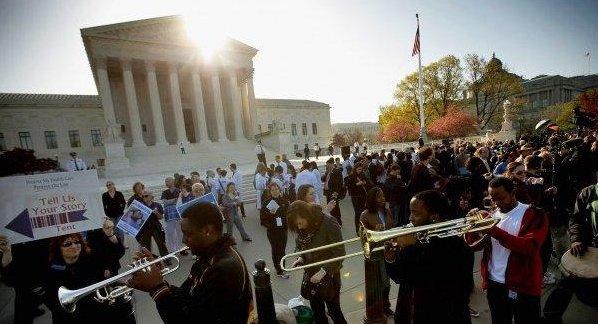
Chances are, you’re aware of the fact that the Supreme Court this morning will be deciding the constitutional fate of the Affordable Care Act, in what may prove to be the most important high court ruling in at least a generation.
While we wait (and sweat, and feel nauseous, and have heart palpitations), it’s worth pausing to appreciate what to expect when you’re expecting, because the matter is not a simple up-or-down, yea-or-nay proposition. Indeed, it’s not even limited to one case.
The justices will issue rulings this morning on the scope of the Commerce Clause and whether it includes the power to create an individual health care mandate, whether the mandate is actually a tax penalty, whether the rest of the law can remain intact if the mandate is deemed unlawful, and whether the law’s expansion of Medicaid eligibility constitutes some kind of unconstitutional coercion.
Putting aside predictions about what’s going to happen — we’ll find out soon enough, and no one outside the court can say with any confidence — the question to kick around now is what could happen.
Some of the groups involved in the case are putting together as many as eight different press releases, preparing for the various contingencies. That may seem excessive, but it’s really not. Let’s run down some (but not all) of the possibilities:
1. The justices can uphold the law: The court majority can do what legal experts predicted they would do all along, and reject the challenges. It would mean “Obamacare” is safe through at least January, pending the outcome of the presidential election.
2. The justices can kill the entire law: Most experts believe it’s unlikely, but the majority may decide to strike down every letter of every word of the ACA, bring back the entirety of the old, dysfunctional health care system.
3. The justices can kick the can down the road: If the court sees the mandate as a tax penalty, rather than a required purchase, the Anti-Injunction Act says the court can’t even consider the case until someone’s actually paying the tax. It would delay the case until 2015.
4. The justices can strike down just the mandate: Though existing precedent makes clear that the provision falls well within the Commerce Clause, and it would take a radical reinterpretation of generations of court rulings to rule otherwise, the Roberts Court is not above radicalism. The majority may leave the larger law intact, but strike down this one element.
5. The justices can strike down just the Medicaid expansion: It seems improbable, but under the law, states aren’t given much of a choice: go along with Medicaid expansion or risk losing all Medicaid funding from Washington. Critics say that’s mean and hope five justices will rule that mean = unconstitutional. If so, the relationship between D.C. and the states would be dramatically rewritten.
6. The justices could have some combination of #4 and #5: Anything’s possible. From there we get into a series of more arcane possibilities, some of which include the consumer protections, some of relate to how narrowly (or broadly) the court majority wants to make its ruling. It’s unsatisfying, but there are subtle legal nuances between all of these possible outcomes, and it will come down to the specific language in the rulings themselves. What do I think is going to happen? I’m awful at predictions, and if I’m being honest, my perspective is skewed by my emotional investment in the larger issue (a gambler once told me, “Never bet on a game if you care who wins”). If you’d asked me the day before the Supreme Court’s oral arguments about my expectations, I would have told you this whole challenge is a farce and the outcome is obvious — sure, there are conservative justices, but they care about their unique responsibilities, and won’t simply toss aside their constitutional duties to serve a political agenda. And if you’d asked me the moment oral arguments were complete about my expectations, I would have told you my confidence in the integrity of the conservative justices was a naive fantasy and that the law is toast. As of this morning, I don’t know what to think, except that I’m glad the wait is just about over.
The place for in-depth analysis, commentary and informed perspectives. Recommended


