








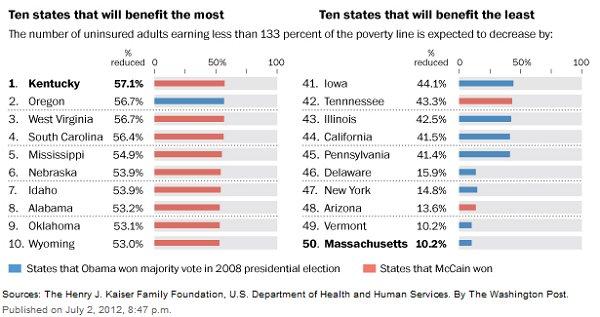
If there’s any state in the nation that should welcome the Medicaid expansion provisions in the Affordable Care Act, it’s Kentucky. Ezra Klein published this chart the other day, highlighting which states benefit most, and least, from the policy. Take a look at which state was #1.
With that in mind, one would assume that Kentucky Republicans, based on nothing but common sense and a basic desire to do right by their own state, would have to concede that Obamacare’s Medicaid expansion is a great deal. Except, they’re not — Kentucky’s House Minority Leader, Republican Jeff Hoover, argued this week that the state should deliberately opt out.
What was his rationale? Hoover and his GOP colleagues pointed to an Urban Institute report that showed 400,000 uninsured Kentuckians would be eligible for coverage under the expansion, and that the state simply can’t afford to bring access to so many people.
Joe Sonka noticed the problem with the argument.
Actually, the Urban Institute says Kentucky and all but four states will save money with this reform…. Taking a conservative estimate on Kentucky’s potential savings, the Urban Institute (KY GOP approved) expects Kentucky to save anywhere from $140 million to $828 million by 2020.
So according to the Urban Institute, the dreaded Obamacare Medicaid expansion will bring to Kentucky: additional coverage for around 400,000 low-income Kentuckians [and] an additional $140-$828 million dollars saved in the state budget.
In other words, Kentucky Republicans want Gov. Steve Beshear (D) to turn down a great deal for Kentucky — a deal that will save the state money while expanding access to medical care for hundreds of thousands of people in the state — just because. In this case, they’re citing an Urban Institute study that actually shows the opposite of what they think it does.
And as you may have heard, it’s not just Kentucky.
As of the last count, “at least 15” governors are prepared to reject Medicaid expansion, no matter how good a deal it is, and no matter how many of their constituents would be better off. The states that would benefit most are generally the same states that are most adamant about rejecting progress.
This doesn’t make sense. Why would governors be fiscally irresponsible (on purpose), while keeping health care coverage from their own constituents (on purpose)? Even in the face of simple arithmetic? I think Ed Kilgore has the right answer: You can expect the Jindals and Haleys and Perrys to ignore or dismiss such estimates as biased or unreliable, just as Republicans have almost universally scoffed at the CBO estimates “scoring” ACA as a federal deficit reducer. Another problem is that Republican pols typically claim that the existing Medicaid program as fiscally unsustainable, so they won’t accept it as a baseline for what is tolerable in the future. But more importantly, we have to remember that this is an ideological and even a moral issue to conservatives, who view dependence on any form of public assistance as eroding the “moral fiber” of the poor (as Paul Ryan likes to put it), and as corrupting the country through empowerment of big government as a redistributor of wealth from virtuous taxpayers to parasites who will perpetually vote themselves more of other people’s money. That those who’ll benefit most are poor, who are presumably supposed to pull themselves up by their bootstraps after the rich get another tax cut, doesn’t help. Republican policymakers prioritize some constituents more than others, and struggling families without health coverage just aren’t important right now.
The place for in-depth analysis, commentary and informed perspectives. Recommended


