








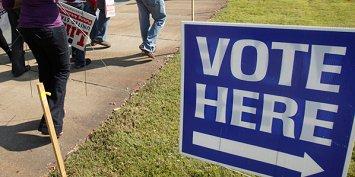
Attorney General Eric Holder spoke to the NAACP last week and strayed from his prepared remarks, telling the crowd the truth about Republicans’ voter-ID laws: they’re modern-day “poll taxes.” Yesterday, Texas Gov. Rick Perry (R) condemned the comments, saying they “inflame passions and incite racial tension.”
It’s a fascinating perspective. When white Republican policymakers disenfranchise African Americans in an election year, based on trumped up allegations of “fraud,” that doesn’t “incite racial tension.” But when the Attorney General notices white Republican policymakers disenfranchising African Americans in an election year, based on trumped up allegations of “fraud,” that does “incite racial tension.” Good to know.
In the meantime, while most of the recent talk about voter-ID laws has focused on who’ll be blocked from casting a ballot, the Brennan Center for Justice has a new report looking at a different angle: those who’ll struggle to get the mandatory ID in the first place.
New laws in 10 states requiring voters to show IDs could present serious challenges to voters without financial resources and transportation, according to a report released Wednesday.
The study by the Brennan Center for Justice at the New York University School of Law, which opposes the new laws, found several obstacles that could keep voters from being able to cast ballots, including limited access to offices that issue the IDs required under the new measures.
Recommended


“The advocates of these laws kept saying we’re going to provide these IDs for free and that’s going to eliminate all of the problems,” said Keesha Gaskins, co-author of the report. “We found the ability to get documents isn’t that simple.”
This is clearly important. It’s obviously a problem to create new barriers between Americans and their democracy, but this new study shines a light on the hurdle before the barrier: not only do many low-income voters not have the ID Republicans demand, they’ll also struggle to get the ID. (Update: here’s a copy of the Brennan Center report.)
“In some areas, the offices that issue IDs maintain limited business hours. Rural areas in Alabama, Georgia, Mississippi, and Texas are served by part-time ID offices. And in an extreme example, the researchers found the office in Sauk City, Wis., is open only on the fifth Wednesday of any month. That would limit the office to being open just four days this year.”
It is, as Eugene Robinson recently put it, “an unconscionable crime.”
Steve Benen is a producer for "The Rachel Maddow Show," the editor of MaddowBlog and an MS NOW political contributor. He's also the bestselling author of "Ministry of Truth: Democracy, Reality, and the Republicans' War on the Recent Past."
