









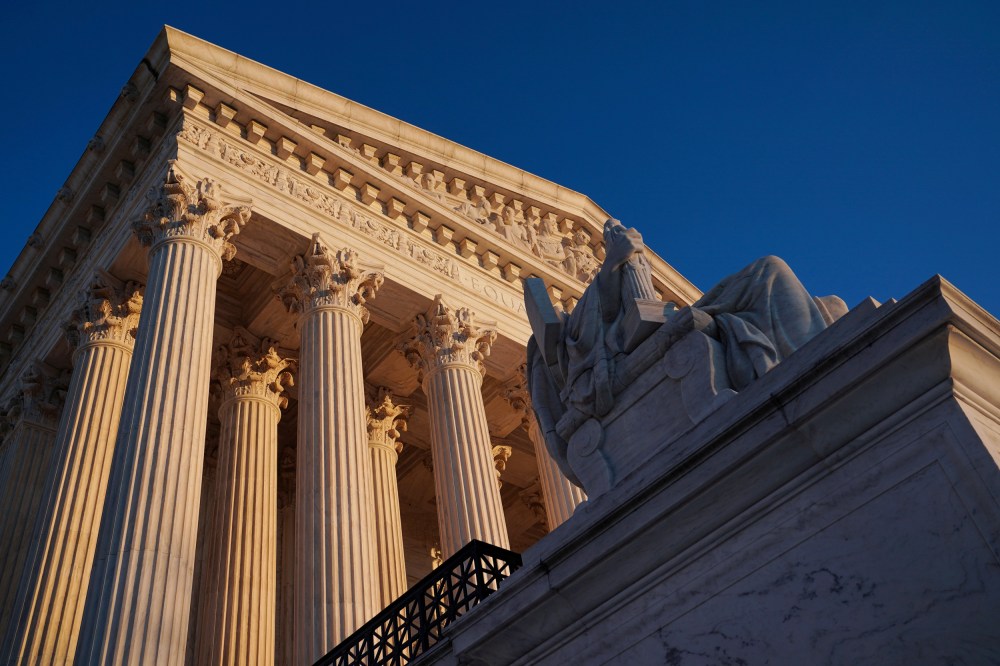

While we waited for the Supreme Court’s DACA ruling, and the likelihood that the court’s five conservative justices would side with the White House, the stage appeared to be set for an important election-year showdown.
If the high court allowed Donald Trump to scrap legal protections for Dreamers, would policymakers scramble to find a legislative fix? What would it look like? If they failed, how might that affect the elections?
As it turns out, those questions are suddenly moot — because the U.S. Supreme Court ruled today that the president cannot legally end the Deferred Action for Childhood Arrivals program.
The decision is a big legal defeat for President Donald Trump on the issue of immigration, which has been a major focus of his domestic agenda. The ruling said the government failed to give an adequate justification for ending the federal program. The administration could try again to shut it down by offering a more detailed explanation for its action, but the White House might not want to end such a popular program in the heat of a presidential campaign.
The full ruling in Department of Homeland Security v. Regents of Univ. of California is online here.
Note, it was a 5-4 ruling, with Chief Justice John Roberts — who wrote the majority opinion — siding with Justices Stephen Breyer, Ruth Bader Ginsburg, Elena Kagan, and Sonia Sotomayor. (It comes the same week as Roberts also sided with the more progressive justices on anti-LGBTQ workplace discrimination.)
The point from the NBC News report about the administration failing to give an adequate justification for ending DACA is an important detail: the Supreme Court didn’t say the action itself was impermissible; it said the White House failed when it came to justifying the move.
BuzzFeed’s Zoe Tillman explained this well: “This outcome is similar to what happened in the census citizenship question case — in both cases, Roberts wrote for the majority of the court that the Trump admin could in theory do what they were trying to do, but that officials had gone about it in an unlawful way.”
It’s also reminiscent of the White House’s Muslim ban, which the high court ultimately approved after Team Trump crafted a fig leaf the justices deemed satisfactory.
As for the case itself, let’s revisit our earlier coverage for those who may need a refresher, because it’s worth considering the chain of events that brought us to this point.
Barack Obama announced DACA protections for Dreamers shortly after the 2014 midterms, and the program worked exactly as intended — right up until Donald Trump was elected. There was cause for concern among DACA beneficiaries and their allies: Candidate Trump vowed to pursue mass deportations, without exceptions. In a not-so-subtle shot at Dreamers, the Republican vowed, “[U]nlike this administration, no one will be immune or exempt from enforcement.” This followed related comments in which he said Dreamers “have to go.”
As president, however, Trump seemed to realize how radical a posture this was. A few months into his term, the Republican said Dreamers should “rest easy” about his immigration policies. Trump told the Associated Press at the time that he’s “not after the Dreamers, we are after the criminals.” In September 2017, the administration changed course again, “rescinding” the program and its protections for the young immigrants. For Trump, their fate became a bargaining chip, with the president telling congressional Democrats that the only way to save the Dreamers was to agree to finance a giant border wall. The gambit failed spectacularly for two reasons. First, when Dems grudgingly agreed to pay the ransom, the president balked and demanded even more concessions. And second, several federal courts ended up blocking Trump’s attempt at scrapping the DACA protections, and in the process, they took the president’s political hostages away. The White House hoped the Supreme Court’s conservative majority would rescue Trump’s policy. That’s not at all what happened. The result is an unexpected election-year dynamic: does the president scramble to craft a new rationale to hurt Dreamers ahead of Election Day, or does the White House retreat?
Steve Benen is a producer for "The Rachel Maddow Show," the editor of MaddowBlog and an MS NOW political contributor. He's also the bestselling author of "Ministry of Truth: Democracy, Reality, and the Republicans' War on the Recent Past."
Latest Post
Recommended


