










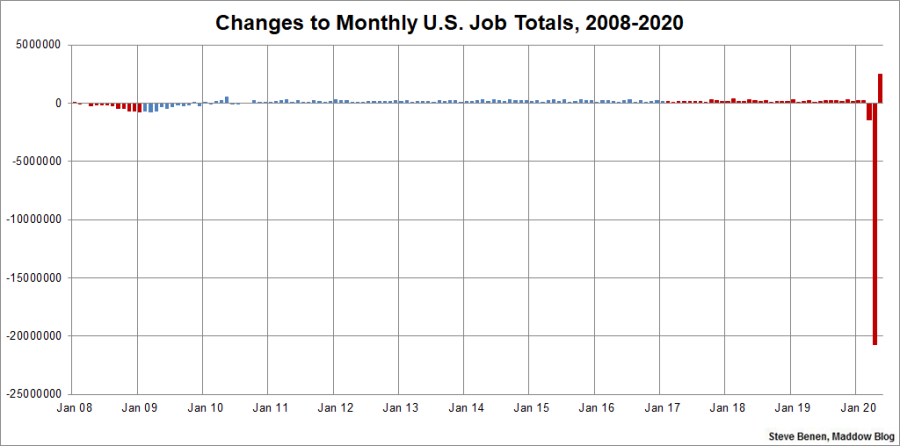
Everyone had a pretty good idea about what was going to happen this morning. The Bureau of Labor Statistics would release another brutal jobs report, on the heels of last month’s catastrophic numbers, and the unemployment rate would almost certainly reach 20% — a number unseen in the United States since before World War II.
I pre-wrote a perfectly nice blog post capturing the historical context of all of this, which I had to delete the moment these numbers were released.
Total nonfarm payroll employment rose by 2.5 million in May, and the unemployment rate declined to 13.3 percent, the U.S. Bureau of Labor Statistics reported today. These improvements in the labor market reflected a limited resumption of economic activity that had been curtailed in March and April due to the coronavirus (COVID-19) pandemic and efforts to contain it.
In other words, everyone expected job losses and a higher unemployment rate, but what the data is showing is unexpected job gains and a lower unemployment rate.
So what happened? I’ll look forward to analysis from experts who can speak to this with far more authority than I can, but Betsey Stevenson, a professor of public policy and economics at the University of Michigan, wrote a Washington Post piece last month that included an observation that’s worth revisiting.
“States have started relaxing rules, and while many businesses are staying closed for now, furloughs have likely slowed,” Stevenson wrote. “If more workers are brought back from furlough by next week than were laid off in the second half of April and early May, then non-farm payrolls could even start to climb. This shouldn’t be surprising.” Give that professor a gold star for foresight. At first blush, it appears nearly 21 million Americans were sent home in April, and then a modest percentage of them were brought back in May. That doesn’t mean the economy’s fine — it’s clearly not — but it is in a better position than was widely assumed.
Steve Benen is a producer for "The Rachel Maddow Show," the editor of MaddowBlog and an MS NOW political contributor. He's also the bestselling author of "Ministry of Truth: Democracy, Reality, and the Republicans' War on the Recent Past."
Latest Post
Recommended


