








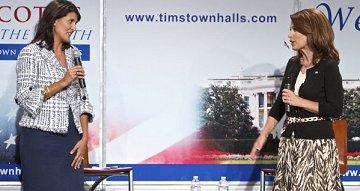
Over the last year or so, some prominent far-right officials, most notably Rep. Michele Bachmann (R-Minn.) and South Carolina Gov. Nikki Haley (R), have helped make the HPV vaccine a national political issue. With that in mind, today’s news deserves some broader attention.
For those looking for a refresher, the human papillomavirus increases a woman’s chances of developing cervical cancer. For several years, there’s been an FDA-approved vaccine available that immunizes against HPV infection. But as the Republican Party has become more radicalized, the vaccine has been caught up in a culture war — many conservatives believe the vaccine encourages minors to have sex.
It doesn’t (thanks to my colleague Will Femia for the heads-up).
Since public health officials began recommending in 2006 that young women be routinely vaccinated against HPV, many parents have hesitated over fears that doing so might give their children license to have sex. But research published on Monday in the journal Pediatrics may help ease those fears.
Looking at a sample of nearly 1,400 girls, the researchers found no evidence that those who were vaccinated beginning around age 11 went on to engage in more sexual activity than girls who were not vaccinated.
Recommended


“We’re hopeful that once physicians see this, it will give them evidence that they can give to parents,” said Robert A. Bednarczyk, the lead author of the report and a clinical investigator with the Kaiser Permanente Center for Health Research Southeast, in Atlanta. “Hopefully when parents see this, it’ll be reassuring to them and we can start to overcome this barrier.”
The politics surrounding the HPV vaccine took a turn towards the ridiculous a year ago, when Bachmann, at the time an almost-credible presidential candidate, went after Texas Gov. Rick Perry (R) for giving the vaccine to girls in his state. The right-wing lawmaker claimed that the HPV vaccine can lead to mental retardation — a claim with no foundation in reality — and Perry ended up apologizing for one of his only progressive acts in office.
The story took another turn in June when South Carolina Gov. Nikki Haley (R) vetoed an HPV vaccine bill approved by lawmakers from her own party, even though the bill made it easy for parents to opt their kids out.
Chances are, this newly-published research won’t change conservative politicians’ minds, but if it helps with public education, the news may hopefully save lives.
The place for in-depth analysis, commentary and informed perspectives.
