








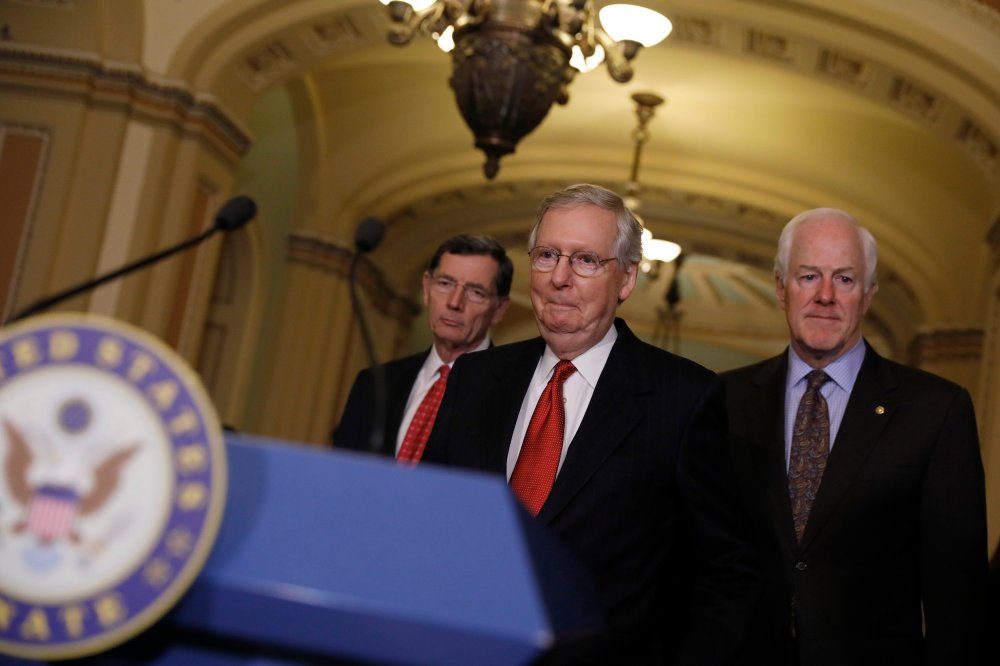
Senate Republican leaders established a timeline of sorts for their health care overhaul, complete with a self-imposed deadline: a GOP bill is supposed to pass the upper chamber before Congress breaks for the 4th of July.
In practical terms, that means a Senate vote on a health care vote by Friday, June 30 — the last day before the holiday recess — which is two weeks from today. The Washington Post reports that Republicans continue to believe this schedule is realistic.
Senate Republican leaders are aiming to bring a major revision to the nation’s health-care laws to the Senate floor by the end of June even as lingering disagreements, particularly over Medicaid, threaten to derail their efforts, several Republicans familiar with the effort said Thursday.
President Trump and Senate Majority Leader Mitch McConnell (R-Ky.) are pressing for an ambitious timeline to complete the bill, although it is being drafted in the Senate with little assistance from the White House.
Just so we’re clear about the calendar, Senate Republican leaders intend to finish a secret overhaul of the American health care system, share it with at least some of their colleagues, send it to the Congressional Budget Office, receive a score from the CBO, bring it to the floor for some perfunctory debate, and pass the bill — all over the next 14 days.
That’s a tall order, to be sure, but I’m not convinced they’ll fail.
The House passed their far-right legislation last month without a CBO score, but in the Senate, that’s not an option: under the budget reconciliation process, which Republicans are using to prevent a filibuster, senators will need to ensure that their version doesn’t affect the deficit more than the House version.
Ordinarily, on a bill of this importance, it takes the Budget Office between 10 and 14 days to produce a score — which in this case, would necessarily mean that GOP lawmakers miss their deadline — but TPM reports that many Republican senators “hope” it will take less time “because they’ve had the CBO provide feedback on the various individual proposals under consideration.”
In the meantime, there’s still the underlying scandal of how the bill is being constructed: in a process unlike anything in the American tradition, Republicans are still trying to overhaul behind closed doors, in total secrecy, without so much as a single committee hearing. Even many GOP lawmakers have publicly conceded that they have no idea what their party has in mind because Republican members of the Senate “working group” haven’t shared the uncompleted bill.
Several GOP senators have complained about the process, but none of them has used his or her power to change the party’s strategy.
For his part, Senate Majority Leader Mitch McConnell (R-Ky.) told reporters this week that “nobody is hiding the ball here” and people are “free to ask anybody anything.” This is, of course, ridiculous. McConnell is trying to pass a secret bill that affects one-sixth of the world’s largest economy, and which will have a life-or-death impact on millions of Americans. Because he knows the bill will be unpopular, he’s keeping it hidden, even from many of his own members. The fact that we’re all “free to ask anybody anything” is irrelevant — since the only people with answers about the legislation refuse to share information with the public. McConnell added that there’s no need for legislative hearings on the legislation because Congress has been working on health care for seven years and there have been “gazillions of hearings” on the subject. New York‘s Jon Chait explained in response that McConnell “has spent seven years sustaining the fiction that he can produce the magical better plan without any trade-offs. The ‘gazillions of hearings on this subject’ have all been about the bill Democrats wrote. None of them have concerned the one McConnell wants to pass in secrecy and haste.” If and when the Republican bill is complete, it will pass unless three GOP senators balk. There’s no firm head-count yet because — you guessed it — no one’s seen the secret bill.
Steve Benen is a producer for "The Rachel Maddow Show," the editor of MaddowBlog and an MS NOW political contributor. He's also the bestselling author of "Ministry of Truth: Democracy, Reality, and the Republicans' War on the Recent Past." Recommended


