








About a week ago, health care advocates had reason to feel optimism. Senate Republicans publicly conceded that their efforts to craft their own health care blueprint weren’t going especially well.
Asked if there will be a Senate-passed version of the GOP health care plan by the end of the year, Sen. Lindsey Graham (R-S.C.) conceded, “I don’t think there will be. I just don’t think we can put it together among ourselves.” Sen. Richard Burr (R-N.C.) added that he believed it’s “unlikely” a Republican bill would pass.
But while those comments offered hope to health care proponents, as the week progressed, the winds began to shift direction. Vox’s report on Friday afternoon is consistent with everything I’ve heard about the state of the debate.
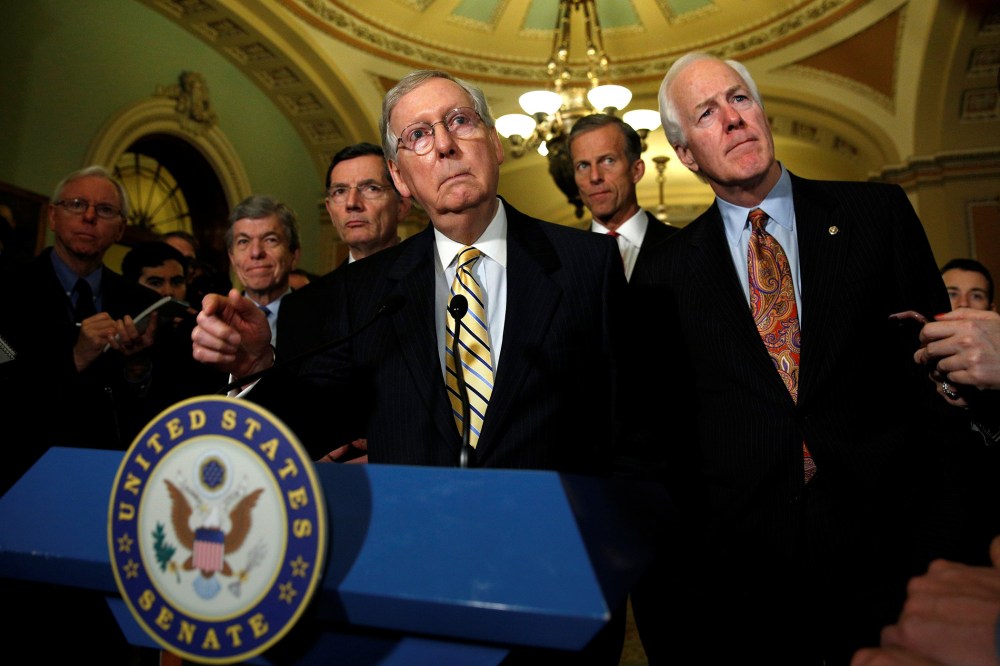
Behind closed doors, the Senate is drawing closer to passing a health care bill that looks a lot like the widely disliked version that cleared the House.
Any agreement currently on the table would almost certainly result in millions fewer Americans having health coverage, including low-income workers on Medicaid. It could roll back some Obamacare protections for people with pre-existing health conditions.
This is a big story with a lot of moving parts, so it’ll probably be easier to go through this in a Q&A.
I feel like I haven’t heard much about health care lately.
That’s because you haven’t, and part of that is by design. Certainly, Donald Trump’s Russia scandal is dominating the headlines, and for good reason, but Senate Republicans have created a “working group” that’s writing their bill in secret, entirely behind closed doors. They’ve been quite effective in keeping details out of the public eye, knowing that the more Americans learned of their ideas, the more controversial their plan would become.
Is there a Senate GOP bill?
Not yet, but by all accounts, the Senate’s legislation is coming together, and it’s a safe bet they’ll have a final version fairly soon.
Assuming there’s legislation, is it true GOP leaders will simply skip over committee hearings and bring the secret bill directly to the floor for a vote?
Yes. Senate Majority Leader Mitch McConnell (R-Ky.) last week invoked Rule XIV, which allows him to expedite the legislative process and bypass every relevant committee. This is, of course, the opposite of how Democrats passed the Affordable Care Act in 2009 and 2010.
But if they skip past committee hearings, how will anyone have a chance to scrutinize the bill?
That’s the point: Republicans are hoping to avoid scrutiny. It’s why they’re writing a bill in secret, and are moving forward with no hearings, no amendments, no transparency, no input from subject-matter experts, and no effort at bipartisan negotiation.
What changed last week to shift the direction of the debate?
Republican leaders are determined to eliminate the ACA’s Medicaid expansion fairly quickly, and last week, several Republican skeptics said they’re willing to go along — if Medicaid expansion is killed more slowly. Instead of a three-year phase-out, these GOP senators expressed support for a seven-year phase-out.
What does the CBO have to say about the effects of the Senate plan?
Because there’s no Senate bill yet, there’s no CBO score. That said, we know what the CBO had to say about the House Republican legislation and its disastrous effects on the public.
But why is the CBO report on the House bill relevant? I thought the Senate was starting from scratch with a blank sheet of paper?
That’s what some GOP senators said after the House bill passed, but that was apparently untrue. Sen. John Thune (R-S.D.) recently told reporters that the far-right House version will serve as the “foundation” for the Senate version. Senate Majority Whip John Cornyn (R-Texas) added, “The practical matter is that 80 percent of what the House did we’re likely to do.”
So how close are they to having the votes?
There’s no firm head-count, and by most reports, the votes aren’t yet in place. It’s likely to come down to a handful of members who’ll dictate the outcome.
Since there are only 52 Senate Republicans, how will they overcome a Democratic filibuster?
While Democrats passed the Affordable Care Act with 60 votes, Republicans are taking an easier path, using budget reconciliation rules in the hopes of passing their plan with just 51 votes. A Democratic filibuster is not procedurally possible. To stop this bill, health care advocates will need some GOP members to break ranks. Is that realistic? Maybe. Sen. Susan Collins (R-Maine), for example, has balked at the House version, and she said yesterday that any bill resulting “in 23 million people losing coverage is not a bill that I can support.” What’s less clear is what she might do with a bill in which 15 million — or 10 million, or 5 million — lose coverage. Sen. Rand Paul (R-Ky.), meanwhile, has criticized any legislation that relies on tax credits to subsidize coverage, and tax credits are at the core of both the House and Senate approaches. Other members who are considered “in play” are senators who are up for re-election next year (Nevada’s Dean Heller and Arizona’s Jeff Flake), senators whose constituents would face brutal consequences if the ACA is gutted (Alaska’s Lisa Murkowski and West Virginia’s Shelley Moore Capito), and senators representing states where the uninsured rate has already dropped thanks to the ACA (Colorado’s Cory Gardner and Ohio’s Rob Portman). There are also a couple of far-right senators (Texas’ Ted Cruz and Utah’s Mike Lee) who could conceivably withhold their support if they conclude that the Senate bill isn’t radical enough — especially if they consider the tax subsidies too generous as compared to the House version. What now? There are all kinds of provisions on which Republicans are still seeking some kind of intra-party consensus. Medicaid is probably at the top of the list, but they’re also deliberating over how and whether) to protect those with pre-existing conditions, essential health benefits, taxes that pay for benefits, and funding for Planned Parenthood (full disclosure: my wife works for Planned Parenthood). When should we expect a vote? GOP leaders have publicly said they plan on bringing the bill to the Senate floor before their 4th of July recess, which means a vote no later than Friday, June 30. Health care advocates that I’ve spoken to privately have said there’s been less public activism on the issue in recent weeks, but it’s their hope that the public will start contacting senators’ offices in greater numbers once there’s a bill and the threat to millions of families is more real. Why has there been so much talk about June 20? Because private insurers have to decide by June 21 the extent to which they’ll participate in ACA markets next year. Republicans are creating uncertainty, which could create systemic disasters, and which has put pressure on GOP leaders to give the industry some guidance by June 20. If the Senate passes a bill, can it pass the House? Let’s not get too far ahead of ourselves. We don’t know when a Senate bill will exist, what will be in it, or whether it can even pass the upper chamber. If it does clear the Senate, we don’t know whether the House will take up the Senate version, or whether members will try to reconcile the competing versions in a conference committee. It’s a long process, with plenty of choke points, and anyone who says they can say with confidence what’s going to happen deserves skepticism. My family relies heavily on our health benefits. Is it too early to panic? I generally recommend against panic. The threat in this case is real, but the Senate Republicans’ plan, assuming it comes together, can be derailed.
Steve Benen is a producer for "The Rachel Maddow Show," the editor of MaddowBlog and an MS NOW political contributor. He's also the bestselling author of "Ministry of Truth: Democracy, Reality, and the Republicans' War on the Recent Past." Recommended


