








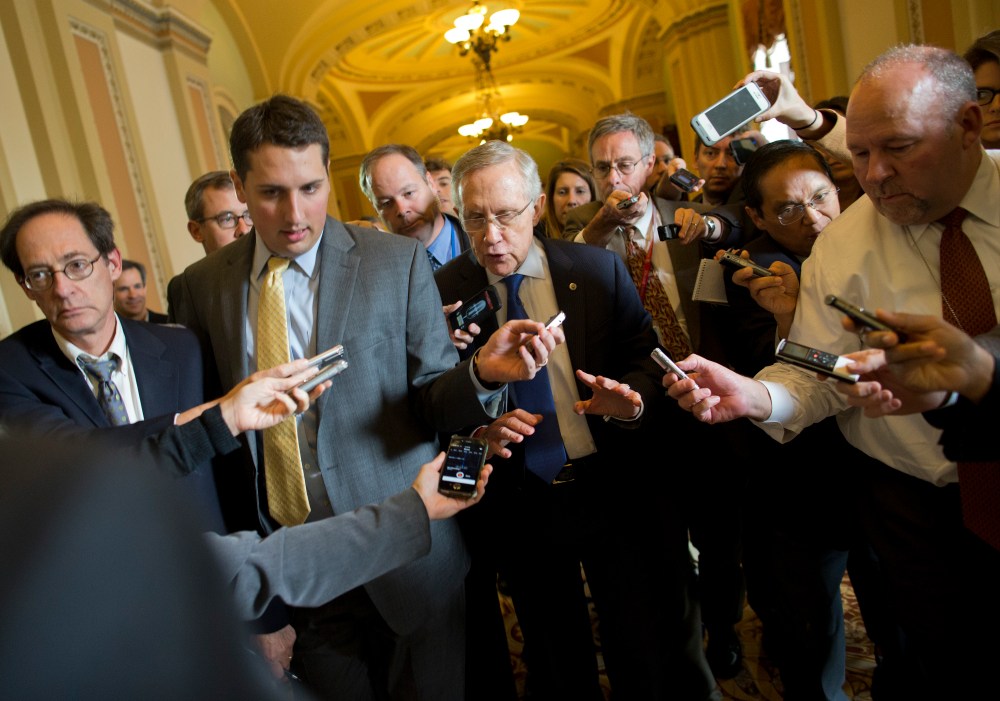
With the government already shut down and a debt-ceiling deadline just a couple of days away, a burst of optimism swept through the Senate yesterday. There is, at this moment, no final agreement that’s been endorsed by both parties, but Senate Majority Leader Harry Reid (D-Nev.) and Senate Minority Leader Mitch McConnell (R-Ky.), as they’ve done before, appear to have worked out a package both can live with.
So, what’s in it? Benjy Sarlin has a tidy summary:
The deal under discussion would include an extension of federal funding to January 15, an extension of the debt limit until February and terms for a budget conference to work out a longer term spending deal by December 13, according to a Democratic aide.
The proposal would also make two minor changes to the Affordable Care Act. First, it would delay to the law’s reinsurance fee, a provision requiring employers to pay into a pool that would support insurers if too few healthy people obtained coverage through the exchanges. This fee is opposed by labor unions, so the move would be considered a plus for Democrats. Second, it would put in place a stricter procedure for verifying the income of people applying for government subsidies to buy insurance, which Republicans could claim as a win.
Both parties would get something out of the bill.
And that’s no small detail. Since the start of the crisis, congressional Republicans have made all kinds of “offers,” each of which asked Democrats to make concessions in exchange for nothing. The package Reid and McConnell worked out is closer to a genuine compromise — they each gave a bit on the calendar, with funding levels extended longer than Democrats wanted and the debt limit is extended a little longer than the GOP wanted, and then traded a couple of similarly sized policy concessions related to health care, which tinkers with the Affordable Care Act without making any major, substantive changes.
As for negotiations on the longer term spending deal, the framework for the talks will include, at Democrats’ demand, the damaging-by-design sequestration policy that’s hurting the economy.
Now what happens? Other than high anxiety?
One thing to keep an eye on is Senate procedure — even if a deal is finalized today, it would only take one senator to delay the process and push the nation past the deadline.
Even if Senators are able to agree to a debt ceiling and government spending framework on Tuesday, any one senator could delay the chamber from passing it until Friday — a day after the Treasury says it will run out of money to pay the nation’s bills. On Monday, Sen. Joe Manchin III, D-W.Va. indicated that Democrats have not gotten assurances that all GOP senators will give up their rights to filibuster and allow the Senate to expedite its proceedings. If Sens. Ted Cruz, R-Texas, Mike Lee, R-Utah, or another potential opponent of the emerging deal objected, 60 senators would be needed to break a procedural filibuster on the motion to open debate. Would Cruz singlehandedly delay the process and force the nation closer to default. As of last night, he hadn’t ruled it out. The junior senator from Texas has the global economy in his hands, and he hasn’t decided whether he wants to squeeze or not. And then, of course, there’s the House, which would have about a day to do the right thing, assuming everything goes perfectly in the Senate. We’ll tackle the prospects in the lower chamber in the next post. Finally, let’s also not forget that all of this leaves open the possibility of another similar crisis in 2014, if Republicans are in the mood to threaten and punish the country all over again.
Steve Benen is a producer for "The Rachel Maddow Show," the editor of MaddowBlog and an MS NOW political contributor. He's also the bestselling author of "Ministry of Truth: Democracy, Reality, and the Republicans' War on the Recent Past." Recommended


