








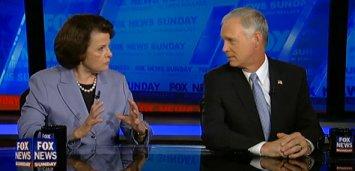
Given the massacre in Aurora on Friday, much of the discussions on the Sunday shows dealt with what, if anything, can be done to prevent similar violence in the future. One of the more noteworthy discussions was held on “Fox News Sunday,” where Sen. Dianne Feinstein (D-Calif.) made the case for gun control, and Sen. Ron Johnson (R-Wis.) argued against it.
Much of the conversation went about as one might expect. Johnson, a right-wing senator in his second year, argued that policymakers can’t enact any new restrictions on firearms, and that even high-capacity magazines, which had been banned as part of the federal assault-weapon ban that expired in 2004, must be legally permissible.
If policymakers even try to “keep these weapons out of the hands of sick, demented individuals who want to do harm,” the result is undue restrictions on “our freedoms.”
So what would Johnson prefer to see as an alternative?
JOHNSON: Well, it’s certainly one of the rationales behind conceal and carry, where criminals actually have to be a little concerned before they commit a criminal act that maybe somebody could stop them. And I think that is the truth. That somebody, a responsible individual had been carrying a weapon, maybe — maybe — they could have prevented the death and injuries. I mean, that’s just the truth.
FEINSTEIN: And maybe you could have had a firefight and killed many more people.
This apparently has become the principal talking point for many opponents of gun-control laws: if there were others in the theater with loaded firearms, maybe they could have shot at the deranged gunman wearing Kevlar and a helmet.
Indeed, this seems to come up quite a bit after every similar incident — we heard very similar rhetoric after the massacres in Tucson and Blacksburg. Just a few days after the assassination attempt on Gabrielle Giffords’ life, Rep. Trent Franks (R-Ariz.) said, “I wish there had been one more gun there that day in the hands of a responsible person.”
Let’s unpack this a bit, because it seems like an important part of the larger discussion.
First, I think there’s a risk that this argument starts to blame the victims, as if it was the job of those in that Aurora theater to bring loaded guns with them to the movies.
Second, the circumstances generally aren’t as obvious as some would like to believe. I’m reminded of a piece from William Saletan published soon after the Tucson shootings, about Joe Zamudio, which I wrote about at the time.
Zamudio, you may recall, was in a nearby store when he heard gunshots. He took his own gun, clicked off the safety, and advanced towards the gunman. When he got to the scene, Zamudio saw a man holding a gun and shouted at him to drop his weapon. Indeed, Zamudio very nearly shot the man holding the gun.
The man Zamudio saw, however, wasn’t Jared Lee Loughner; it was the man who’d wrestled the gun away from Jared Lee Loughner. This is a much more dangerous picture than has generally been reported. Zamudio had released his safety and was poised to fire when he saw what he thought was the killer still holding his weapon. Zamudio had a split second to decide whether to shoot. He was sufficiently convinced of the killer’s identity to shove the man into a wall. But Zamudio didn’t use his gun. That’s how close he came to killing an innocent man. He was, as he acknowledges, “very lucky.” That’s what happens when you run with a firearm to a scene of bloody havoc. In the chaos and pressure of the moment, you can shoot the wrong person. Or, by drawing your weapon, you can become the wrong person — a hero mistaken for a second gunman by another would-be hero with a gun. Bang, you’re dead. Or worse, bang bang bang bang bang: a firefight among several armed, confused, and innocent people in a crowd. It happens even among trained soldiers. Among civilians, the risk is that much greater. We’re enormously lucky that Zamudio, without formal training, made the right split-second decisions. We can’t count on that the next time some nut job starts shooting. The point, of course, isn’t to take anything away from Zamudio. On the contrary, he showed great courage, and it’s likely he played a role in saving lives. But after the Aurora violence, Ron Johnson sees his approach as “just the truth,” and it’s not that simple. The common assumption — more armed citizens means more public safety — is more complicated than some conservatives would like us to believe. Update: After the Tucson shootings, my colleague Laura Conaway did some great reporting on modern examples (or lack thereof) of armed civilian bystanders intervening to stop mass shootings.
The place for in-depth analysis, commentary and informed perspectives. Recommended


