








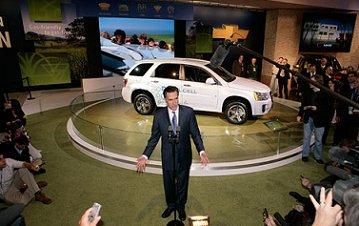
Mitt Romney likes to blame President Obama for developments the president didn’t really have anything to do with. As it turns out, the inverse is true, too — Romney likes to take credit for developments the Republican didn’t have anything to do with, either.
Despite his 2008 call to “let Detroit go bankrupt,” presumptive Republican presidential nominee Mitt Romney said Monday that he would “take a lot of credit” for his impact on the U.S. automobile industry’s comeback.
During an interview with WEWS-TV in Cleveland following a campaign stop, Romney said his views helped save the industry.
“I pushed the idea of a managed bankruptcy,” Romney said. “And finally, when that was done, and help was given, the companies got back on their feet. So I’ll take a lot of credit for the fact that this industry’s come back.”
Look, I’ve come to expect quite a bit of dishonesty from Romney, who seems a little too comfortable working from the assumption that he can say literally anything and quite a few voters will believe his nonsense.
But even by Romney standards, this is just laughable.
The former Massachusetts governor — the guy who said we should “let Detroit go bankrupt” — predicted that we could “kiss the American automotive industry goodbye” if Obama’s policy moved forward in 2009. Indeed, at the time, Romney called the administration’s plan “tragic” and “a very sad circumstance for this country.” He wrote another piece in which he said Obama’s plan “would make GM the living dead.”
We now know that Obama was right and Romney was wrong. We now also know that Romney wants “a lot of credit” for the same Obama policy the Republican said wouldn’t work.
Following up on a piece from last week, Romney can condemn the Obama administration’s policy or it can take credit for the Obama administration’s policy, but he can’t do both.
Romney has said, publicly and repeatedly, that he opposed Obama’s industry rescue plan — the one he now wants credit for. The former governor has said repeatedly that GM and Chrysler should rely on private funding to restructure and get back on their feet.
Of course, in early 2009, the credit markets were frozen and there was no private funding available. (When a company called Bain Capital was approached, it refused to invest.) How does Romney reconcile his demands with reality? For the last three years, he hasn’t even tried to explain the contradiction. In fact, he’d prefer if we just overlook the details altogether.
Just at face value, it takes a fair amount of chutzpah to face a crisis, get it wrong, then whine about the way in which the other guy got it right. But it takes truck loads worth of chutzpah to condemn the other guy then take credit for his success. We can say a couple of things with certainty. First, when President Obama launched his ambitious policy in 2009, he was taking a major gamble — not only with the backbone of American manufacturing, but with his presidency and its ability to use the power of government to repair a private industry facing collapse. As First Read noted at the time, “As the GM bailout goes, so goes the Obama presidency.” We now know the gamble paid off. GM and Chrysler are making money, expanding American facilities, and operating at capacity. It’s a remarkable success story and one of Obama’s most important domestic accomplishments. Republicans were absolutely certain the White House’s policy would fail, and they were wrong. Second, we also know that if policymakers had followed Romney’s advice, and waited for private financing, the American auto industry likely would have collapsed while waiting for capital that simply wasn’t available. An economy that was already on the brink would have been forced to absorb hundreds of thousands of unemployed auto workers, crushing already-struggling communities in the Midwest. As of yesterday, Romney is effectively telling voters, “Wait, did I say I hate Obama’s policy? What I meant to say was that I love Obama’s policy because I came up with it. Never mind all that other stuff I said two months ago.” How anyone could find this nonsense credible is a mystery to me.
The place for in-depth analysis, commentary and informed perspectives. Recommended


