








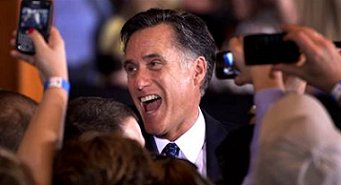
Looking back over the last couple of months, Mitt Romney’s most notable success stories usually come with a “yes, but.” Did he win in New Hampshire? Yes, but Romney’s practically a local. Did he score victories in Ohio and Michigan? Yes, but the margins were unimpressive and narrow. Did he crush the competition in Virginia? Yes, but no one else was on the ballot.
Fortunately for Romney, his win in Illinois is largely “yes, but” free. His 11.7% margin over Rick Santorum may not count as a blowout victory — Romney came up short of the 50% threshold — but it was still an impressive showing in a key state. After third-place finishes in Alabama and Mississippi last week, the former governor had reason to smile last night.
The trajectory of this race was of particular interest. Three weeks ago, Romney and Santorum were effectively tied in Illinois, and two weeks ago, Romney’s lead in the polls was only four points. How’d he turn a competitive primary into a relatively easy win? By sticking to the usual playbook: he and his super PAC spent $3.7 million, mostly on attack ads, in Illinois — about seven times what Santorum spent.
Indeed, everything about the Illinois primary seemed to fit into a rather predictable model. The race looked close early on; Romney vastly outspent his main rival; Santorum suffered from a poor organizational structure; and Romney walks away with a win in a traditionally “blue” state. If you feel like you’ve seen this movie before, you have, more than once.
The larger post-Illinois takeaway is how little the outcome changes the race. Romney still looks like the frontrunner; Newt Gingrich still doesn’t want to quit despite another fourth-place finish; Santorum is still picking up enough delegates to at least slow Romney down. Before Illinois, it looked as if Romney wouldn’t reach 1,144 delegates until May or June, and after Illinois, it still looks that way.
Given the larger dynamic of the nominating race, if Romney’s easy win in Illinois were likely to give him some new momentum going into future contests, the results would be quite meaningful. But does anyone really believe Louisiana Republicans will be more likely to back Romney on Saturday because of last night’s results? The odds are against it. And so the slog continues. Down ballot in the Land of Lincoln, freshman Rep. Adam Kinzinger defeated long-time incumbent Rep. Don Manzullo in a Republican primary in the 16th district, thanks in part to the support of Eric Cantor and the party establishment. In Illinois’ 10th, businessman Brad Schneider beat former MoveOn.org organizer Ilya Sheyman in a Democratic primary by about eight points, despite the efforts to progressive activists who rallied behind Sheyman.
The place for in-depth analysis, commentary and informed perspectives. Recommended


