








There was quite a bit of discussion on the Sunday shows yesterday as to why there’s so little compromise and even less constructive, bipartisan policymaking in Washington. Doris Kearns Goodwin blamed the role of money in politics, while Bob Woodward blamed President Obama’s lack of schmoozing. Soon after, Senate Minority Whip Jon Kyl (R-Ariz.) blamed the media, while the Associated Press blamed the scarcity of moderates.
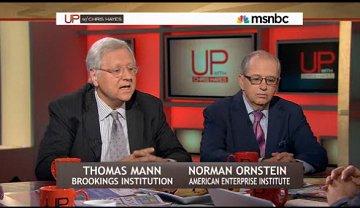
There is a more plausible explanation. Maybe this is a good time to reflect again on the thesis presented earlier this year by Tom Mann and Norm Ornstein: “[W]e have no choice but to acknowledge that the core of the problem lies with the Republican Party.”
The GOP has become an insurgent outlier in American politics. It is ideologically extreme; scornful of compromise; unmoved by conventional understanding of facts, evidence and science; and dismissive of the legitimacy of its political opposition.
When one party moves this far from the mainstream, it makes it nearly impossible for the political system to deal constructively with the country’s challenges.
“Both sides do it” or “There is plenty of blame to go around” are the traditional refuges for an American news media intent on proving its lack of bias, while political scientists prefer generality and neutrality when discussing partisan polarization. Many self-styled bipartisan groups, in their search for common ground, propose solutions that move both sides to the center, a strategy that is simply untenable when one side is so far out of reach.
The point is not that money, interpersonal conflicts, and the media and public discourse are irrelevant, but rather, they’re all peripheral concerns that overlook the root problem: constructive, bipartisan policymaking in Washington is impossible when there’s a radicalized major party that doesn’t believe in compromise — and they have the power necessary to exert their will.
It’s not as if GOP leaders have been bashful on this point. John Boehner himself has declared in recent years, “This is not a time for compromise,” and “I reject the word” compromise. Mitch McConnell has said several times that defeating President Obama, not helping Americans, his top “priority,” and that he deliberately refused to consider bipartisan proposals, even ones that he liked and approved of, in order to advance his larger partisan cause. For his part, Obama has frequently adopted GOP measures as his own, in the hopes of advancing bipartisanship, only to find Republicans opposing their own proposals. Remind me: why, exactly, does the political establishment consider dysfunction and acrimony a mystery?
The place for in-depth analysis, commentary and informed perspectives. Recommended


