








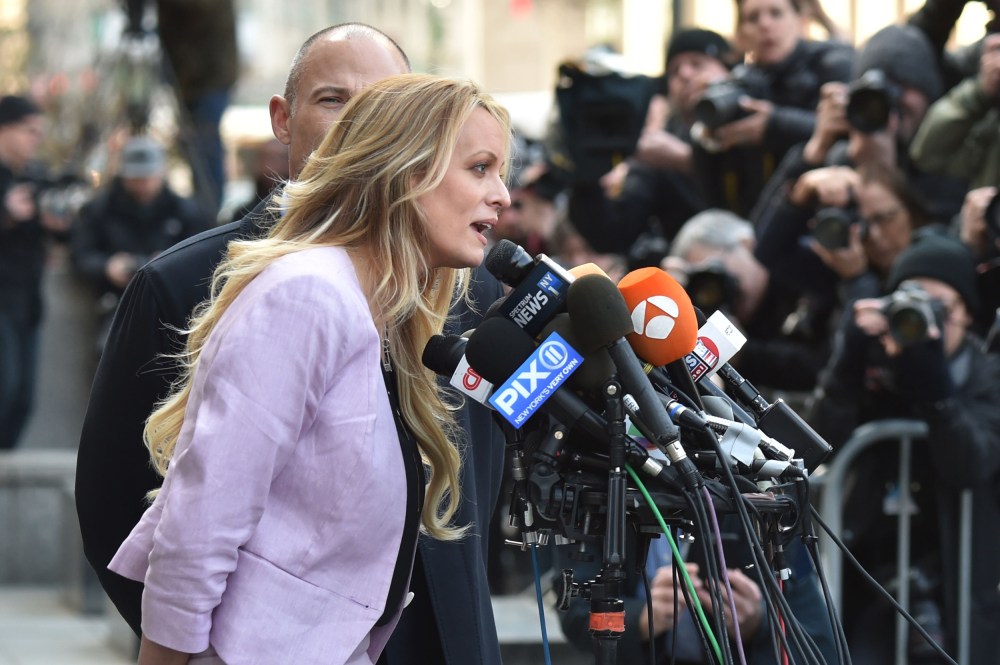

Donald Trump’s Stormy Daniels scandal broke in earnest more than three years ago, and though it was ultimately overshadowed by the other Republican fiascos, the controversy was a doozy.
The Wall Street Journal reported in 2018 on Michael Cohen, Trump’s former fixer, paying the porn star $130,000 in pre-election hush money. In exchange, Daniels agreed not to discuss her alleged extramarital affair with the future president. Cohen was later convicted and sentenced to prison for, among other things, breaking campaign finance laws. Trump, meanwhile, was referenced in the case as “Individual 1” — in effect, an unindicted co-conspirator — after Cohen identified his client as having directed him to make the illegal payment.
Trump, who was caught brazenly lying about his role in the mess, has never faced any legal consequences. As the New York Times reported, the Federal Election Commission, not surprisingly, took an interest in the scandal, but we know that the case is closed — at the insistence of Republican commissioners.
In December 2020, the F.E.C. issued an internal report from its Office of General Counsel on how to proceed in its review. The office said it had found “reason to believe” violations of campaign finance law were made “knowingly and willfully” by the Trump campaign. But the election commission — split evenly between three Republicans and three Democratic-aligned commissioners — declined to proceed in a closed-door meeting in February. Two Republican commissioners voted to dismiss the case while two Democratic commissioners voted to move forward. There was one absence and one Republican recusal.
The result of that February vote was announced yesterday.
If recent history is any guide, the former president will seize on this as proof that he’s been “fully exonerated” by the Federal Election Commission, but that’s clearly not what happened.
On the contrary, FEC officials recommended further investigation into the allegations, at which point Republican commissioners — appointed by Trump — intervened to ensure that Trump faced no consequences for his actions. Two of the Democratic commissioners on the FEC, Shana Broussard and Ellen Weintraub, wrote in an objection, “To conclude that a payment, made 13 days before Election Day to hush up a suddenly newsworthy 10- year-old story, was not campaign-related, without so much as conducting an investigation, defies reality. But putting that aside, Cohen testified under oath that he made the payment for the principal purpose of influencing the election. This more than satisfies the Commission’s ‘reason to believe’ standard to authorize an investigation.” For his part, Cohen told the Times, “The hush money payment was done at the direction of and for the benefit of Donald J. Trump. Like me, Trump should have been found guilty. How the F.E.C. committee could rule any other way is confounding.” The former president may not be in office anymore, but some Republican officials continue to carry his water.
Steve Benen is a producer for "The Rachel Maddow Show," the editor of MaddowBlog and an MS NOW political contributor. He's also the bestselling author of "Ministry of Truth: Democracy, Reality, and the Republicans' War on the Recent Past."
Latest Post
Recommended

