








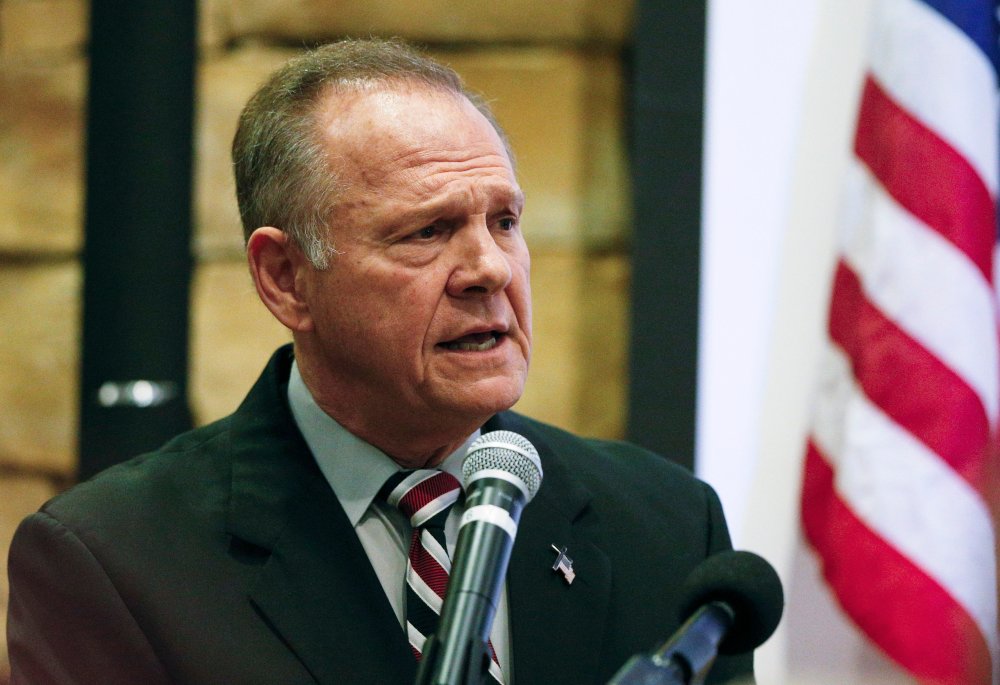

The original Washington Post report on Roy Moore’s alleged sexual misconduct pointed to four accusers, including one woman who was 14 when Moore pursued her. He was 32 at the time. Earlier this week, another accuser came forward, alleging that the Republican Senate candidate in Alabama attacked her when she was 16.
Yesterday afternoon, AL.com reported on two more accusers, which was soon followed by a Washington Post report that highlighted two more.
As Rachel explained on last night’s show, it was against this backdrop that the Alabama GOP’s steering committee had an important decision to make.
The Alabama Republican Party is sticking with Senate candidate Roy Moore, party leaders told NBC News on Wednesday night, even as more women were reported to have accused him of making unwanted advances. […]
The steering committee of the state Republican Party — the only entity with the power to remove Moore from the Dec. 12 special election ballot — took no action on Moore’s nomination at a meeting Wednesday.
By law, the Alabama Republican Party’s steering committee couldn’t remove Moore’s name from the ballot — it’s too late for that — but it could decertify him as the GOP candidate, which would effectively nullify votes cast for his candidacy. The idea would be for party officials to open the door to a write-in candidate, which is an idea that several Republicans at the national level have expressed an interest in.
Except the steering committee’s members said no. They’re sticking with Roy Moore — even now.
And that, in turn, has led increasingly desperate Republican officials in Washington to consider an even more dramatic possibility. Politico reported last night:
Republican leaders are exploring a dramatic remedy to salvage the Alabama Senate seat as fresh polling shows Roy Moore’s prospects fading fast.
With less than four weeks until the special election and no sign that the party’s besieged nominee will exit the race, Senate Majority Leader Mitch McConnell and his top advisers are discussing the legal feasibility of asking appointed Sen. Luther Strange to resign from his seat in order to trigger a new special election.
The article emphasized that there’s uncertainty about the legal and procedural hurdles involved in such a move, which is still in the discussion stage and may not come to fruition.
That said, if they’re serious about pursuing this, it’s worth appreciating just how bold a scheme this is. Jeff Sessions gave up his seat to become attorney general, which led to Luther Strange’s appointment. Strange ran to stay in the seat, but lost to Moore in a primary, setting up a general election Moore may lose. The new idea would involve Strange resigning now, short-circuiting the ongoing process, requiring the governor to appoint a new temporary senator, and starting the process anew. From where I sit, there are at least two problems with such a tack. The first is a matter of principle: in a democracy, major parties aren’t supposed to hatch schemes to derail an ongoing election simply because they suspect they won’t like the results. The second is more practical: if Strange resigns, triggering a new process, what’s to stop Alabama Gov. Kay Ivey (R) from appointing Moore to the vacant Senate seat? For that matter, even if she went in a more responsible direction, there’s no reason to assume Moore wouldn’t run again, and win another GOP primary, putting everyone right back where we are now. At least for now, Election Day in Alabama is Dec. 12, which is just 26 days away. Watch this space. Update: Ivey made clear today she’s not on board with the scheme.
Steve Benen is a producer for "The Rachel Maddow Show," the editor of MaddowBlog and an MS NOW political contributor. He's also the bestselling author of "Ministry of Truth: Democracy, Reality, and the Republicans' War on the Recent Past." Recommended


