








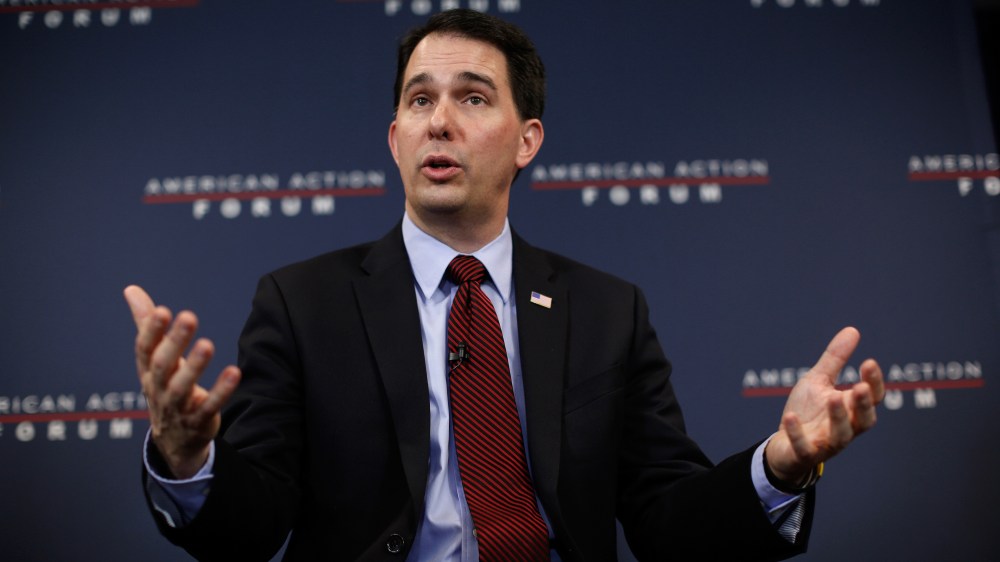
At roughly this point eight years ago, Wisconsin’s Scott Walker (R) was a governor-elect, just weeks ahead of taking the oath of office, and he made one thing clear: the outgoing Democratic governor shouldn’t try to sign any laws that might affect the soon-to-be Walker administration.
The Wisconsin Republican specifically condemned changes that might “tie the hands” of the incoming governor.
Eight years later, Walker, having been rejected by his state’s voters in his bid for a third term, has a very different perspective. The Milwaukee Journal Sentinel reported this afternoon:
Outgoing Gov. Scott Walker signed lame-duck legislation Friday that will scale back the authority of his Democratic successor — approving the entire legislation after saying he was inclined to veto parts of it. […]
The legislation also puts limits on the incoming attorney general and curb early voting — provisions that will likely ignite legal fights.
As the NBC News report on this noted among changes the Republican governor signed into law are measures that would “prevent the governor from scrapping the state’s Medicaid work requirements and hamper his ability to withdraw Wisconsin from lawsuits like the one challenging the Affordable Care Act.”
The new Republican measure would also “limit gubernatorial appointments to an economic board, and require legislative sign-off for the governor to make changes to certain programs and for the attorney general to settle certain lawsuits.”
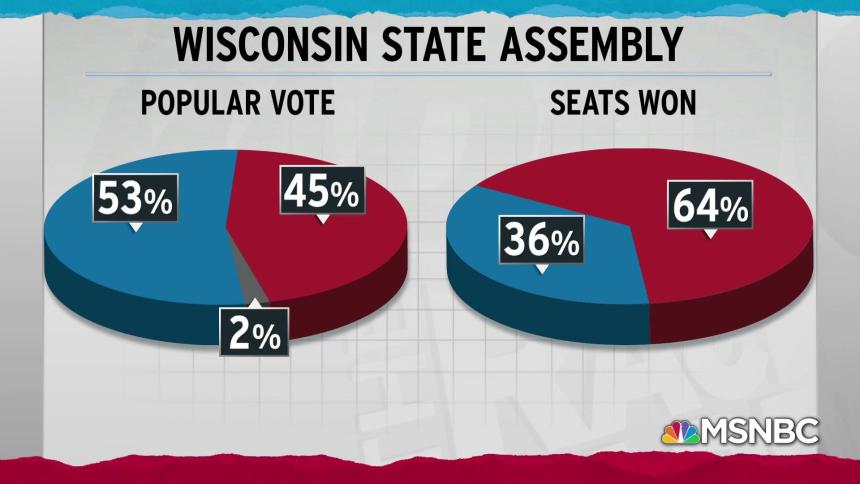
Remember, it was just last month when Wisconsin voters elected a Democratic governor, re-elected a Democratic U.S. senator, re-elected a Democratic secretary of state, and elected a Democratic state attorney general. Even in the state legislature, Democratic candidates easily won the most votes.
Republicans responded to the results by scrambling to pass measures that proved one thing: Wisconsin’s GOP leaders prioritize their wishes, not voters’.
Next door in Michigan, an eerily similar scene is playing out. The Detroit News reported this afternoon:
Michigan Gov. Rick Snyder on Friday signed controversial bills to weaken minimum wage and paid sick leave initiatives that had been headed toward the Nov. 6 ballot before intervention by the Republican-led Legislature.
The minimum wage law will raise Michigan’s rate from $9.25 to $12.05 per hour by 2030, instead of the $12 by 2022 proposed under the initiative. The minimum wage for tipped restaurant workers will rise to $4.58 by 2030 instead of $12 by 2024.
The paid sick leave law now exempts more than 160,000 small businesses that have fewer than 50 employees each from a mandate that would have otherwise applied to every company in the state.
The Detroit Free Press‘ Brian Dickerson recently explained that the outgoing Republican governor had to decide “whether he wishes to be remembered as the conservative accountant who brought order to Michigan’s fiscal house or the GOP apparatchik who enabled his party’s 11th-hour smash-and-grab.”
Snyder did not choose wisely. Circling back to our previous coverage, we’ve all heard the cliché: elections have consequences. Evidently, it’s going to need an addendum: elections have consequences, except in Wisconsin and Michigan, where the consequences are whatever Republicans say they are. In this model, the right to govern doesn’t come from the electorate; it comes from what a radicalized GOP is willing to tolerate. The Republicans’ posture is based on an elitist arrogance that says democracy is an annoyance that must occasionally be ignored. It’s a sentiment that effectively asks, “Who are the voters to tell us what to do with state government?” What’s more, let’s not forget the importance of gerrymandering in this ugly scheme: Wisconsin and Michigan have among the nation’s most egregiously drawn district maps. Don’t look at what happened in these states as anti-Democratic; look at the developments as anti-democratic. Postscript: This is a trivial point, but for the record, Scott Walker brought a poster board with a Venn diagram to his event today. In the process, the Wisconsin Republican made clear he has no idea how Venn diagrams are supposed to work.
Steve Benen is a producer for "The Rachel Maddow Show," the editor of MaddowBlog and an MS NOW political contributor. He's also the bestselling author of "Ministry of Truth: Democracy, Reality, and the Republicans' War on the Recent Past." Recommended


