










To watch Democratic politics right now is to see a messy dynamic unfold in slow motion. Democratic officials have crafted a lengthy to-do list, which has predictably led to intra-party disputes over COVID relief, the minimum wage, student loans, and immigration policy.
This is, of course, just the start: President Joe Biden’s term is just a month old, in the coming months and years, Democrats will continue in their messy efforts, some of which will produce successful policy outcomes, some of which won’t.
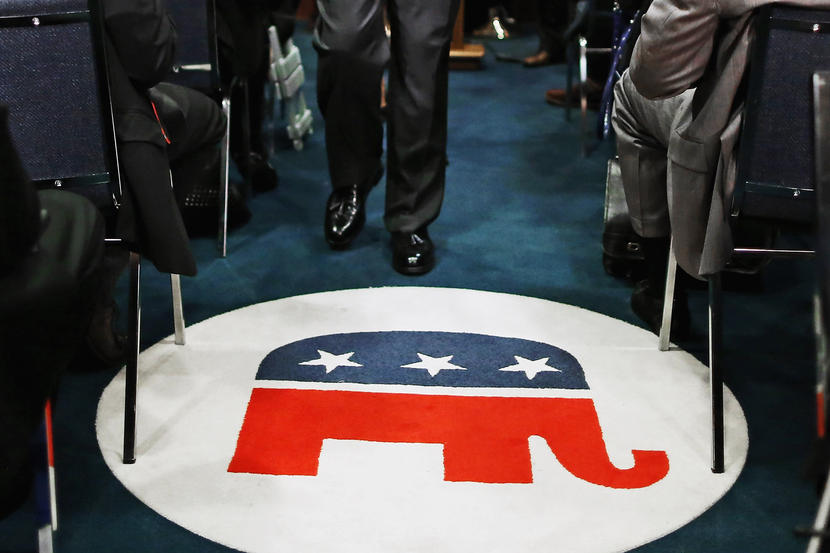
While Democrats proceed as a governing party, their Republican counterparts aren’t just offering different answers; they’re also asking different kinds of questions. How much fealty should the GOP show their corrupt former president who lost re-election by 7 million votes? To what extent should the party embrace crackpot conspiracy theories and their adherents?
How severely should the party punish its members who bothered Donald Trump? In what ways can democracy be beaten into submission to meet the GOP’s goals? How often can members squeeze “Green New Deal,” “cancel culture,” and “socialism” into debates where they don’t fit?
The Washington Post‘s Michael Gerson, a former speechwriter for George W. Bush, argues in his new column that in the United States, “there’s only one political party right now” — and it’s not his.
This type of disagreement — progressive vs. moderate, ambition vs. incrementalism — is sometimes described as dysfunction. In fact, it is the beating pulse of a healthy party…. I watch these Democratic arguments with envy.
Gerson’s colleague, Jennifer Rubin, recently wrote a related item, conceding that the contemporary Republican Party is simply “not a normal” political party, at least not anymore.
The evidence to bolster the thesis is overwhelming, but it’s worth remembering why it matters. Part of the problem is substantive: our Madisonian model expects a constructive competition between parties, and right now, that’s not a credible possibility. The Republican Party isn’t a governing party, making a give-and-take between Democratic and GOP leaders hopeless. But there are also political consequences: plenty of pundits and politicians like Sen. Joe Manchin (D-W.Va.) demand as much bipartisanship as humanly possible in all matters. If the parties aren’t compromising and cooperating, the argument goes, then the system is failing in intolerable ways. Those expectations are in need of a reassessment. The more observers can agree that the Republican Party is suffering from a lack of “normalcy,” the easier it is to discard the assumption that GOP approval is important in all things.
Steve Benen is a producer for "The Rachel Maddow Show," the editor of MaddowBlog and an MS NOW political contributor. He's also the bestselling author of "Ministry of Truth: Democracy, Reality, and the Republicans' War on the Recent Past."
Latest Post
Recommended


