








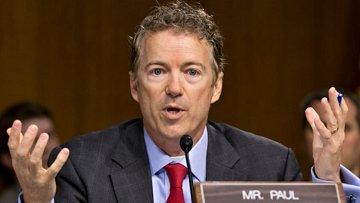
New Jersey Gov. Chris Christie (R) has been feuding with Sen. Rand Paul (R-Ky.) for a while, and a couple of weeks ago, the governor made his pitch at a Republican National Committee meeting in Boston.
“I think we have some folks who believe that our job is to be college professors,” Christie said. “Now college professors are fine I guess. Being a college professor, they basically spout out ideas that nobody does anything about. For our ideas to matter we have to win. Because if we don’t win, we don’t govern. And if we don’t govern all we do is shout to the wind.”
Hearing this, one might get a certain impression about competing contingents within the party, and the larger fight between pragmatism and idealism. Christie, in this vision, is the pragmatist, who has no use for Paul, with his head in the clouds, pondering questions better left to philosophers.
But the takeaway from this may be misleading. If one is left to believe that the junior senator from Kentucky uses his expertise on principles to compensate for his lack practical solutions, this is a terrible error. Paul is neither the learned philosopher or the practical problem-solver.
Take the senator’s understanding of the concept of “rights,” for example.
“There’s a philosophic debate which often gets me in trouble, you know, on whether health care’s a right or not,” Paul, in a red tie, white button-down shirt, and khakis, tells the students from the stage. “I think we as physicians have an obligation. As Christians, we have an obligation…. I really believe that, and it’s a deep-held belief,” he says of helping others.
“But I don’t think you have a right to my labor,” he continues. “You don’t have a right to anyone else’s labor. Food’s pretty important, do you have a right to the labor of the farmer?”
Paul then asks, rhetorically, if students have a right to food and water. “As humans, yeah, we do have an obligation to give people water, to give people food, to give people health care,” Paul muses. “But it’s not a right because once you conscript people and say, ‘Oh, it’s a right,’ then really you’re in charge, it’s servitude, you’re in charge of me and I’m supposed to do whatever you tell me to do… It really shouldn’t be seen that way.”
Perhaps this is “a philosophic debate” that often gets Paul “in trouble” because he’s spouting gibberish.
As Paul Waldman responded, it turns out “you can be a libertarian and not actually have spent any time thinking about those big ideas!”
Paul is obviously unaware of this, but saying that health care is a right doesn’t mean that doctors have to treat people without being paid, any more than saying that education is a right means that public school teachers have to work for free. Because we all agree that education is a right, we set up a system where every child can be educated, whether their families could afford to pay for it themselves or not. It doesn’t mean that any kid can walk up to a teacher in the street and say, “I command you to teach me trigonometry for free. Be at my house at 9 tomorrow. You must do this, because I have a right to education and that means I am in charge of you and you’re supposed to do whatever I tell you to do.”
Recommended


All this talk of “servitude” and “conscription” is just baffling. The only way I can interpret it is that libertarianism is something Paul picked up from his dad, and it seems to go over well with Republicans when he mentions it, but he hasn’t spent any time thinking about it.
Now, I suspect some Rand Paul defenders would say, “Fine, he doesn’t understand the idea of rights on a conceptual level. But he’s more familiar with other stuff.”
Except, he’s not. The senator says he cares deeply about minority rights, which he struggles to grasp. Paul talks about drone policy, which he flubs badly. He’s expressed a great interest in the Federal Reserve, which he doesn’t understand in the slightest. Paul claims to hate Obamacare, but he fails to appreciate what the policy is and what it does. He says he’s deeply concerned about the deficit, but doesn’t know what the deficit is.
The senator has a great number of opinions, many of which appear to be completely nonsensical.
And that wouldn’t be terribly problematic — there are plenty of silly people in Congress — except Rand Paul wants to be considered by friend and foe alike to be a deep thinker. He is, in Chris Christie’s words, the philosophical “college professor.”
As a rule, professors have some idea as to what they’re talking about, especially when addressing the issues they’re most heavily invested in.
Rand Paul still doesn’t understand what he doesn’t understand.
Steve Benen is a producer for "The Rachel Maddow Show," the editor of MaddowBlog and an MS NOW political contributor. He's also the bestselling author of "Ministry of Truth: Democracy, Reality, and the Republicans' War on the Recent Past."
