








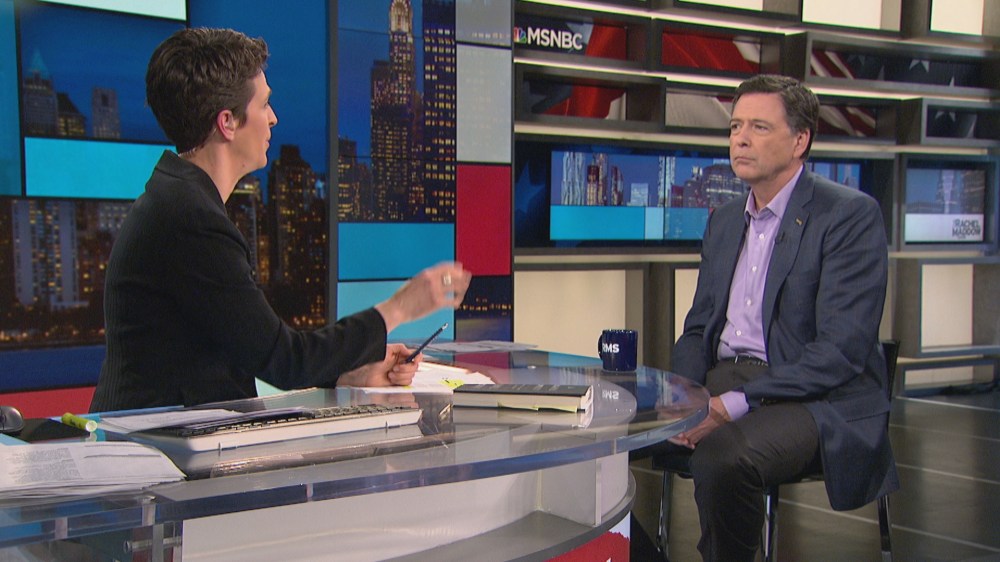
If you missed Rachel’s interview with former FBI Director James Comey, we’ve published several video clips from the show, but just as importantly, we’ve also published the full transcript:
RACHEL MADDOW, MSNBC: So, it is fortuitous timing that the man who wrote these memos is our guest tonight. I’m very much looking forward to asking him about that and everything else under the sun.

James Comey has been a lifelong public servant and law enforcement professional. He served as a federal prosecutor in the Eastern District of Virginia and Southern District of New York where he rose to become U.S. attorney in the Southern District. He then became deputy attorney general of the United States and then director of the FBI.
At this point, he expected to be about halfway through the normal ten-year term for an FBI director, but President Trump fired him in May. Mr. Comey has now written a book about his time in public life and his views of ethical leadership. It is driving everybody absolutely crazy up to and including the president. It’s called “A Higher Loyalty: Truth, Lies and Leadership.”
Director Comey, it’s really nice to meet you. Thanks for being here.
JAMES COMEY, FORMER FBI DIRECTOR: It’s great to meet you. Great to be here.
MADDOW: Thank you for timing this whole thing, so the memos came out just before you sat down.
COMEY: I had no idea.
MADDOW: Yes. And I haven’t actually had a chance to read what they have released. I can tell you how they start. What follows are notes I typed in the vehicle immediately upon exiting Trump Tower on 1-6-17, although I wrote this in less than five minutes after the meeting and I have tried to use actual words spoken, including quoting directly in some places. I have not used quotation marks throughout because my purpose was to capture the substance of what was said. I’m not sure of the proper classification here, so have chosen secret. Please let me know if it should be higher or lower than that.
Do you recognize those as your words?
COMEY: I do.
MADDOW: Why did — you explained to Congress that you didn’t write memos like this after other interactions with other presidents. What trained you or told you or made you believe that you should write a memo like this after interactions with President Trump?
COMEY: Well, the first meeting in particular I was concerned that I needed a record to show the other intelligence agency chiefs who had been with me but didn’t stay behind for the second private meeting, and I also was worried that I was meeting alone with the president who talk about things that were relating to him and to the FBI’s core responsibilities. And given the nature of the person, as I understood the president-elect, he might not tell the truth about those if it ever became an issue, and so, I needed a written record.
MADDOW: And is this the sort of thing that FBI officials and even FBI special agents and people throughout the bureau do as a matter of course? Is there a template for this kind of thing? Do you train one another this is a way to approach your role as a potential witness and important interaction?
COMEY: These are different than what agents would normally do. Agents would normally prepare a, what’s called a 302 and making an official record. This was an e-mail to my team who had been there just telling them what went on. The other memos I wrote were more sort of aides to my own memory.
But none of them were done in sort of the way an FBI agent would do. I’m not an FBI agent. I wasn’t. I was the director.
MADDOW: You have shared a lot of your details in congressional testimony, in particular now in the book, which I buried under my notes here, about your meetings and interactions with President Trump. And so, we know some of what is in these memos. Is Congress, is the public going to learn substantially new information and important new information about your interactions with the president, or do you feel like you conveyed the most important stuff to Congress?
COMEY: I don’t know because I don’t — I haven’t had access to my memos in quite a while so I don’t know whether there’s significant stuff that’s in there that I wasn’t able to tell in the book. I don’t think so.
MADDOW: OK.
COMEY: But I haven’t read them myself. So I’m OK with transparency. I just assume the Department of Justice went through the steps to make sure it wasn’t jeopardizing an ongoing investigation.
MADDOW: Well, I mean, to that point, you say in the book that you don’t know if the president’s requests to you about the Russia investigation and your firing constituted obstruction of justice. You said a prosecutor would need to review all the evidence of the president’s intent behind those actions in order to do that.
Do you think these memos are part of the evidence that a prosecutor, Robert Mueller or somebody else, should be considering when determining the president’s intent?
COMEY: Yes. In this way — I’m sure the special counsel’s considering my recollection of those events, which are reflected in these memos, but it’s my recollection that is the evidence that would be used if there was ever a proceeding. These would be to show that I wrote it down at the time, sort of bolster the credibility of my recollection.
MADDOW: Can it as a general matter impede an ongoing investigation to have central evidence, important evidence, made available to the public and that, of course, includes being shown to the person who may be the subject of investigation?
COMEY: Could in general, it could.
MADDOW: Yes.
COMEY: It would depend upon the circumstances of the case and the material.
MADDOW: And in this case, do you worry that that’s a possibility?
COMEY: I don’t know because I haven’t gone through them in detail. I think all the significant parts are also in my book, which the FBI reviewed and approved as part of the pre-publication review. So, I really can’t say here.
MADDOW: In terms of what Congress has had access to — Deputy Attorney General Rod Rosenstein has come under a lot of really intense political pressure to hand over internal documents from the investigation. It has led to some unprecedented stuff being made either public or given to Congress, information about a FISA warrant to surveil a Trump foreign policy adviser, the E.C., the electronic communication from July 2016, which is a term I didn’t know before this week, but that’s apparently the document that officially launched the Russia investigation and also now these memos, even though they’re part of an ongoing investigation.
What do you think of the kind of demands that Republican members of Congress have been making to see these documents that are internal to this investigation? Does it worry you that this kind of stuff is being exposed for the first time?
COMEY: I don’t know enough about what the considerations are inside the department to know whether I should be worried. I assume there’s a robust back and forth and they’re protecting the prerogatives of the special counsel and the FBI but I don’t know enough to say.
MADDOW: In terms of the Carter Page FISA warrant, because I mentioned it, it used to be that even the existence of a FISA warrant or sometimes even the existence of the FISA court was something that public officials didn’t even want to acknowledge. But now we know that you and many other officials are among those who at one point or another signed off on applications for a surveillance warrant against this guy who at one point was part of the Trump campaign. Nearly a dozen members of Congress this week said that every official who signed off on those warrant applications, including you, should be prosecuted for doing so, that that FISA warrant is a scandal and that Carter Page was wronged.
What do you make of that whole line of criticism?
COMEY: I don’t think it’s based in substance or law or a genuine concern for the integrity of the FISA process, which is incredibly rigorous and overseen by independent federal judges. So, I think it’s a political deal.
MADDOW: Carter Page was a foreign policy adviser to the president’s campaign. From what we know in terms of him being mentioned in other court cases, including a Russian spy ring that was wrapped up in here in New York, which he was in contact with, it seems, just from a layman’s perspective, that there was reasonable cause to at least look at him in terms of his contacts with the Russian government. He’s then announced as a foreign policy adviser to the Trump campaign.
Paul Manafort is announced as chairman for the Trump campaign. It has been credibly reported that Paul Manafort was under FBI investigation as far back as 2014 because of his dealings in the former Soviet Union and potentially with the Russian government.
When the FBI knows that kind of stuff about people, who end up getting vaulted from relative obscurity into important positions in an active presidential campaign for the nominee of a major party, is there some duty to warn? Is there any sort of — is there some action that the FBI should take? You’re not asked to do background checks on people for political campaigns, but when you know what you know about these folks, you know about ongoing investigations involving these people and serious matters, should something have been said?
COMEY: I don’t want to talk about those in particular, but in general, it depends upon what the facts are that started the investigation and what you’ve learned. The goal is always to disrupt and defeat the adversary’s actions.
So, sometimes, that means building a criminal case and locking up the person who has been working with the foreign power. Sometimes it means going to the person and saying, hey, we know you’re hooked up with them, knock that off. Sometimes, it is a laying in the weeds trying to develop sources of information to get close to them.
Lots of different techniques. Always the goal is to defeat the adversary’s actions in an effort to influence the United States.
MADDOW: Did anything like that happen in terms of Paul Manafort?
COMEY: I can’t answer that. I mean, I could but I can’t. And that kind of stuff is not in the book because the book can’t contain classified information or investigative information.
MADDOW: Right.
These memos that have just been made public tonight, they literally became public as you sat down. I want to ask you about a couple of things that in my control room, they’ve just identified as information that they think is new to the public. As I read this to you, I will be reading it to myself for the first time. I’ve not seen this.
From one of your memos dated February 8th, 2017, quote: As I waited in the West Wing lobby, Mike Flynn stopped by and sat down. We chatted for about five minutes about his new job, the challenges in building a staff and working with folks who had never been in government before, how he maintains fitness, et cetera. There was no mention by either of us of redacted, redacted, redacted.
Mike Flynn at that point had already been interviewed — February 2017, had already been interviewed by FBI agents. He was interviewed by FBI agents at the White House two days after he was sworn in in January 2017. Clearly, the FBI had reason to be questioning him while he’s serving as national security adviser.

Was that awkward? I’m not going to ask you what’s redacted here. Presumably, it’s redacted for good reason. But your interactions with Mike Flynn at that point when he’s at least been just questioned by the FBI, there’s been a warning about him from the Justice Department to the White House, clearly he’s still in his national security adviser role.
COMEY: Yes, it was awkward. One of the reasons I recorded it was given those circumstances, I wanted to make sure I was able to remember that we didn’t talk about the subject of the interview. I didn’t say a word about it. He didn’t say a word about it. It was just sort of chit-chat as I waited for another meeting that wasn’t involving him.
MADDOW: Why was Flynn interviewed by FBI agents after he was sworn in?
COMEY: I don’t know whether I can answer that, Rachel. Again, I don’t know — I want to be careful that I don’t say anything that steps on Robert Mueller’s investigators’ work. And so, I don’t think I can answer that as I sit here.
MADDOW: Let me ask you a related question that I also don’t know if you can answer. This has bothered me just as a citizen. This has sort of made me itch from the very beginning.
Given what the FBI and other intelligence agencies knew about Flynn at the time, it has always bothered me to think that he was sitting in on the president’s daily brief, that he was involved in the highest level national security discussions at the White House as the president’s duly sworn national security adviser. I mean — and this is after the Justice Department had taken this remarkable step where the Acting Attorney General Sally Yates went to the White House and warned them that he was compromised by the Russian government, that he was not being honest, that he appeared to be vulnerable to blackmail. Did the FBI — did any intelligence agency that was involved in coming to this conclusion about Flynn take any measures to keep sensitive information from him, to protect national security from somebody who is believed to be compromised? He stayed in the White House for a long time after that warning was given.
COMEY: Yes, you predicted correctly. I understand why you have that question.
MADDOW: Yes.
COMEY: I’m not permitted to answer that.
MADDOW: In terms of what happened once Flynn was sworn in, once that warning happened, once he stayed on in the office, ultimately he does get fired. The president, you’ve testified to Congress and you write about in the book, told you to lay off the investigation to Flynn. It’s been publicly reported that President Trump did more than just ask you himself. It’s been publicly reported that he also asked the director of national intelligence, Dan Coats, to intervene with you, to end the investigation into Flynn. And you said in June that you never talked to DNI Coats on that subject.
Did anybody at any time other than the president ever ask you to back off the Flynn investigation?
COMEY: No.
MADDOW: Has there ever been any interaction between either yourself or the FBI in general and CIA, NSA, Treasury, any of the other agencies that might have been involved in this investigation that seemed not fulsome, that seemed not in keeping with the way previous counterintelligence investigations might have gone? Was there any reason to worry about anything going on in any other agency?
COMEY: Not that I’m aware of. I have seen the public reporting that you mentioned, but I have no personal knowledge of that.
MADDOW: OK.
I want to ask you about George Papadopoulos.
COMEY: OK.
MADDOW: On page 189 of your book, you say, in late July, the FBI learned that a Trump campaign foreign policy adviser named George Papadopoulos had been discussing months earlier obtaining from the Russian government e-mails damaging to Hillary Clinton.

Now, that was news to me in the book. And I know the FBI had to sign off on everything that’s in the book. But the statement of offense around George Papadopoulos just says that he was told that the Russian himself e-mails of Hillary Clinton’s. You appear to be going further here saying that it was more than that, that he actually was in conversations with them about obtaining those e-mails presumably for the Trump campaign.
Is that how you meant that?
COMEY: Yes. I took that — that comes from — the public source for that is the two versions of the memo. I don’t know what they called it, from the HPSCI over the Page FISA.
MADDOW: OK.
COMEY: So that’s an accurate description of what is in the public record.
MADDOW: So, Papadopoulos, that information came to the FBI and the FBI brought together a multi-agency working group to start this investigation or did the FBI start this on its own?
COMEY: The FBI opened it in our counterintelligence division in late July of 2016.
MADDOW: OK. That timing ends up being important for the late politicization of that question because there’d been a lot of allegations that maybe the FBI started that investigation because of Christopher Steele’s dossier, those intelligence memos he prepared. That’s not true?
COMEY: Not true.
MADDOW: Did the FBI have a relationship with Christopher Steele that you would consider to be one of trust, a useful relationship, fruitful relationship with him?
COMEY: All I’m permitted to say about that as I understand it is he was considered a reliable person by the FBI.
MADDOW: OK. And in terms of how that broke down, I want to talk to you a little bit about some stuff that happened closer to the election. But it seems like there was a mutual breakdown in the relationship between Mr. Steele and the FBI getting close to the time of the election. He’s characterized it that way. Would you see it that way as well?
COMEY: Yes, I don’t know anything about that. And if I did, I wouldn’t say. But I don’t know anything about it.
MADDOW: All right. I’m going to ask you more questions that you can answer when we come back —
COMEY: OK, good.
MADDOW: — in part because I’m going to read this memo that just came out.
James Comey is our guest tonight. Stay with us.
(COMMERCIAL BREAK)
MADDOW: Joining us once again is former FBI Director James Comey. His new book “A Higher Loyalty” is driving everybody crazy. It’s very good actually. It’s very readable book. Usually, public official books kind of feel like paint by numbers, but you can kind of tell that you wrote this and you’re into it.
COMEY: It’s a high bar, isn’t it?
MADDOW: I know, I’m sorry. The same thing — you should hear when cable news hosts write books. It’s not even paint by numbers, it’s just splatter.
Since you sat down, we have been absorbing the memos that you wrote after interactions with President Trump before he fired you, which have just this hour been made public. I want to ask you about something that is new to me in these memos, which concerns a conversation you apparently had with then White House Chief of Staff Reince Priebus.
Quote: Mr. Priebus then asked me if this was a private conversation. I replied that it was. He then said he wanted to ask me a question and I could decide whether it was appropriate to answer. He then asked: do you have a FISA order on Mike Flynn?

I paused for a few seconds and then said that I would answer here but that this illustrated the kind of question that had to be asked and answered through established channels. I said the answer redacted. I then explained that the normal channel was from DOJ leadership to the White House counsel about such things, redacted. I would normally make sure the A.G. and deputy A.G. were aware and they would likely inform the White House counsel and he could decide whether to inform that chief of staff. I explained that it was important that communications about any particular case go through that channel to protect us and to protect the White House from any accusations of improper influence.
What’s the context there? What’s going on there in this moment?
COMEY: I was in a meeting with him in the White House. This is the president’s then-chief of staff, Reince Priebus. It was a follow-up to the dinner I’d had with the president on the 27th. As I understood the meeting, it was for me to introduce myself, get to know him and to explain how we interact, how the FBI interacts with the White House. He seemed to want to get it right. That was what I understood the purpose to be.
MADDOW: And so, when he was asking you this, when you’re having this interaction with Reince Priebus, at that time, the White House had been warned that Mike Flynn was perceived to potentially be compromised by a foreign power, that FBI interview had happened, the warning from the acting attorney general had happened — and at that time, Mike Flynn was still in the White House.
This actually goes to the questions I was asking you a little bit before about the potential threat that it poses to national security to have somebody compromised by a foreign power in a national security job in the White House. It sort of sounds like Reince Priebus was asking for a little help on that. Do you have a FISA order on Mike Flynn?
I mean, was he asking if Mike Flynn is currently under surveillance or if Mike Flynn is under a very serious form of investigation? Do you know what he was getting at by asking you that?
COMEY: Not for sure. I think he was asking, is there current electronic surveillance under the Foreign Intelligence Surveillance Act of the national security adviser?
MADDOW: Yes, and you did give him an answer?
COMEY: Correct. And then told him that the way that should work is you should go to ask the Justice Department. They’ll figure out whether they can answer the question and they’ll get back, White House counsel should.
MADDOW: Was it improper for you to tell him directly in that moment?
COMEY: I didn’t think so. I hesitated because I thought — I’m trying to illustrate how it should work and I made a judgment in the moment that the answer — that I was confident that if the president’s chief of staff, White House counsel, asked the Justice Department, they would get the answer. And so, I could give the answer in the moment and use it to illustrate the way it should work going forward.
MADDOW: So, you’re sort of teaching the White House chief of staff how these things are supposed to happen when they’re handled — when the relationship between the Justice Department and the White House is properly handled?
COMEY: Yes, trying to.
MADDOW: Did he learn?
COMEY: I don’t know. Some indication that he didn’t because at the end of this, after I have explained the importance of regularized communication, he took me to see the president on the way out. Even though I said, I’m fine, I’m sure he’s really busy, I don’t need to see him, but — so that was at least was some indication that he wasn’t getting it.
MADDOW: I have a bunch of questions to ask you about this. One particular question about Rod Rosenstein, who’s deputy attorney general, who remains in his role, although he’s been attacked a lot by the president and there’s a lot of political pressure on him because of his role overseeing the Russia investigation. Obviously, you explain in the book your concerns about the way he handled your firing. He produced that memo that — essentially, the way you see it and the way a lot of people see it sort of cooked up a pretense for firing you.
Did he know at the time that he did that about the president asking you to lay off Mike Flynn and to lift the cloud of the Russia investigation? Was Rosenstein one of the people who was in the know in terms of the kinds of interactions you’d had with the president that you felt were alarming.
COMEY: I don’t know. I didn’t inform him of those, but I don’t know what he’s — there was an acting person in that role before he got there, Dana Boente. I don’t know what briefing Dana gave him on what we’ve been telling Dana.
MADDOW: I have a question about Dana Boente. I don’t know if you know this, but we obtained some handwritten notes that we believe Mr. Boente took after talking with you on March 30th, 2017. They’re in what we confirmed are his handwriting.
And he has since — or, sorry, I should say, “The Washington Post” has since obtained confirmation that these notes are what they appear to be, which is his handwritten note. So, it’s all caveats. That’s why we think they’re real.
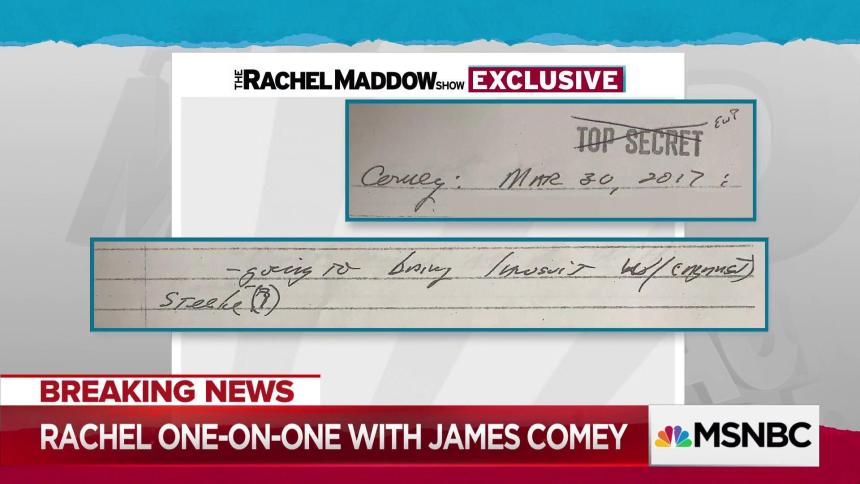
But this is something that we haven’t reported and I wanted to ask you about it because it’s essentially hearsay. Mr. Boente in these notes is writing down what appears to be what you’re telling him about your conversation with the president. And one of the things that was most striking to us which we’ve already reported is these phrases “lift the cloud,” talking about needing relief from the Russia investigation, very, very directly tracked with what you testified to Congress about what the president told you. Mr. Boente also took a note that looks like it says, “going to bring lawsuit” with something we candidate read, “Steele.”
This looks from Boente’s notes, I don’t know if you know his handwriting. But that’s what he says.
COMEY: I don’t.
MADDOW: It looked like he was taking a note when he was talking to you about your interactions with the president and which the president — it looks like the president told you he was going to bring some sort of lawsuit over the Steele dossier.
COMEY: Yes.
MADDOW: Did the president say that to you?
COMEY: You know, I have some — looking at this, I have some recollection of that. I don’t know whether it’s in my memo. I wrote a memo after that March 30th call from the president, but it actually rings a bell as I sit here.
MADDOW: And the content of the dossier, particularly the prostitute allegation involving the Ritz Carlton Hotel room and all of that, you write in detail about bringing that up with the president, how unnerving that was for you both after — shortly after the election in January 2017.
Was it your impression that the president was concerned about the real damage that the dossier could do to him as a legal matter, as sparking an investigation or was — did he seem more concerned in terms of embarrassment or sort of the way he might have to personally answer for it to his wife or to his family?
COMEY: I don’t know. It may have been both. But my sense is he was focused most on the personal piece because he would bring it up with me repeatedly. And at least once or twice in bringing that up, he mentioned his wife and how bad it would be if she thought — at one point, he said, if there was even a 1 percent chance it was true.
So, it could be both by I remember mostly I believe that the focus on the personal.
MADDOW: In terms of the president’s personal concerns there, you say at one point in these memos that when you were talking with him about those kind of allegations in the dossier, the president on his own terms brought up women who, quote, falsely accused him of grabbing them or touching them, says there was a, quote, stripper, and Trump gave me the sense that he was defending himself to me.
What does that mean when you were talking to the president about the dossier, he on his own accord brought up other allegations that have been made against him by other women during the course of the campaign?
COMEY: Yes.
MADDOW: And was he asking you to investigate those matters? Was he — why would he bring that up with the director of the FBI?
COMEY: I had no idea. It seemed off axis from what I was there to talk to him about. And so, it was kind of spontaneous from him. I didn’t ask any question that elicited that statement and I didn’t know.
MADDOW: A bunch of the senior officials who you briefed at the time, who you gave these memos to about your interactions with the president. A bunch of these folks have ended up having their lives follow curvy paths in the past year. Obviously, you’ve had the biggest curveball of them all.
But Jim Rybicki, is how you say it I think?
COMEY: Yes.
MADDOW: He’s resigned from the FBI.

James Baker I believe is still there, although he’s been reassigned, and our reporting indicates that he’s been reassigned to what’s basically sort of a potted plant job at the FBI, in comparison with the kind of high level job he had in the past.
Your deputy, Andrew McCabe, very publicly fired, publicly attacked by the president.
You, of course, have not just lost your job but have spent a year as a pinata for the president and for congressional Republicans.
Andrew McCabe said when he was fired: Here’s the reality, I’m being singled out and treated this way because of the role I played, the actions I took, the events I witnessed in the aftermath of the firing of James Comey. The release of this inspector general report against McCabe was accelerated only after my testimony to the House Intelligence Committee revealed that I would corroborate former Director Comey’s accounts of his discussions with the president.
Do you think that’s the case? Are you concerned there’s been an orchestrated campaign to target you and other people who could corroborate your testimony as witnesses?
COMEY: There’s certainly been an organized campaign to target me. There was definitely an organized campaign to attack Andy McCabe, and urge his firing, tear down his reputation, attack his wife — just shameful attacks from the president directly.
And with respect to the others, I know them all well, there’s different stories. Rybicki was going to leave anyway, Baker was reassigned, very talented general counsel and is in a job, I don’t think you call it a potted plant job, but he is way away from the leadership floor of the FBI.
MADDOW: Andrew McCabe was raked across the coals in this inspector general report. We’re now told today that it has resulted in a criminal referral to a U.S. attorney’s office. McCabe’s lawyer says he doesn’t think that Andrew McCabe will end up being charged here.
But this all stems from an incident in which Mr. McCabe was involved in talking to the press about the Clinton investigation, how it was being handled by DOJ and FBI. He says everything he did was — it was within his job description, it was to preserve the public standing of the FBI. He says it was all authorized.
Clearly, the inspector general doesn’t agree with him on that. While you were director of the FBI and he was your deputy, was there clarity under your leadership about talking to the press, about the issue of leaks, about who could authorize people to discuss things with reporters?
COMEY: I think so. There were two people who could authorize disclosures, the director and deputy director. So, Andy had the authority to speak to the media and to authorize communications with the media.
MADDOW: Do you think he improperly spoke to the media in that capacity then?

COMEY: I don’t know for sure. I know that he didn’t tell me about it, didn’t ask me about it before he did it. I think the inspector general’s report is right in that respect. And I would have expected that.
But I think he had the authority to do that and I think if he were here, he might say, well, I didn’t need to talk to the boss because I had the authority to do that.
MADDOW: Yes.
COMEY: And that’s a hard one, because given all that was going on at that point in time, I would have expected him to talk to me. But I think as a matter of rule, he had the authority.
MADDOW: We have another matter to ask you about that relates to the press learning something the press probably should not have learned. We’ll do that right after we come back from this break.
COMEY: OK.
MADDOW: Thank you, sir.
(COMMERCIAL BREAK)
MADDOW: We’re back now with James Comey, former director of the FBI, author of the new bestselling book “A Higher Loyalty.”
Thank you again, Mr. Director.
COMEY: Thanks for having me. MADDOW: We are still absorbing these memos of yours which were just released as we sat down to talk. We were discussing the fact that in Dana Boente’s notes, which we obtained about his conversation with you, he references the president telling you he wanted to bring a lawsuit against Christopher Steele. You did note that in your memo, which we found here. Yes! COMEY: That’s why I created them. MADDOW: The president reportedly telling you, I have a beautiful wife, it has been very painful, can you imagine me, hookers? The president then telling you, according to your own memo, he’s bringing a personal lawsuit against Christopher Steele. As far as we know, the president never did that, but he advised you he might at that point. I want to ask you about one other statement that the president reportedly made to you that’s in these memos that have just been released tonight. This is in your words. The president brought up the golden showers thing and said it really bothered him if his wife had any doubt about it. He then explained as he did at our dinner that he hadn’t stayed overnight in Russia during the Miss Universe trip. Twice during this part of the conversation, Reince Priebus tried to interject a comment about the redacted, and why it was even in there, but the president ignored him. The president said, the hookers thing is nonsense, but that Putin had told him we have some of the most beautiful hookers in the world. He did not say when Putin had told them this — told him this and I don’t recall redacted. Some of this is redacted. The president was conveying this to you at the White House. COMEY: In the Oval Office. MADDOW: And he told you he’d had a personal conversation with President Putin about hookers? COMEY: Yes. MADDOW: Did you believe him or did you think he was speaking hyperbolically? COMEY: He didn’t seem to be speaking hyperbolically. MADDOW: Do we otherwise know the president had personal conversations with Vladimir Putin at that point? COMEY: I can’t recall. I think there was public reporting that he had spoken to Vladimir Putin as sort of a welcome — you know, congratulations on taking office thing at that point. I’m not suggesting they talked about how beautiful the hookers were in Russia, but do I know there was at least one publicly reported conversation. MADDOW: That would be an unusual first call between new heads of state, a congratulatory phone call to be bragging about the relative value of each country’s hookers would be an unusual — COMEY: I think that’s a fair statement. MADDOW: I think so, too. I’m just going to go ahead and assert that my statement is fair there, which is probably improper. All right. I’d like to ask you something about Rudy Giuliani. On October 28, 2016, you sent a letter to Congress notifying them that the FBI was reopening the investigation on Hillary Clinton’s e-mails. Eleven days before the election, and event that Hillary Clinton perceived to have landed on them like a meteor in the closing days of that campaign. Two days before you did that, President Trump’s friend, former mayor of New York, your predecessor as U.S. attorney SDNY, Rudy Giuliani, said this on FOX News — (BEGIN VIDEO CLIP) UNIDENTIFIED MALE: Mr. Mayor, we got 14 days. Does Donald Trump plan anything except for a series of inspiring rallies? RUDY GIULIANI, FORMER NYC NEW YORK: Yes. UNIDENTIFIED FEMALE: What? When will this happen? GIULIANI: We got a couple of surprises left. UNIDENTIFIED MALE: October surprises? (CROSSTALK) GIULIANI: Well, I call them surprises in the way that we’re going to campaign to get our message out there, maybe in a little bit of a different way. UNIDENTIFIED MALE: OK. GIULIANI: You’ll see, and I think it will be enormously effective. And I do think that all of these revelations about Hillary Clinton finally are beginning to have an impact. He’s got a surprise or two that you’re going to hear about in the next two days. UNIDENTIFIED FEMALE: All right. GIULIANI: I mean, I’m talking about some pretty big surprises. UNIDENTIFIED FEMALE: I heard you say that this morning. What do you mean? GIULIANI: You’ll see. (LAUGHTER) (END VIDEO CLIP) MADDOW: So, he’s not just hinting there, he’s bragging that he has advanced notice that something is coming. Two days later, you announced the reopening of the Clinton e-mail investigation. And then whether or not we can guess what he was hinting at there, Mayor Giuliani then thereafter did go back on Fox and say, yes, that’s what he was hinting about, that’s what he was talking about, he explained basically that FBI agents had told him that announcement was coming in advance. (BEGIN VIDEO CLIP) GIULIANI: I had expected this for the last — honestly, tell you the truth, I thought it was going to be about three, four weeks ago because back — way back in July this started. So, this has been boiling up — (CROSSTALK) GIULIANI: I did nothing to get it out. I had no role in it. Did I hear about it? You’re darn right I heard about it. And I can’t even repeat the language that the heard. (END VIDEO CLIP) MADDOW: Did Rudy Giuliani and therefore the Trump campaign have advanced notice from inside the FBI, from the New York field office or wherever, that this announcement from you was coming? COMEY: Not that I know of, but I saw that same publicity and so I commissioned an investigation to see if we could understand whether people were disclosing information out of the New York office or any other place that resulted in Rudy’s report on Fox News and other leaks that we were seeing in the media. I don’t know what the result of that was. I got fired before it was finished, but I know that I asked that it be investigated. MADDOW: You write in the book about how the New York field office, how some agents in the New York field office had been leaking information related to the Clinton investigation. You talk about that on page 208 of your book. I read it many times. COMEY: Thank you. MADDOW: Whether or not they were behind those leaks to Rudy Giuliani, did agents in that office and their propensity to leak specifically about Hillary Clinton, did they basically force you to make that public notification because you knew they’d put it out whether or not you said anything publicly? COMEY: Yes. No, I did not consider the prospect of a leak. Now, that actually figured in a conversation I recount in the book that Loretta Lynch and I had the following week, where she appeared to be saying to me it would have come out anyway basically. But that’s not why I made that decision, because I didn’t know and still don’t know as I sit here whether people in the FBI office in the New York were leaking. MADDOW: Given what you know about the Mueller investigation and Rudy Giuliani, I want to ask you about news that just broke tonight. Rudy Giuliani is going to be joining the president’s legal team. You obviously worked for Rudy Giuliani when he was U.S. attorney in Manhattan and then you later got his job. This is a little bit about what you write about that experience in the book. Quote: There was something of an unwritten code about working in the office of Giuliani, as I suppose there is in most organizations. In his case, the message was, that Rudy was the star at the top and the successes of the office flowed in his direction. You violated this code at your own peril. Giuliani had extraordinary confidence and as a young prosecutor, I found his brash style exciting, which is part of what drew me to his office. It took me a while to realize that his confidence was not leavened with a whole lot of humility. The cost of that imbalance was that there was very little oxygen left for others. Then you describe your first press conference with Giuliani in a case you worked on. Quote: My supervisor told me I was to stand behind the podium while Giuliani, the NYPD commissioner and the head of the FBI New York office spoke to the press. I was not under any circumstances to speak or move. He then repeated a line I heard before, the most dangerous place in New York is between Ruddy Giuliani and a microphone. I stood frozen in the back, looking like an extra from a basketball movie who had wandered on to the wrong set. Though Giuliani’s confidence was exciting, it fed an imperial style that severely narrowed the circle of people with whom he interacted, something I didn’t realize was dangerous until much later. A leader needs the truth but an emperor doesn’t consistently hear it from his underlings. My sense in reading that striking description is that you are drawing a comparison between Rudy Giuliani and Donald Trump as men and in terms of their leadership styles. Is that a fair reading? COMEY: In some ways, yes. This imperial style, the boss is the dominant figure is consistent in my impression in both of their leadership styles. MADDOW: Given what you know about the Mueller investigation and about Rudy Giuliani from working with him, what is your reaction to the news tonight that Mr. Giuliani is going to join Trump’s legal team? He says he’s going to join the team to, quote, negotiate an end to the Mueller investigation and he’s told reporters tonight that he expects that he will be able to negotiate that end. He’ll end the Mueller investigation in about two weeks? COMEY: I saw that in the media, struck me as interesting. I don’t know what his vision would be for that. I also don’t know how it will be coming into the new legal team and working with the president, given the strength of Rudy’s personality and the president’s. I just don’t know. MADDOW: If somebody did want to end the Mueller investigation, how would they do it? COMEY: I actually don’t think you could accomplish that by firing Director Mueller. I think you’d have to fire everybody in the FBI and the Justice Department to accomplish that in practice, given the commitment of the people in those organizations. So, I don’t know what he has in mind. I really don’t. MADDOW: Somebody new to oversee the investigation orders it — orders it staffed to be unseconded. Orders the — that there be no new major investigatory steps taken. I mean, presumably someone in an oversight role — in the oversight role that Rod Rosenstein has now who wanted to kill it could kill it. COMEY: It would be hard to kill given the culture of that, the people in those organizations. Maybe not impossible, but very hard to kill. MADDOW: FBI Director James Comey, I have one more question I want to ask you after the break. COMEY: OK. MADDOW: Thank you again for doing this. All right. We’ll be right back with James Comey. (COMMERCIAL BREAK) MADDOW: Joining us once again James Comey, former FBI director, the author of the book “A Higher Loyalty” which is out there week and you can’t get because everybody else already bought it. But do what you can. Director Comey, thank you again. COMEY: Thanks for having me. MADDOW: In the book you spell out three reasons, I hesitate to call them concerns. Sort of three reasons you had worries about Attorney General Loretta Lynch when it came to the Hillary Clinton e-mail investigation. One is that you say that she asked you to call the investigation a matter, which instead of an investigation. There was the meeting that she had with former President Clinton on an airport tarmac which you note didn’t seem that consequential to you but it did get a tide of critical media attention, which was important. And then there’s something that you very carefully describe as an unverified intelligence report suggesting that she had offered assurances to the Clinton campaign about the investigation, improper assurances, or that she was somehow controlling you with regard to the investigation. Because of those worries you basically — the way you put it is you step away from Loretta Lynch, you announce the FBI findings in the Clinton e-mail investigation without her. The FBI separates from her. COMEY: Yes. MADDOW: Part of why you decided to do was the existence of the unverified intelligence document that could have cast doubt on her independence from the Clinton campaign, even though you didn’t think she really had that problem. Did you ever brief her on that and give her a chance to defend herself? COMEY: That’s another one you can’t answer. I’m very concerned and wrote this very carefully, because I don’t want to be unfair to Loretta, who I like very much, she’s a friend of mine over a long time — MADDOW: Yes. COMEY: — and respect, and don’t think she acted improperly. The problem here was, there was real material, not bogus material, real material that at first I thought would come out in 50 years when it was declassified. MADDOW: Yes. COMEY: And once the Russians started dumping stuff in the middle of June, I thought, oh, man, it’s going to come now. And it would allow — even though I didn’t believe it to be true, it would allow people to have significant doubts about whether the fix was in some way that the Justice Department was in cahoots with the Clinton campaign. MADDOW: And when you say it was real, you mean that this was a thing that happened that Loretta Lynch did? COMEY: No, no. MADDOW: No? COMEY: That’s why we’re very clear about, we had not verified that the thing recounted in these documents was — had had happened. MADDOW: Right. COMEY: But the documents was real. MADDOW: So, it was a real description of a fake thing? COMEY: Well, I believe it to be fake. I never saw any indication that Loretta was compromised and had acted inappropriately. We never spoke about the investigation after that “call it a matter” conversation from the previous fall. MADDOW: The thing that troubles me about that is it seems like even the way you talk about it in the book sort of cast aspersions on Loretta Lynch and whether or not she was doing anything wrong with regard to this investigation. She did take herself out of the loop in terms of overseeing that investigation. And you write early in the book, page 42 about a mentor that you had in the Eastern District of Virginia, about a U.S. attorney who you felt like you learned from. COMEY: Yes, Helen Fahey. MADDOW: Helen Fahey. You say, she didn’t care much what misinformed people said about her, a lesson I would find very valuable as I grow older. She put the interest of the team and the important job we had to do higher than her own feelings or her worries about reputation. It seems to me like with Loretta Lynch, you worried very much about what misinformed people were going to say about her? That they were — that there was no true reason to have concerns about Loretta Lynch’s integrity with that investigation but misinformed people would get the wrong idea and you took action to account for that rather than the truth. COMEY: Well, maybe in a slight sense. That was one of the bricks in the load that led me to believe that if I do the announcement next to Loretta, it won’t have credibility. The most important was her decision not to recuse herself after the airplane business and to say she would accept my recommendation. Look, I get it, which is why it’s in the book because it’s true that this one of the factors that I considered. MADDOW: And it was — but there — but do you see what I’m expressing as a worry here? COMEY: Yes. MADDOW: That effectively, something untrue about her that people would have misperceived ends up being the limiting factor in terms of whether or not she’s allowed to do her job. (CROSSTALK) COMEY: It’s a little tricky though because untrue about her, we had not verified it and I did not believe she had acted in any way inappropriate. MADDOW: And you later investigated those claims and found them not to be true. You explained to George Stephanopoulos on Sunday night. I read the transcript. COMEY: Yes, I don’t — I can’t remember what I said, but anyhow, I’m trying to be careful because I’m not supposed to talk about our investigation. But I don’t believe that Loretta did anything improper. MADDOW: James Comey is the author of “A Higher Loyalty: Truth, Lies and Leadership.” I’m sorry that I asked you 40,000 questions you were not allowed to answer. I am very grateful to you that you sat here and were kind to me about it throughout. Thank you for your lifetime of public service. I’m sorry that the president ended it the way that he did. COMEY: Yes, me, too. Thanks, Rachel. MADDOW: I appreciate it. COMEY: Thank you.
Steve Benen is a producer for "The Rachel Maddow Show," the editor of MaddowBlog and an MS NOW political contributor. He's also the bestselling author of "Ministry of Truth: Democracy, Reality, and the Republicans' War on the Recent Past." Recommended


