








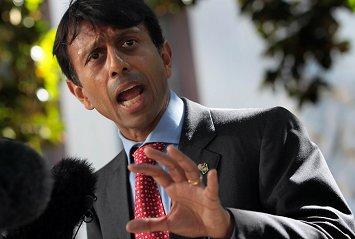
Two weeks ago, Louisiana Gov. Bobby Jindal (R) raised a few eyebrows when he urged public-school science classes to include lessons on both science and pseudo-science. Making the case for a state law allowing creationism to be taught alongside evolutionary biology, the Republican governor asked, “What are we afraid of?“
The obvious answer is the fear of a generation of American young people who’ve been deliberately confused by lesson plans that include bogus claims on purpose. The Guardian went a step further, publishing a piece from an activist critic of the state law, which highlighted the adverse economic consequences for Louisiana, in the short and long term.
The good news is, state officials were given an opportunity this week to undo their mistake. The bad news is, they chose not to take advantage of that opportunity.
Louisiana law that allows public school science teachers to use supplemental materials in their classrooms will remain on the books, despite criticism that it’s a back-door way to teach creationism.
The Senate Education Committee voted 3-2 Wednesday against the proposal by Sen. Karen Carter Peterson, D-New Orleans, to repeal the Louisiana Science Education Act, in what has become an annual debate before the panel.
More than 70 Nobel Prize-winning scientists have urged the scrapping of the 2008 law.
Well, sure, but what do several dozen Nobel laureates — i.e., elitist eggheads — know about science?
Up against the 70 Nobel Prize-winning scientists were Jindal and far-right activists, including a home-schooled 14-year-old from Baton Rouge who argued, without a hint or irony, “If we can’t think critically, then we might as well throw out the scientific method.”
The education policymakers found this persuasive. They shouldn’t have.
I can appreciate the folksy appeal of exposing students to competing claims — some of which are wrong — and then encouraging young people to, in Jindal’s words, “make up their own minds.”
But as a matter of proper education, this is ridiculous. To reiterate a point from a recent discussion, classrooms are hardly the appropriate setting to expose kids to lessons known to be wrong. When teaching students about heliocentrism, we don’t usually invite critics who believe the earth is at the center of the galaxy in for a presentation. When teaching students the value of pi, we don’t encourage those who’d like to see it changed to just 3.0 to make their best in-class pitch.
Presenting fact and fiction in the same class, as if both are equally credible, does not help students “think critically”; it breeds confusion and ignorance.
When it comes to science, there’s already an equal and open playing field. Creationists can submit their ideas to scientific journals, endure the peer-review process, and engage in a substantive debate with colleagues in their field. If their ideas withstand scrutiny, good for them — they’ll be part of the scientific canon and students will be exposed to their theories. If not, then their ideas need more work. Jindal and his allies think creationists should skip this process altogether — bypass scientific canon and head straight for Louisiana’s public school science classes. I suspect some of you are asking whether the state law is legal, since the Supreme Court has already ruled against teaching science and religion in public school science classes. The problem with legal challenges to this is that the Louisiana policy was crafted to make lawsuits difficult — under state law, teachers still use real science textbooks and real science curricula, and there’s nothing in the policy that specifically promotes or encourages religion. But under this controversial policy, teachers are also permitted to use “supplemental materials” on science Republicans don’t like, including evolutionary biology and global warming. It allows pseudo-science to sneak in, without the fingerprints of state policymakers. (“Today, I’d like you to open to chapter three in your biology textbook, and while you do that, I want to pass around some materials I brought in from the local fundamentalist church….”) Jim Dugan, an anthropology instructor at Tulane University, told policymakers, “Louisiana deserves national ridicule for having this act.” That’s true, but for now, the act isn’t going anywhere.
The place for in-depth analysis, commentary and informed perspectives. Recommended


