








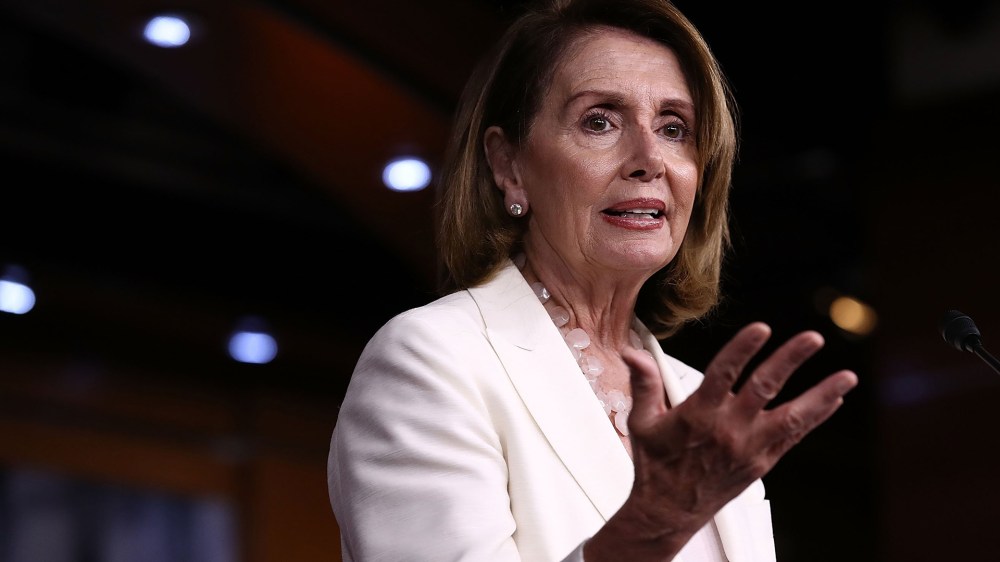
We can’t yet say with certainty exactly how large the new Democratic House majority will be in the new Congress, but as of this morning, it looks like the total will be about 233. If Nancy Pelosi is going to reclaim the House Speaker’s gavel, she’ll need at least 218 of them to support her.
The arithmetic is pretty straightforward: if 16 or more of the 233 House Dems balk, Pelosi won’t have the intra-party backing she needs. If 15 or fewer balk, she’ll be fine.
With this in mind, the Democrats’ anti-Pelosi contingent raised a few eyebrows this week when it released a letter insisting that “the time has come for new leadership in our caucus.” The letter was signed by 16 current or incoming members — and the door was open to others to add their names, too.
So, the circumstances spell trouble for the current House minority leader? Maybe, though the fact that the anti-Pelosi contingent just lost its ostensible candidate suggests the campaign isn’t going especially well.
The only potential Democratic challenger to publicly consider challenging Rep. Nancy Pelosi, D-Calif., for speaker of the House on Tuesday threw her weight instead behind the California congresswoman.
As Rep. Marcia Fudge, D-Ohio announced her decision as Pelosi announced she would reinstate a subcommittee on elections, naming Fudge chair of that panel.
Fudge said in a statement Pelosi had guaranteed her that black women, a loyal Democratic constituency, would be at “the decision-making table” and that as chair of the new subcommittee, she will be able to work to uphold the Voting Rights Act.
Around the same time as Fudge’s endorsement of Pelosi, none other than Barack Obama — the nation’s most popular and influential Democrat — hailed Pelosi as “one of the most effective legislative leaders that this country’s ever seen.”
“Nancy is not always the best on a cable show or with a quick sound bite or what have you,” Obama added. “But her skill, tenacity, toughness, vision, is remarkable. Her stamina, her ability to see around corners, her ability to stand her ground and do hard things and to suffer unpopularity to get the right thing done I think stands up against any person that I’ve observed or worked directly with in Washington during my lifetime.”
The former president didn’t explicitly endorse Pelosi’s bid to become Speaker, but his message wasn’t exactly subtle. Making matters just a little worse for Pelosi’s Democratic detractors, several Democratic Congressional Campaign Committee donors also expressed their support for the Californian. This is not to say the race is over, but given where things stand, I wouldn’t bet against her. * Update: Rep. Brian Higgins (D-N.Y.), one of the House Dems who signed the anti-Pelosi letter this week, has announced that he’s changed his mind.
Steve Benen is a producer for "The Rachel Maddow Show," the editor of MaddowBlog and an MS NOW political contributor. He's also the bestselling author of "Ministry of Truth: Democracy, Reality, and the Republicans' War on the Recent Past." Recommended


