








Under normal political circumstances, the congressional procedures surrounding a State of the Union address are routine and entirely ignored. This year, things are a little different.
In a typical year, following undramatic behind-the-scenes negotiations, the House leadership extends an invitation to the White House, the president accepts, and the House and Senate approve a concurrent resolution that formally establishes the schedule for the event. If none of this sounds familiar to you, that’s because it’s never important and no one ever covers it as news.
When a State of the Union address is scheduled during the longest government shutdown in American history, however, things inevitably get more complicated.
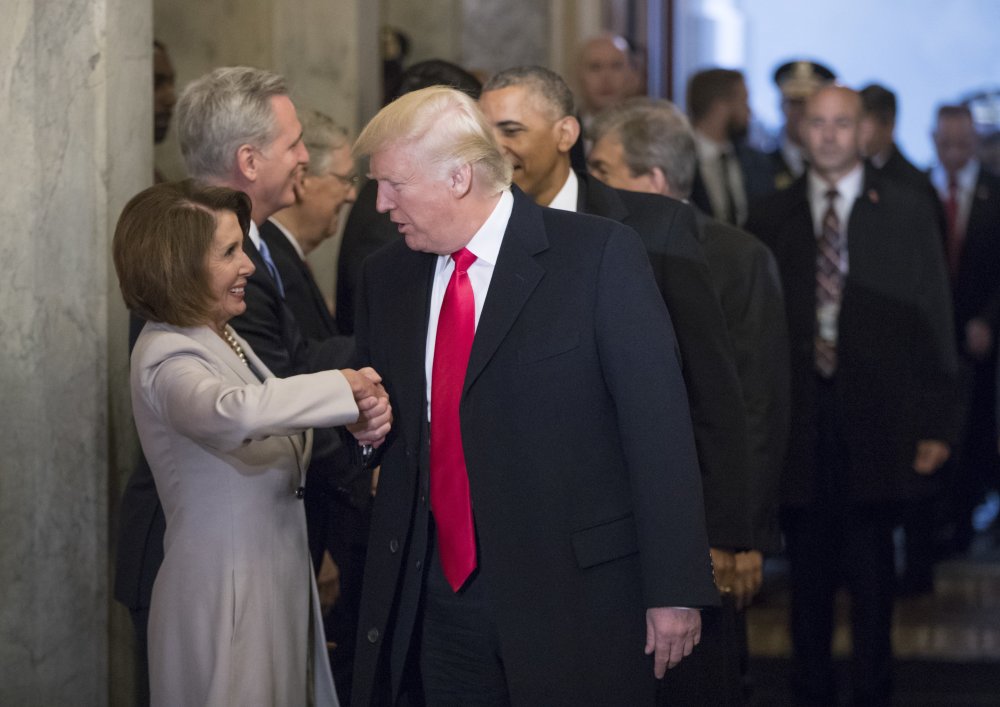
A week ago today, House Speaker Nancy Pelosi (D-Calif.) wrote a letter to Donald Trump, asking that they “work together to determine another suitable date after government has re-opened for this address or for you to consider delivering your State of the Union address in writing.” The president initially responded by derailing Pelosi’s trip to Afghanistan to see U.S. troops.
This morning, Trump responded again, this time with another letter, telling Pelosi that he intends to stick to the original schedule and plans to deliver his address from the House floor on Jan. 29. A few hours later, Pelosi sent another letter of her own. It read in its entirety:
“When I extended an invitation on January 3rd for you to deliver the State of the Union address, it was on the mutually agreed upon date, January 29th. At that time, there was no thought that the government would still be shut down.
“In my further correspondence of January 16th, I said we should work together to find a mutually agreeable date when government has re-opened and I hope that we can still do that.
“I am writing to inform you that the House of Representatives will not consider a concurrent resolution authorizing the President’s State of the Union address in the House Chamber until government has opened.
Recommended


“Again, I look forward to welcoming you to the House on a mutually agreeable date for this address when government has been opened.”
As a matter of procedure, if the House doesn’t consider a concurrent resolution, there will be no event in the chamber.
So, now what? Well, no one seems to know for sure.
Maybe the president will end the shutdown sometime over the next week, at which point Pelosi will likely welcome him back to the chamber. Maybe Trump will instead find an alternate venue — which could include anything from the U.S. Senate, a state legislature, a military base, a room in the White House, or some other creative location White House officials are likely kicking around.
I suppose it’s also possible that the president will ignore Pelosi’s latest letter and simply show up on Tuesday, expecting to deliver remarks to the nation. I’m not exactly sure what would happen then, though McClatchy had a good report last week noting that the Speaker of the House has quite a bit of control over when the chamber is in session and whose remarks can be televised.
I won’t pretend to know how this will unfold in the coming days, though Trump told reporters this afternoon that he believes Democrats have become “radicalized.” The irony of the comments was apparently lost on him.
Steve Benen is a producer for "The Rachel Maddow Show," the editor of MaddowBlog and an MS NOW political contributor. He's also the bestselling author of "Ministry of Truth: Democracy, Reality, and the Republicans' War on the Recent Past."
