








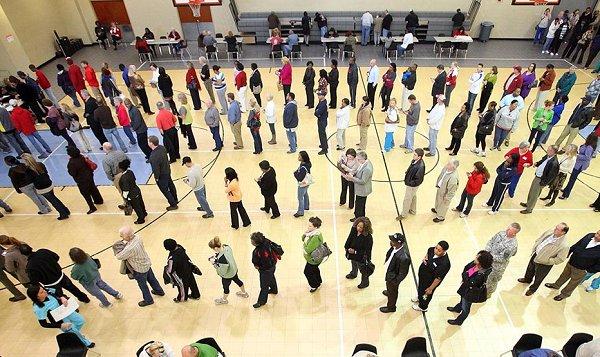
On Election Night 2012, President Obama added a line to his speech that wasn’t in the original text: referencing election reform, he said, “By the way, we have to fix that.”
In January, Obama referenced the issue again in his inaugural address: “Our journey is not complete until no citizen is forced to wait for hours to exercise the right to vote.” And in February’s State of the Union address, the president went a step further, not only emphasizing the need for election reforms, but vowing to create “a nonpartisan commission to improve the voting experience in America — and it definitely needs improvement.”
The good news for reform proponents is, Obama followed through yesterday, signing an executive order to establish the commission. The bad news is, the commission faces an uphill climb.
The commission will be headed by the lawyers for last year’s presidential campaigns: Robert Bauer, who represented Mr. Obama, and Benjamin Ginsberg, who represented his Republican challenger, Mitt Romney. Mr. Bauer has long been Mr. Obama’s legal adviser and served a stint as his White House counsel. In addition to Mr. Romney, Mr. Ginsberg represented former President George W. Bush during both of his campaigns and the 2000 recount.
Mr. Obama’s order directed the new commission to submit a final report within six months of its first public meeting, but it was not clear when it would gather because seven other members are still to be appointed by the president.
The commission was charged with finding ways to shorten lines and “to promote the efficient administration” of elections.
There’s certainly nothing wrong with the commission’s goals, and there can be no doubt that the problems the panel hopes to address are real. When we have a system that asks 102-year-old voters to wait six hours to participate in their own democracy, no fair-minded person can doubt that the status quo is indefensible.
What’s more, I’m delighted the Obama White House continues to take this issue seriously. It’s common for election reform to be an important issue in the immediate aftermath of an election, but the issue invariably fades as the campaign season gets further away in the political world’s rear-view mirror. The president deserves credit for keeping the issue alive. But let’s not overlook the commission’s hurdles. As we talked about in February, it makes sense that Obama wants the panel to have bipartisan credibility. But by tapping Mitt Romney’s lawyer, the White House has made Ben Ginsberg the commission’s co-chair — that would be the same Ben Ginsberg who helped represent the Swift Boat liars’ smear campaign against John Kerry in 2004. In 2006, Ginsburg famously said, “Just like really with the Voting Rights Act, Republicans have some fundamental philosophical difficulties with the whole notion of Equal Protection.” The president’s goals are admirable, but Ginsberg’s inclusion suggests expectations for this commission should probably be kept in check.
The place for in-depth analysis, commentary and informed perspectives. Recommended


