








As fiscal talks in Washington continue, it’s generally wise not to react too strongly, one way or the other, to various offers and counteroffers. There’s a high degree of fluidity to every relevant detail, and provisions are constantly changing. Two weeks ago, for example, a lot of folks seemed convinced that President Obama was poised to accept an increase in the Medicare eligibility age, and now that idea is apparently “a line White House is unwilling to cross.”
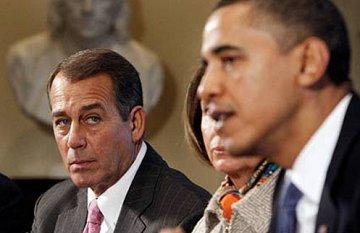
That said, while the caveats are important, there is ample evidence that Obama and House Speaker John Boehner (R-Ohio) are inching closer to a deal.
President Obama delivered to Speaker John A. Boehner a new offer on Monday to resolve the pending fiscal crisis, a deal that would raise revenues by $1.2 trillion over the next decade but keep in place the Bush-era tax rates for any household with earnings below $400,000.
The offer is close to a plan proposed by the speaker on Friday, and both sides expressed confidence that they were closing in on a major deficit-reduction plan that could be passed well before January, when more than a half-trillion dollars in automatic tax increases and spending cuts would kick in.
This is no small concession of the president’s part. He proposed higher marginal top rates on income above $250,000, while Boehner counter-offered with a $1 million threshold. Obama, despite a strong public mandate on the issue, has moved his figure to $400,000 in this latest offer, with the expectation that the Speaker will be similarly flexible.
The president has also lowered his overall tax revenue target to $1.2 trillion, from his initial offer of $1.6 trillion.
On the other side of the ledger, Obama is offering $1.2 trillion in spending cuts, including $400 billion in health care savings, $200 billion from other mandatory programs such as farm price supports, $100 billion in military spending cuts; $100 billion from domestic programs, $290 billion in savings from lower interest on the debt, and $130 billion is savings from “chaining” the Consumer Price Index. More on that in a moment.
As part of the same package, the president would expect an extension on unemployment benefits, new infrastructure investments, another Alternative Minimum Tax extension, and a two-year debt-ceiling increase (it’d be up to the administration to do the paperwork, though Congress could try to vote for default if it wanted to).
Is this a good deal? At a certain level, it doesn’t matter, since Boehner says it’s not good enough and it wouldn’t pass the House. But since it may very well serve as the framework for an eventual agreement, it’s worth paying close attention to its most glaring flaws.
From a progressive perspective, “chaining” the CPI is obviously the most problematic element. For many Democrats in Washington, there seems to be a sense that some kind of entitlement cut will inevitably be part of any bipartisan deal, and that the CPI measure is arguably the least offensive of bad options, but that’s not much of a defense.
Brian Beutler had a good summary on this.
As part of a deal that would include higher taxes on top earners and an increase in the debt limit, Republicans are pushing a plan to index Social Security benefits and perhaps tax brackets to a slower-growing measure of inflation called chained CPI. The plan would reduce Social Security spending by over $100 billion over 10 years by reducing cost of living adjustments, and potentially increase tax revenues by hastening taxpayers into higher tax brackets. Though progressive advocates staunchly oppose the move to chained CPI, aides note that there is a broader consensus in the center-left and conservative policy communities for re-indexing Social Security benefits, particularly by comparison to raising the Medicare eligibility age — the GOP’s other, more controversial benefit cut proposal. For instance, the liberal leaning Center on Budget and Policy Priorities has conditionally endorsed the chained CPI proposal. As such, Democrats will be less likely to support chained CPI unless it’s tied to certain conditions — including an extension of emergency unemployment benefits, and a guarantee that the benefit reduction be used to shore up the Social Security trust fund — not to reduce U.S. budget deficits. For a primer on what a chained CPI is all about, this WonkBlog item is helpful, as is this piece from Tim Noah. For what it’s worth, the New York Times noted that Obama is “insisting on some protections for what he has called the ‘most vulnerable populations,’” as part of this CPI provision, but it’s unclear at this point what those protections might be. There’s a surprising amount of behind-the-scenes activity on this — after quite a bit of silence — and we should know more fairly soon, including whether the entire process will completely fall apart.
The place for in-depth analysis, commentary and informed perspectives. Recommended


