








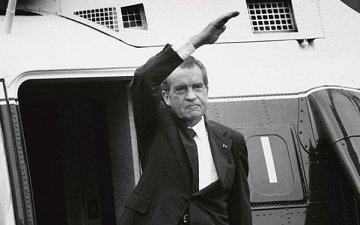
Remember way back in May when the Beltway was buzzing with Obama-to-Nixon comparisons? The chatter was in response to the IRS “scandal,” which turned out to be meaningless, and which didn’t include even a hint of presidential misconduct. The pundits and politicians who casually equated Obama with his Republican predecessor were wrong.
But old habits die hard. George Will, whose columns still run in the Washington Post, argues today that President Obama engaged in an “illegality” when he decided to “unilaterally rewrite” the Affordable Care Act by delaying a provision for a year.
Indeed, Will is quite worked up about this. Obama “ignored the separation of powers,” he said. The president “suspended” the Constitution. Obama relied on a “ukase” — a word more closely associated with Czarist Russia. The president claimed the “right to disregard any portion of any law pertaining to any subject at any time.” And then the conservative columnist not only accused the president of being Nixonian, Will said Obama is worse.
In a 1977 interview with Richard Nixon, David Frost asked: “Would you say that there are certain situations . . . where the president can decide that it’s in the best interests of the nation . . . and do something illegal?”
Nixon: “Well, when the president does it, that means it is not illegal.” Frost: “By definition.” Nixon: “Exactly, exactly.”
Nixon’s claim, although constitutionally grotesque, was less so than the claim implicit in Obama’s actions regarding the ACA.
It’s a genuine shame that no one in the Post’s newsroom pulled Will aside to say, “You know, George, you might want to rethink this one before it’s published.” Indeed, you’d think Will would know better by now. He did, after all, make the same Nixon comparison just three months ago, and it looks pretty silly now.
But if the columnist really believes routine administration decisions are “constitutionally grotesque,” we might as well dig in a little.
The basic argument is simple, and wildly popular with Republicans and Fox News: the Obama administration decided the employer mandate provision in the Affordable Care Act wasn’t quite ready for implementation, so it was put off a year. Republicans are delighted with the substance — they oppose the mandate and they’re glad to see the delay — but claim to be outraged by the process. The administration, the right argues, doesn’t have the legal discretion to delay provisions in a law that aren’t ready to be implemented.
The talking point, which is more desperate than serious, has been debunked before, including by the administration’s own attorneys. This piece last month from Simon Lazarus also helps settle the score. In fact, applicable judicial precedent places such timing adjustments well within the Executive Branch’s lawful discretion. […] The Administration has not postponed the employer mandate out of policy opposition to the ACA, nor to the specific provision itself. Thus, it’s misleading to characterize the action as a “refusal to enforce.” Rather, the President has authorized a minor temporary course correction regarding individual ACA provisions, necessary in his Administration’s judgment to faithfully execute the overall statute, other related laws, and the purposes of the ACA’s framers. As a legal as well as a practical matter, that’s well within his job description. Jon Chait suggests today that the right consider a Godwin’s Law set of rules to avoid future embarrassments. Now, probably when Will invokes “the Constitution,” he doesn’t mean the actual Constitution but the tea-party Constitution, which is less a set of formal laws than a general principle that Democratic presidents shouldn’t pass laws that really freak out conservatives. Obama may not be violating the law per se, but George Will feels violated by the break-in Obama has ordered into his soul. Richard Nixon was a really, really bad guy. It’s worth noting this fact because Nixon has become a kind of domestic analogue to Hitler, invoked as a comparison by everybody, all the time — not just conservatives but also liberals, including a good chunk of Hollywood. Nixon’s administration ordered a break-in to the headquarters of the opposition party and then destroyed evidence of the crime. He ordered the firebombing of the Brookings Institution! If you find yourself tempted to compare a president you don’t like to Nixon, ask yourself, Is this pretty much how I’d react if he had a gang of goons break into the opposition party’s headquarters or told his subordinates to destroy the American Enterprise Institute? If not, you probably need a new comparison.
The place for in-depth analysis, commentary and informed perspectives. Recommended


