








When it comes to debt reduction, President Obama’s favorite word is “balance” — he’s ready to compromise, but there won’t be a deal unless both sides make concessions.
As of yesterday, in something of a minor breakthrough, a bipartisan group of senators began using the same word.
A new group of six Senators committed Monday to working on a “balanced” package to avert the year-end budget cuts required by sequestration.
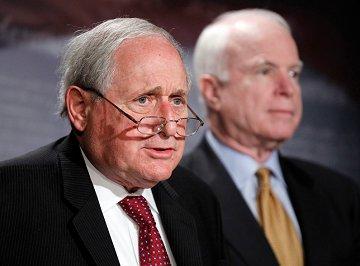
Senate Armed Services Chairman Carl Levin (D-Mich.) and ranking member John McCain (R-Ariz.) led the letter to Senate Majority Leader Harry Reid (D-Nev.) and Minority Leader Mitch McConnell (R-Ky.).
“Failure to act to address the debt would result in sequestration taking effect in January 2013 with significant detrimental impact on our fragile economic recovery,” the Senators wrote. … “We are committed to working together to help forge a balanced bipartisan deficit reduction package to avoid damage to our national security, important domestic priorities, and our economy.”
The choice of words was important because both sides recognize that a “balanced” approach to debt reduction necessarily means a deal that includes new revenue, which Republicans have consistently opposed.
In this case, the six senators — Levin, McCain, Jeanne Shaheen (D-N.H.), Sheldon Whitehouse (D-R.I.), Lindsey Graham (R-S.C.), and Kelly Ayotte (R-N.H.) — are motivated at least in part by concerns about the military. The Republicans in the group are being forced to confront an uncomfortable question: are tax increases worse than deep, arbitrary defense cuts? As of yesterday, the answer may very well be, “No.”
Just to briefly recap for those who’ve forgotten, as part of last year’s debt-ceiling deal, policymakers accepted over $1 trillion in cuts that would be implemented if the so-called supercommittee failed. Democrats weren’t completely willing to roll over — they wanted to create an incentive for Republicans to work in good faith. Republicans agreed: if the committee failed, the GOP would accept defense cuts and Dems would accept non-defense domestic cuts.
The committee, of course, flopped when conservative members refused to compromise, which put us on the clock for the automatic reductions that Republicans contributed to the very process they insisted upon.
Obama has said he’d welcome an alternative solution to replace the triggered sequester, but that’ll require Republicans ready to deal. As of yesterday, three GOP senators at least claim to be ready to look for a “balanced” solution — and that’s three more senators than existed the day before. Now, I know what some of you are thinking. “Sure, they say they’re open to a balanced compromise,” you’re saying, “but we’ve heard this talk before. When push comes to shove, these Republicans just aren’t sincere about striking a deal.” That’s hardly an unreasonable assumption, but with McCain and Graham stepping out in front on this, it’s worth noting that these guys really don’t want the automatic Pentagon cuts. They’re obviously, reflexively opposed to tax increases, but on their list of priorities, defense spending is pretty much alone in the top spot. Indeed, it’s not a coincidence that five of the six senators who signed yesterday’s latter are members of the Armed Services Committee. I still think the odds of an agreement are remote — even if the Senate worked out a deal, it couldn’t pass the House — but they’re slightly better today than they were 24 hours ago.
The place for in-depth analysis, commentary and informed perspectives. Recommended


