








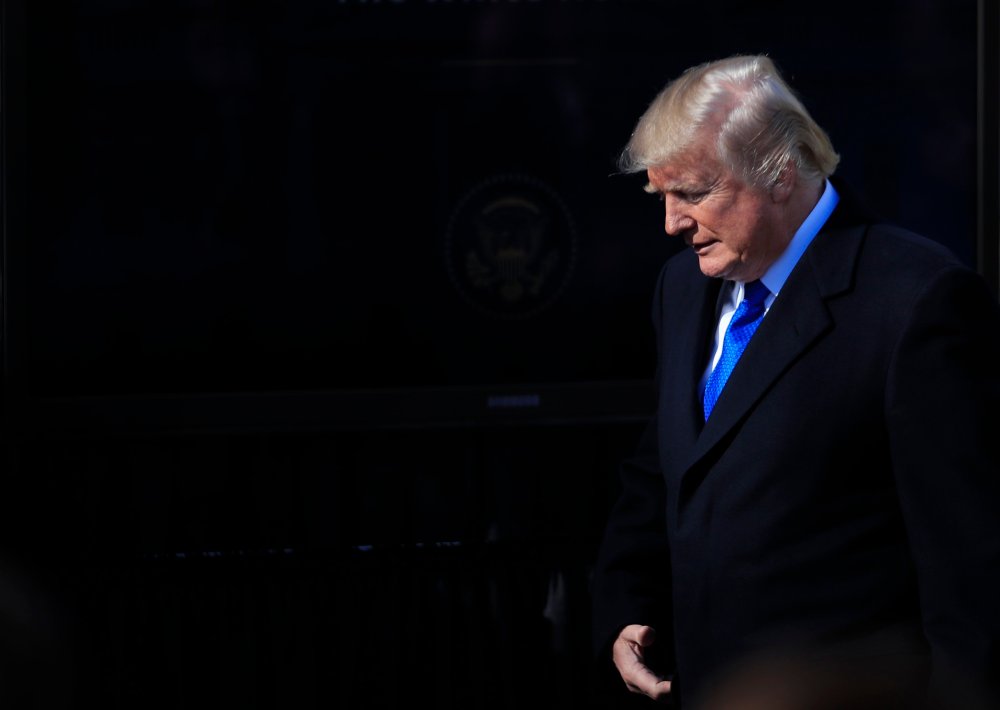
The timing of the event was clearly awkward. On Wednesday night, one of Donald Trump’s lawyers unexpectedly told a national television audience that the president repaid a different lawyer for the hush-money payoff he made to a porn star before the election. On Thursday morning, Trump hosted a National Day of Prayer event at the White House with a group of allied religious leaders.
The gathering, of course, included no references to the intensifying sex scandal, but Trump did insist that people say, “Merry Christmas” more frequently because of him, adding that Americans are also saying “One nation, under God” more often, also because of him.
There’s no evidence that either of those claims is true.
But looking past the latest examples of presidential nonsense, there was an important substantive angle to yesterday’s event that shouldn’t go overlooked. The Washington Post reported:
President Trump in a Rose Garden ceremony Thursday announced an executive order he said would expand government grants to and partnerships with religiously-affiliated groups through a new faith-based office — a move described by one of his top faith advisers as aimed at changing the culture to produce fewer discussions about church-state barriers with “all of these arbitrary concerns as to what is appropriate.”
Trump’s order created something called the White House Faith and Opportunity Initiative, and while there’s still some ambiguity as to what the office will do, Johnnie Moore, the spokesperson for the president’s evangelical advisory group, told the Post Trump is ordering every department in the executive branch to “work on faith-based partnerships.”
That could pose some constitutional problems. For decades, religious social-service organizations have competed for government contracts — receiving funds to run soup kitchens and shelters, for example — but safeguards were put in place. Groups that accepted public money, for example, couldn’t proselytize to those receiving benefits.
When one of the president’s advisers says the Trump administration intends to ignore “arbitrary concerns as to what is appropriate,” it sounds an awful lot like the White House might look for ways around those legal safeguards.
Or put another way, the president who’s been largely indifferent to constitutional principles since taking office appears to have found another — in this case, the separation of church and state — he may not want to honor.
The religious right, not surprisingly, is delighted. It should be: as my friends at Americans United explained, the movement is getting much of it wants. [Trump’s] order creates “Faith and Opportunity” offices or liaisons in every federal agency and department and tasks them with enforcing the U.S. Department of Justice’s 25-page “guidance on religious liberty.” This guidance contains extreme interpretations of the law in an effort to give a green light to religious exemptions, regardless of how an exemption would affect other people or the public interest. For example, the guidance explicitly states that faith-based organizations may accept taxpayer dollars to perform social services and use those funds to discriminate in hiring. And we know some government contractors want to cite religion to refuse to provide vital services required under their contract, like reproductive health care to victims of sexual assault. These offices must also identify and reduce “barriers” to the engagement of faith-based groups and the “burdens on the exercise of religious convictions.” The litigation is bound to be interesting.
Steve Benen is a producer for "The Rachel Maddow Show," the editor of MaddowBlog and an MS NOW political contributor. He's also the bestselling author of "Ministry of Truth: Democracy, Reality, and the Republicans' War on the Recent Past." Recommended


