








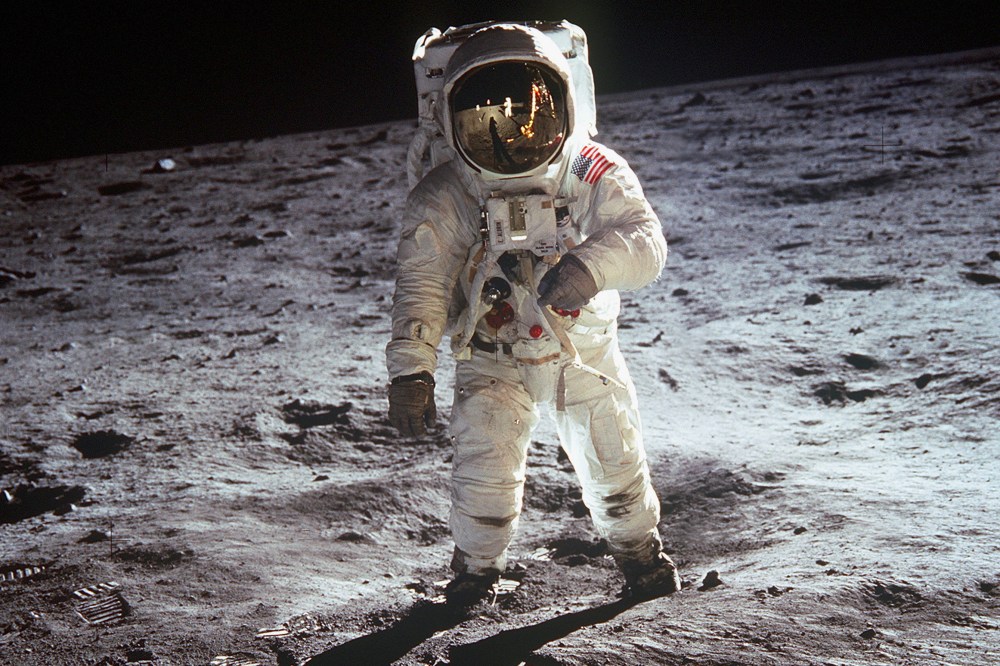
Vice President Mike Pence traveled to Alabama last week for a meeting of the National Space Council, where he made a little news. “In Space Policy Directive-1, the president directed NASA to create a lunar exploration plan,” the vice president said. “But as of today, more than 15 months later, we still don’t have a plan in place. But Administrator Bridenstine told me, five minutes ago, we now have a plan to return to the moon.”
(A day earlier, the White House issued a statement that said Donald Trump is “boldly putting Americans back on the moon.” These guys really do love their adverbs.)
Pence’s remarks drew hearty applause, though they were a little odd. As the Washington Post reported soon after. “Pence did not provide details on how the agency would achieve landing humans on the moon in the five-year time frame, a monumental goal NASA had been hoping to achieve by 2028. He provided no details on the cost or how the mission would unfold.”
And, of course, by the vice president’s own telling, he only learned about the “plan” to return to the moon by the year 2024 just minutes before beginning his speech.
Complicating matters, the “plan” appears to be missing a few things — such as every relevant and practical detail.
NASA Administrator Jim Bridenstine said Monday that the agency will need additional funding to meet a White House mandate to land people on the moon by 2024. But he did not say how much more money NASA would need or provide any specific details of how it plans to accomplish the mission.
Speaking at a town hall meeting at NASA headquarters, Bridenstine made it clear NASA was scrambling to figure out how to get to the lunar surface before the presidential election in 2024.
It’s true, of course, that when John F. Kennedy called for a manned mission to the moon, there was a lengthy list of unanswered questions as to how achieve such a goal, but Kennedy put his money where his mouth was — and NASA, with a soaring budget, had the resources needed to make the dream a reality.
The Trump administration wants to return Americans to the moon and is apparently just hoping NASA will figure something out.
But I’m especially interested in the White House’s target date: 2024. Maybe Team Trump picked a five-year timeframe because five is a common number to work with, but it wouldn’t surprise me if the administration prioritized an endpoint at which Trump expects to still be in office.
Because this president would probably think it was cool if he could go on television and say, “I put Americans on the moon again.”
Circling back to our earlier coverage, at a conference two years ago, Commerce Secretary Wilbur Ross described the administration’s vision for using Earth’s moon as “a type of gas station” for ships en route to other destinations, including Mars. When Ross was asked whether a gas station on the moon would happen in the next decade, the cabinet secretary said it’s coming “a lot sooner than that.”
It wasn’t altogether clear what he was talking about, though the most likely explanation is that Ross was echoing his boss’ thoughts on the subject.
A few months earlier, Trump boasted to an audience that the United States would reach Mars “very soon.” Apropos of nothing, the president added, “You wouldn’t have been going to Mars if my opponent won, that I can tell you. You wouldn’t even be thinking about it.” (Hillary Clinton has long described herself as “an enthusiastic supporter of human space flight,” and during her candidacy, she committed her administration to investing in the endeavor, including a Mars mission.)
Trump’s interest in the subject was apparently quite intense. In April 2017, he participated in a video call with astronaut Peggy Whitson, who’d just broken the record for the longest amount of time in space for any American. The two had this exchange: TRUMP: Tell me, Mars — what do you see a timing for actually sending humans to Mars? Is there a schedule? And when would you see that happening? WHITSON: Well, I think as your bill directed, it will be approximately in the 2030s. As I mentioned, we actually are building hardware to test the new heavy launch vehicle, and this vehicle will take us further than we’ve ever been away from this planet. Unfortunately, spaceflight takes a lot of time and money, so getting there will require some international cooperation to get it to be a planet-wide approach in order to make it successful, just because it is a very expensive endeavor. But it so worthwhile doing. TRUMP: Well, we want to try and do it during my first term or, at worst, during my second term. So we’ll have to speed that up a little bit, okay? WHITSON: (Laughter.) We’ll do our best. It now appears he may not have been kidding. Olivia Nuzzi highlighted an anecdote from Team of Vipers, the book from Cliff Sims, a former Trump aide from the White House and 2016 campaign. As the clock ticked down [before the difficult call to space], Trump “suddenly turned toward the NASA administrator.” He asked: “What’s our plan for Mars?” [Robert Lightfoot Jr., the acting NASA administrator] explained to the president — who, again, had recently signed a bill containing a plan for Mars — that NASA planned to send a rover to Mars in 2020 and, by the 2030s, would attempt a manned spaceflight. “Trump bristled,” according to Sims. He asked, “But is there any way we could do it by the end of my first term?” Sims described the uncomfortable exchange that followed the question, with Lightfoot shifting and placing his hand on his chin, hesitating politely and attempting to let Trump down easily, emphasizing the logistical challenges involving “distance, fuel capacity, etc. Also the fact that we hadn’t landed an American anywhere remotely close to Mars ever.” As the story goes, Trump asked if NASA could put Americans on Mars if he sent the agency’s budget “through the roof.” Told that it wouldn’t matter, the president was “visibly disappointed.”Recommended


Steve Benen is a producer for "The Rachel Maddow Show," the editor of MaddowBlog and an MS NOW political contributor. He's also the bestselling author of "Ministry of Truth: Democracy, Reality, and the Republicans' War on the Recent Past."