










The conventional wisdom in political circles is that scandals have to be simple to gain traction. The more complex the controversy, the more difficult it is for the public to understand. And if the public doesn’t understand, the political world will lose interest, and the scandal won’t generate lasting consequences.
With this in mind, it’s tempting to think yesterday’s stunning report in the New York Times — the kind of article that might generate talk of impeachment under normal political circumstances — will struggle to resonate broadly because of its complexities. It involves a foreign bank few Americans have heard of, and some relatively obscure players lacking household names.
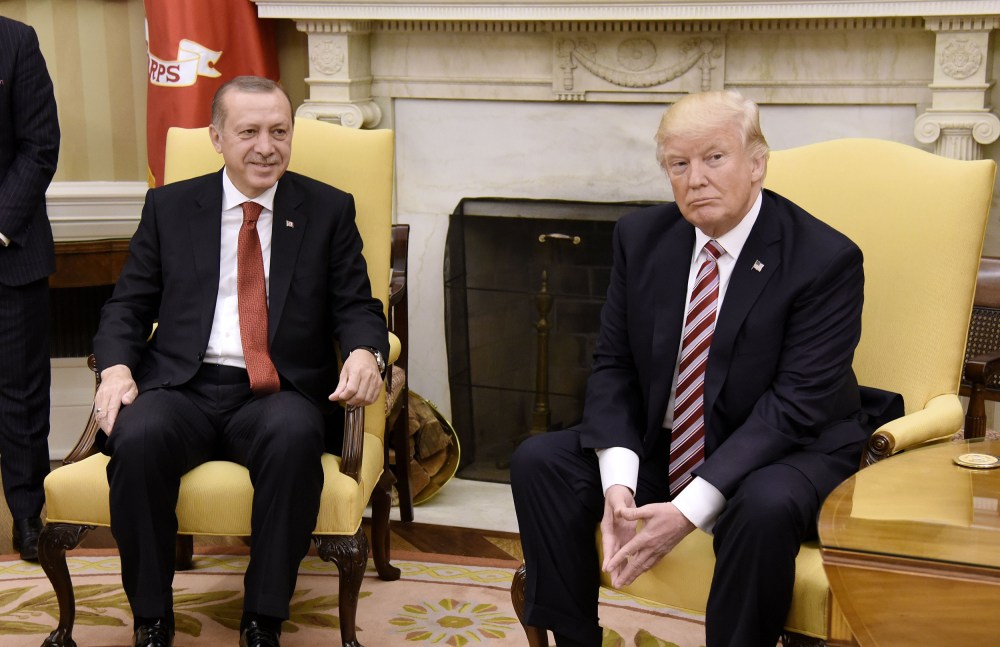
But at its core, the scandal need not be seen as some labyrinthian tale requiring a flow chart to understand. On the contrary, the controversy should probably be seen as painfully simple: a foreign dictator asked Donald Trump to corrupt his own country’s justice system, and the Republican president gladly said yes.
In fact, one of my favorite angles to the story is that it began before Trump took office.
In the summer of 2016, then-Vice President Joe Biden took a diplomatic trip to Turkey, where he was inappropriately lobbied by Turkish President Recep Tayyip Erdogan who wanted the Democratic administration to do him a favor. Specifically, Erdogan pressed Biden to fire a federal prosecutor, whose office was investigating a state-owned Turkish bank called Halkbank — an institution with close ties to Erdogan’s family and political party — which was allegedly violating sanctions by helping Iran.
The Turkish leader went on to tell Biden that he wanted the administration to get rid of the judge handling the case, too.
At a public event, sitting alongside Erdogan, the American vice president explained that the Democratic White House simply could not do what the Turkish president wanted, because in the United States, we take the rule of law seriously. “If the president were to take this into his own hands, what would happen would be he would be impeached,” Biden explained.
Of course, three months later, there was an election in the United States, and a change in administrations soon after. And wouldn’t you know it, Donald Trump — whose company had business interests in Turkey — was far more amenable to the Turkish leader’s appeals. From the Times‘ report:
The president was discussing an active criminal case with the authoritarian leader of a nation in which Mr. Trump does business…. And Mr. Trump’s sympathetic response to Mr. Erdogan was especially jarring because it involved accusations that the bank had undercut Mr. Trump’s policy of economically isolating Iran, a centerpiece of his Middle East plan. Former White House officials said they came to fear that the president was open to swaying the criminal justice system to advance a transactional and ill-defined agenda of his own.
This wasn’t an instance in which the White House simply placated a foreign leader, humoring Erdogan while ignoring his demands. On the contrary, the Republican White House, unlike Obama and Biden, pressed the Justice Department to back off in the Halkbank case.
After initially saying he wouldn’t, Trump did fire the U.S. Attorney whose office was investigating the Turkish bank. The prosecutor’s successor, Geoffrey Berman, moved forward with the probe, but when his office was ready to file criminal charges, the effort was blocked — by Trump’s acting attorney general at the time, Matt Whitaker, who made clear that he wanted the matter “shut down.” When Whitaker was replaced by Bill Barr, the current attorney general, Barr reportedly told the U.S. Attorney he wanted prosecutors to go easy on Halkbank, allowing it to avoid an indictment “by paying a fine and acknowledging some wrongdoing.” At that point, Barr’s Justice Department “would agree to end investigations and criminal cases involving Turkish and bank officials who were allied with Mr. Erdogan and suspected of participating in the sanctions-busting scheme.” To his credit, Geoffrey Berman balked, saying the move would be unethical and at odds with Justice Department policy. Ultimately, Berman was fired, too. It’s important to emphasize that federal prosecutors did end up prosecuting Halkbank, not because of a change in the case, but only after Trump clashed with Erdogan about an unrelated matter. I realize this story is landing at a busy time, but I don’t think we’ve heard the last of it. Yes, it may seem complex, with a lot of moving parts, but keep the bottom line in mind: a foreign dictator asked Donald Trump to corrupt his own country’s justice system, and the Republican president, along with top members of his team, gladly said yes.
Steve Benen is a producer for "The Rachel Maddow Show," the editor of MaddowBlog and an MS NOW political contributor. He's also the bestselling author of "Ministry of Truth: Democracy, Reality, and the Republicans' War on the Recent Past."
Latest Post
Recommended


