










It took about a year for Democrats to pass the Affordable Care Act, but that wasn’t the timeline then-President Barack Obama had in mind. On the contrary, Obama wanted to see the health care debate wrap up in 2009, creating possible windows of opportunity in 2010.
But that’s not what happened. Instead, there was a “Gang of Six” — a group of three Democratic senators and three Republican senators, led by then-Sen. Max Baucus (D-Mont.) — which was ostensibly focused on crafting a bipartisan health care reform package. The “gang” invested months into fruitless negotiations, in which Democrats pleaded for GOP votes that did not, and would not, materialize.
One Republican member of the “gang,” Wyoming’s Mike Enzi, later conceded that he negotiated with Democrats in bad faith, stringing Dems along and weakening the Affordable Care Act blueprint, though he didn’t have any intention of voting for it. Eventually, the Democratic majority recognized reality and approved their plan on their own, but not before moderate Dems wasted a precious resource: time.
Baucus’ unfortunate experiment came to mind this morning reading Politico‘s report on infrastructure talks.
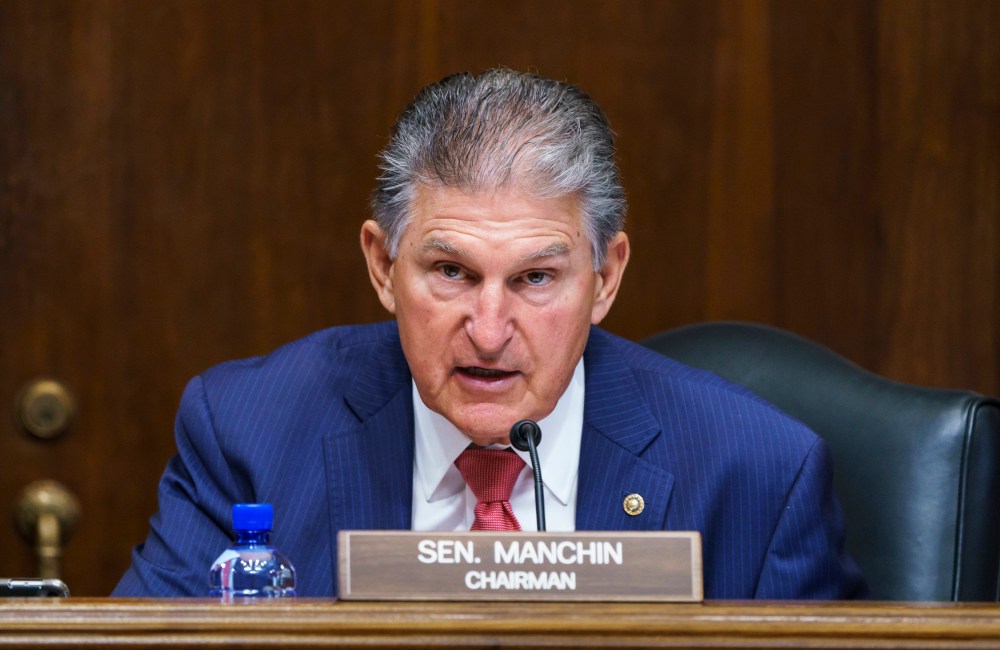
Democrats are warning time is already running out for President Joe Biden’s agenda. Joe Manchin isn’t in any rush. The West Virginia Democrat isn’t ready to wind down bipartisan negotiations on infrastructure, willing to blow through the unofficial Memorial Day deadline.
Congress’ most conservative Democrat told Capitol Hill reporters yesterday afternoon, “This is the long game, it’s not a short game.”
Perhaps, although that’s a matter of choice. The process doesn’t have to be a “long game.” It will only be dragged out if senators like Manchin insist on it being dragged out.
For weeks, leaders in both parties more or less agreed that Memorial Day was a sensible deadline. If President Joe Biden and Senate Republicans couldn’t strike a deal by May 31, the relevant players would agree that a bipartisan deal on this issue simply wasn’t possible. At that point, it would be up to Democrats to pursue their own plan using the budget reconciliation process (a step Democratic leaders have “quietly” started preparing for).
Given the scope of the differences between the White House’s infrastructure pitch and the GOP alternative, many Senate Democrats agree that it’s time for the majority party to move forward with governing.
But not Manchin, who has more of a Baucus-esque vision in mind, working from the assumption that it’s possible to find 10 Republican senators to eventually support a Democratic infrastructure package.
If senators were immortal, this approach might be less concerning, but given the precarious state of the Democratic majority in the upper chamber, the West Virginian is taking a significant risk with a key national priority for no real reason.
What’s more, Manchin is already reportedly exploring the possibility of a side deal with some Republican senators on an entirely new infrastructure plan that’s smaller, less ambitious, and less effective than Biden’s proposal. In case this isn’t obvious, the president has enjoyed a fair amount of leverage in the infrastructure talks: everyone involved understood that if Republicans refused to strike a credible deal, Biden had the option of walking away from the table and pursuing his own plan without them. That leverage disappears when Manchin freelances and starts negotiating with GOP senators on his own. As things stand, Biden has already lowered the topline price tag of his infrastructure plan from $2.25 trillion to $1.7 trillion, and the White House this week said the ball is in the GOP’s court. Republicans will reportedly unveil a counter-proposal tomorrow, which will be in the ballpark of $1 trillion. That said, pay attention to the details. When Senate Republicans ostensibly put forward a $568 billion plan last month, it wasn’t long before we took a closer look and realized the pitch was actually far smaller than it appeared. My hope is the counter-offer will make clear what is obviously true: it’s time to stop pretending that there’s an effective and worthwhile infrastructure plan that can get 10 Republican votes in the Senate. My fear is this will not be obvious to Joe Manchin.
Steve Benen is a producer for "The Rachel Maddow Show," the editor of MaddowBlog and an MS NOW political contributor. He's also the bestselling author of "Ministry of Truth: Democracy, Reality, and the Republicans' War on the Recent Past."
Latest Post
Recommended


