








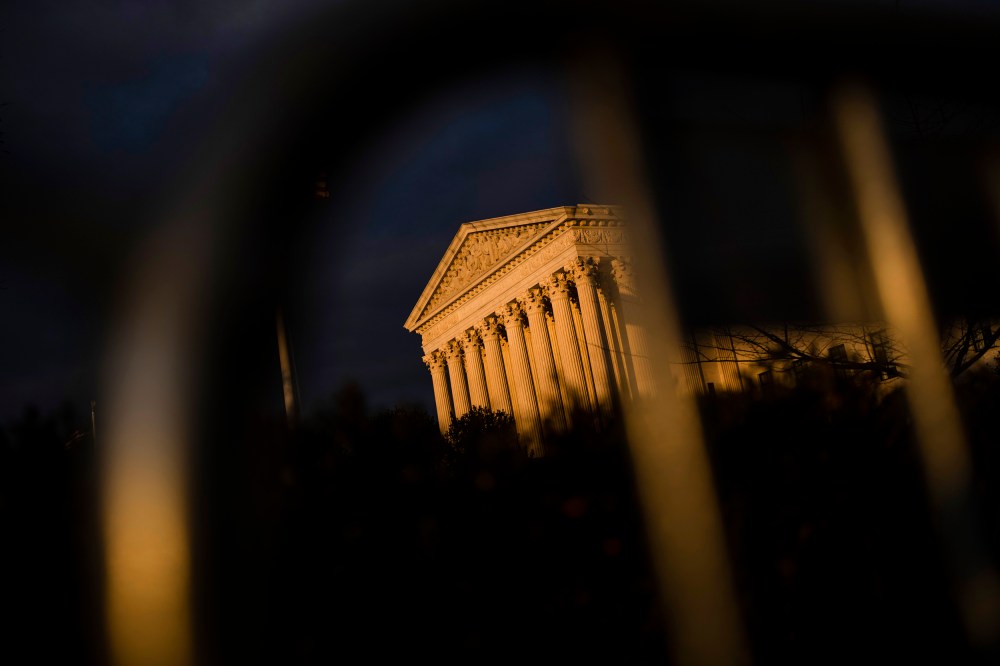

At first blush, a legal fight over education subsidies in Maine might seem like an inherently dry subject. But today’s U.S. Supreme Court ruling in Carson v. Makin is actually an important matter that blasts a hole in the wall of separation between church and state. NBC News reported:
The Supreme Court ruled Tuesday that state programs providing money for public school tuition cannot exclude schools that offer religious instruction. The 6-3 decision relaxed long-standing restrictions on using taxpayer money to pay for religious education, further lowering the wall of separation between church and state.
For those who may need a refresher, let’s revisit our earlier coverage.
There are areas in rural Maine in which there are no public schools. Families in those areas are given taxpayer subsidies from the state — money that would ordinarily go to schools themselves — which they can use at public or private schools of their choice.
But under Maine’s program, the money can’t go toward religious education. The underlying principle is obvious: In the United States, we have a First Amendment that separates church and state. People can give money to religious institutions for faith-based education if they want to, but the government shouldn’t force taxpayers to subsidize religious lessons.
Some families in Maine didn’t quite see it that way and challenged the state’s policy in court, claiming discrimination. Today, the Republican-appointed justices agreed, ruling that Maine taxpayers will be required to fund religious education.
That’s a pretty radical move, as Justice Stephen Breyer seemed eager to point out in his dissent. “We have never previously held what the Court holds today, namely, that a State must (not may) use state funds to pay for religious education as part of a tuition program designed to ensure the provision of free statewide public school education,” the retiring center-left jurist wrote.
Remember, during oral arguments in this case, Breyer declared, “We don’t want to get into a situation where a state will pay for the teaching of religion.”
Now that we’ve seen the six-member majority’s ruling, it appears that’s precisely the “situation” that Breyer’s colleagues on the right are looking for.
Justice Sonia Sotomayor was even less reserved in her own dissent this morning. “This Court continues to dismantle the wall of separation between church and state that the Framers fought to build…. Today, the Court leads us to a place where separation of church and state becomes a constitutional violation.” She added that she has “growing concern for where this Court will lead us next.” Slate’s Mark Joseph Stern noted in December that Maine officials filed a brief with the justices, highlighting the policies at Bangor Christian School and Temple Academy — the two schools that would be in a position to receive taxpayer subsidies if the Supreme Court sided with the plaintiffs. From Stern’s article: The point is not that these schools should be prohibited from espousing such beliefs or adopting such employment practices, offensive as they are. The schools are part of private religious institutions, and these policies are protected under the First Amendment. The point, rather, is that taxpayers shouldn’t be asked to subsidize such religious institutions. Thanks to the high court’s new ruling, taxpayers will have to do exactly that.
Steve Benen is a producer for "The Rachel Maddow Show," the editor of MaddowBlog and an MS NOW political contributor. He's also the bestselling author of "Ministry of Truth: Democracy, Reality, and the Republicans' War on the Recent Past."
Latest Post
Recommended


