









Last summer, Donald Trump had a phone meeting with Ukrainian President Volodymyr Zelensky, who was eager to discuss U.S. military support for his country. But when Zelensky brought up the possibility of purchasing military equipment, his American counterpart quickly tried to change the subject to an unrelated priority.
“I would like you to do us a favor, though,” Trump said, connecting military support to the Republican’s expectations that Ukraine would help with Trump’s political interests. The illegal extortion scheme led to the American president’s impeachment and bipartisan support in the U.S. Senate for his removal from office.
Trump, of course, nevertheless remains in the White House, where he’s still looking for favors from those who need his approval for necessary assistance. Politico reported yesterday:
President Donald Trump on Tuesday suggested that state and local bailout money from the federal government could hinge on whether the immigration policies of the individual governments seeking relief align with Trump administration priorities.
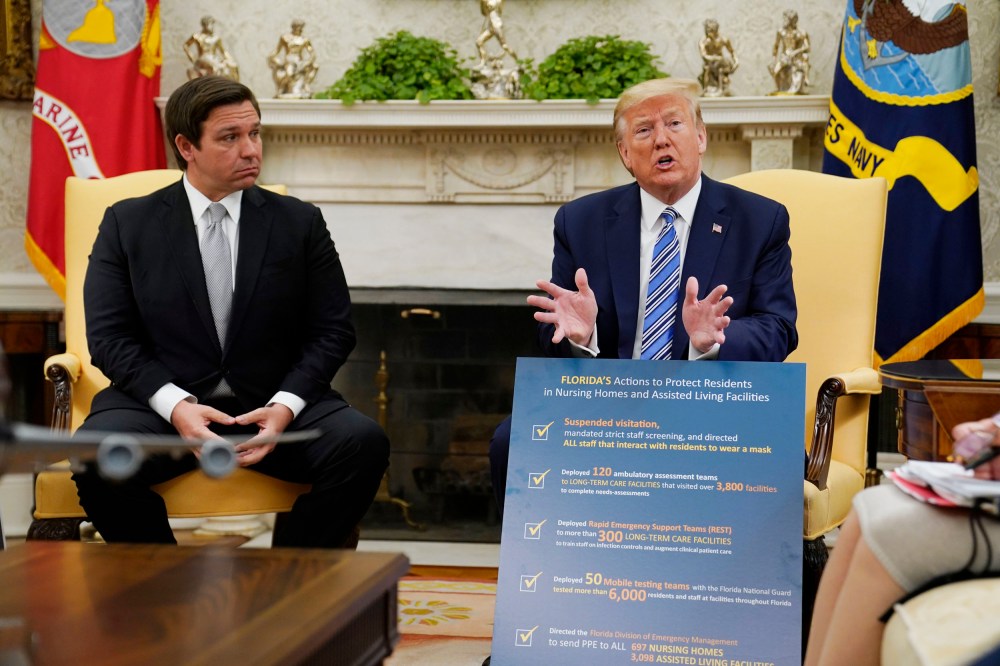
The first sign of trouble came during an Oval Office event with Florida Gov. Ron DeSantis (R), when the president expressed a willingness to negotiate on providing federal aid to states facing fiscal crises as a result of the pandemic. And what, pray tell, does Trump want to negotiate over?
“We’d have to talk about things like sanctuary cities, as an example,” he said.
At a separate White House event later in the afternoon, the president again said he’s ready to discuss state aid, “but we’d want certain things also, including sanctuary city adjustments.”
Or put another way, Trump understands that governors, mayors, and congressional Democrats hope to extend a lifeline to states during this brutal crisis, and he’s willing to listen, but he’d like them to do him a favor, though.
What do policies surrounding so-called “sanctuary cities” have to do with the coronavirus crisis and states facing dire conditions? Nothing. But the president has a political wish list, it’s an election year, and he’s suddenly under the impression that he has some degree of leverage.
As recently as last week, Trump touted his support for state aid and characterized it as a bipartisan issue. The prospect of the president tying unrelated issues to the funding through a clumsy extortion scheme never came up.
But a lot can happen in a week. His new message, in effect, is, “Those are some nice states you have there. It’d be a shame if something happened to them.” Whether Trump realizes this or not, he’s playing a dangerous game for no reason. For example, if he sticks to his new position and conditions state aid on some kind of dramatic shift on “sanctuary cities” policy, Democrats are likely to balk. Indeed, their position — which will have the benefit of propriety — will be that federal policymakers should simply do the right thing during a crisis because it’s the right thing, extortion fantasies notwithstanding. If the president fails to retreat, states won’t get the lifeline they need, which will mean drastically reduced public services and mass layoffs of public-sector employees, including everyone from school teachers to police officers to firefighters. For everyone’s sake, here’s hoping Trump is bluffing. Postscript: Historian Kevin M. Kruse noted on Twitter yesterday, “I know ‘imagine if Obama’ is overused here, but seriously, imagine if Obama had responded to a hurricane by announcing that red states would have to embrace his policies before receiving any aid.” It’s a fair point.
Steve Benen is a producer for "The Rachel Maddow Show," the editor of MaddowBlog and an MS NOW political contributor. He's also the bestselling author of "Ministry of Truth: Democracy, Reality, and the Republicans' War on the Recent Past."
Latest Post
Recommended


