








At last night’s ceremonial event for Supreme Court Justice Brett Kavanaugh at the White House, Donald Trump declared, “On behalf of our nation, I want to apologize to Brett and the entire Kavanaugh family for the terrible pain and suffering you have been forced to endure.” It was a jarring moment for multiple reasons.
For one thing, Americans saw an unpopular president whom most voters opposed speaking on behalf of the nation. For another, he was apologizing to a new justice whom most Americans don’t want to see on the bench.
The wrenching battle over Brett Kavanaugh’s nomination to the high court left the public with sharply negative impressions of the new Supreme Court justice and raised questions about his truthfulness, his temperament to serve and whether his partisan views would influence his work on the bench, according to a CNN poll conducted by SSRS in the final days of the fight over his confirmation.
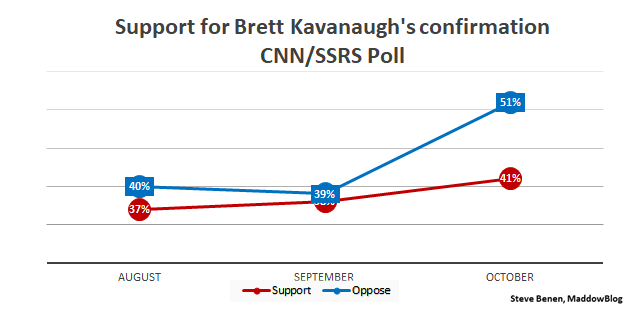
Overall, 51% in the poll oppose Kavanaugh’s confirmation to the Supreme Court, up from 39% who opposed it in early September, after his initial confirmation hearing but before accusations of sexual misconduct emerged. Support for Kavanaugh’s confirmation has merely inched up, by contrast, from 38% backing him in early September to 41% now.
Republicans now have the control they’ve long sought over Supreme Court, extending the control the GOP already has, at least for now, over the White House and Congress. But it’s worth pausing to acknowledge the fact that this isn’t what the American electorate necessarily signed up for.
Kavanaugh has “a distinct honor,” a Washington Post analysis noted over the weekend. “He will be the first justice nominated by someone who lost the popular vote to earn his seat on the bench with support from senators representing less than half of the country while having his nomination opposed by a majority of the country.”
We like to think that in any democratic system, governmental power reflects the will of the electorate. After all, a fundamental tenet of the social compact is the establishment of a political system that acts with the consent of the governed.
Except, that’s not quite what Americans have right now.
A plurality of Americans voted for Hillary Clinton, but they got Donald Trump. Most Americans voted for Democratic congressional candidates, they got a Republican-led Congress. Most Americans opposed nominee Brett Kavanaugh, but they ended up with Justice Brett Kavanaugh. In fact, here’s an amazing piece of trivia: the only two Supreme Court justices in the history of the United States who were nominated by a president who lost the popular vote, and who were confirmed by senators representing a minority of Americans, are Neil Gorsuch and Kavanaugh. As Michael Tomasky explained late last week, we now have “two Supreme Court justices who deserve to be called ‘minority-majority’: justices who are part of a five-vote majority on the bench but who were nominated and confirmed by a president and a Senate who represent the will of a minority of the American people.” Expect calls for systemic reform to the American system, so that it better reflects the wishes of the American electorate, to grow quite a bit louder.
Steve Benen is a producer for "The Rachel Maddow Show," the editor of MaddowBlog and an MS NOW political contributor. He's also the bestselling author of "Ministry of Truth: Democracy, Reality, and the Republicans' War on the Recent Past." Recommended


