








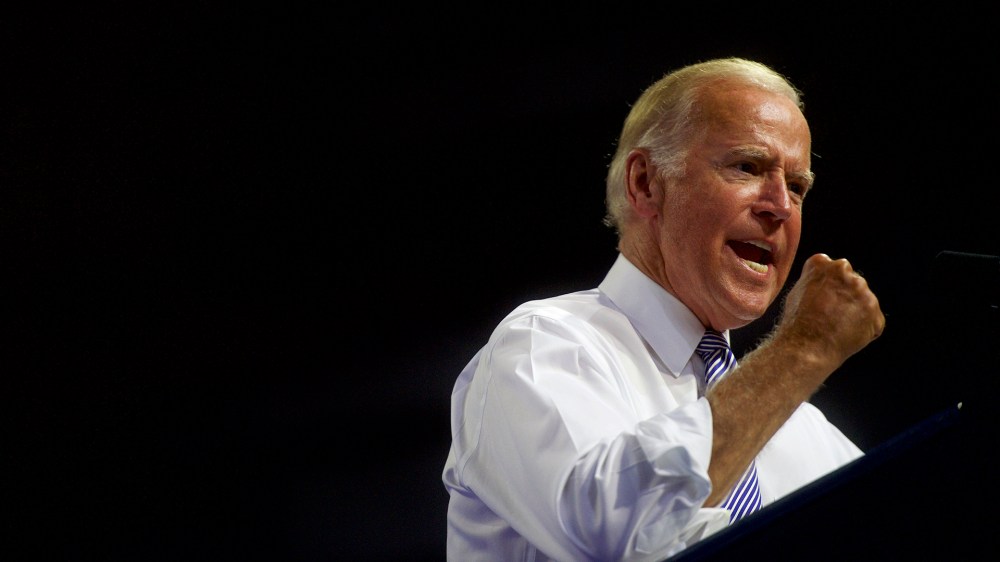
The largest field of presidential contenders in history just got a little bigger, though the latest addition is arguably more notable than most. After months of speculation, former Vice President Joe Biden kicked off his candidacy for the Democratic presidential nomination this morning, insisting that, when it comes to taking on Donald Trump, “we are in a battle for the soul of this nation.”
In the opening of his announcement video, Biden highlighted the 2017 violence in Charlottesville, Virginia, where during a large gathering of white nationalists and counter-protesters, a white supremacist rammed his car into an opposition group, killing one person.
Biden noted that President Donald Trump said there were some “very fine people on both sides” in Charlottesville, where the white nationalist protest was aimed against the city taking down a statue of Robert E. Lee, a Confederate general.
“In that moment, I knew the threat to this nation was unlike any I’d seen in my lifetime,” Biden said, adding that he believes “history will look back on four years of this president and all he embraces as an aberrant moment in time. But if we give Donald Trump eight years in the White House, he will forever and fundamentally alter the character of this nation. Who we are. And I cannot stand by and watch that happen.”
There was some speculation in recent weeks about the Delaware Democrat launching his candidacy with some possible gimmicks, including a vow to only serve one term if elected and/or an early introduction to his running mate.
At least for now, neither of these of things has happened.
This is Biden’s third presidential candidacy, and to put it mildly, the first two did not go well. In the 1988 race, the then-senator — who was just 45 years old at the time — was seen as a credible contender, but his campaign was derailed by a plagiarism controversy. Twenty years later, Biden tried again, only to garner 1% of the vote in the Iowa caucuses. In the wake of his fifth-place finish, he exited the stage.
What Biden didn’t know at the time, of course, was that later in the year he’d join Barack Obama’s national ticket, and he’d soon after become a popular and respected vice president.
All of which leads us to a dilemma of sorts: there are, in effect, two Joe Bidens.
The first Joe Biden is the one Americans saw before 2008. He was a rather moderate senator, who had more than a few critics on the left. This Biden may struggle in the coming months to defend his legislative record on major issues, including race, criminal justice, foreign policy, judicial nominees, bankruptcy policy, and trade.
Put it this way: in this enormous field of 2020 Democratic presidential contenders, Biden will be the only candidate who voted for the war in Iraq, NAFTA, and the controversial 1994 crime bill (which he helped write).
The other Joe Biden is the affable vice president, who stood at Barack Obama’s side for eight years, and was an effective official — taking the lead, for example, in implementing the 2009 Recovery Act that rescued the nation from the Great Recession.
Looking ahead, I have a hunch Biden will spend quite a bit of time focusing on the latter iteration, while his detractors — inside the party and out — shine a spotlight on the former.
The former vice president begins his candidacy as a top-tier contender, and by some measures, the early frontrunner for his party’s nomination. That said, there’s no shortage of questions surrounding his campaign, which don’t yet have obvious answers. He’s nationally popular now, just as Hillary Clinton was four years ago, in part because he’d stepped away from the arena. What happens when the arrows start arriving? Throughout his career, Biden has been undisciplined and prone to embarrassing gaffes. Is he up to the challenge of being a better candidate? Biden is 76 years old and will be 77 on Election Day. If there’s an appetite among Democratic voters for a fresh face, how does he intend to close the sale? Biden will almost certainly present himself as the rightful heir to the Obama mantle. Dems can’t vote for Obama, and his wife isn’t interested, but they can have his vice president. As much as that makes sense — the former president remains popular nationwide, and extremely popular among Democrats — have attitudes and expectations changed among progressive voters for a different style of politics? Vice presidents who’ve run for president haven’t fared especially well in the modern era. (See, for example, Nixon in 1960, Humphrey in 1968, Mondale in 1984, and Quayle and Gore in 2000.) Can Biden succeed where his predecessors fell short? Watch this space.
Steve Benen is a producer for "The Rachel Maddow Show," the editor of MaddowBlog and an MS NOW political contributor. He's also the bestselling author of "Ministry of Truth: Democracy, Reality, and the Republicans' War on the Recent Past." Recommended


