








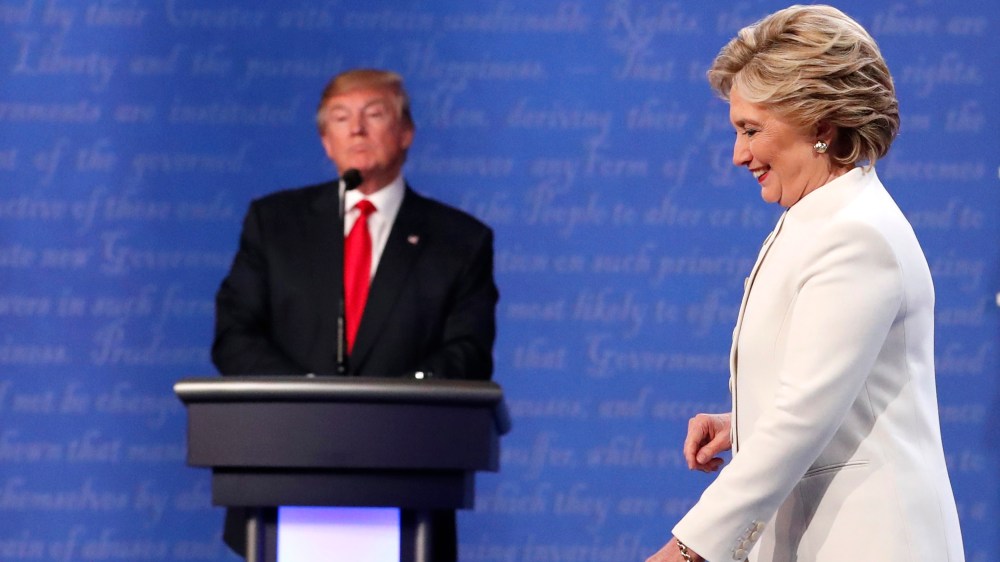
Let’s imagine if 80,000 votes in the Rust Belt had gone the other way in 2016 and Hillary Clinton were president. Let’s also imagine there were controversial circumstances surrounding her victory — a foreign adversary attacked our political system in the hopes of putting her in power — and reasons to believe the Democratic campaign may have cooperated in some way with the attackers.
In this hypothetical, a special counsel was appointed to examine the foreign interference in our elections and scrutinize whether the attackers had American confederates.
Let’s also say Clinton, over the course of her first two years in the White House, flagrantly and repeatedly tried to politicize federal law enforcement — at times publicly calling for the prosecution of her perceived political enemies and favorable treatment for her allies — and even fired her attorney general when he failed to fully insulate her from scrutiny.
In this same scenario, let’s also imagine Clinton and several members of her team were caught lying about her campaign’s contacts with the foreign adversary that helped her win. She was also seen repeatedly siding with the foreign adversary, even against her own country’s intelligence agencies.
As the special counsel’s investigation continued, in our hypothetical, Clinton lashed out wildly against federal law enforcement, condemning the investigation against her as “corrupt” and “illegal,” and suggesting to the public that the findings of the probe should not be trusted. She dismissed damaging evidence against her as “fake news.”
Let’s also imagine the Democratic president chose a new attorney general, with a controversial history of helping cover up presidential-level scandals, and who’d recently written an unsolicited memo to the Justice Department rejecting as illegitimate a key element of the special counsel’s investigation.
Then imagine the special counsel released a report to Clinton’s attorney general — who wrote a brief summary that the White House liked, and who gave vague assurances to the public that Clinton did not cross any legal lines.
The AG’s summary briefly quoted the special counsel’s report, which said his findings “did not exonerate” Clinton — to which Clinton responded by saying the opposite — and said political appointees in Clinton’s Justice Department concluded on their own that she did not obstruct justice.
At that point in our little hypothetical, the Democratic president’s Democratic attorney general suggested no one else should see the special counsel’s actual document. Clinton was in the clear — and he wanted everyone to simply to take his word for it. Let’s imagine this fictional tale were true. How do you suppose the political world would react? Would media professionals accept Team Clinton’s celebrations as legitimate? Would political observers simply take her attorney general’s assessment at face value? Would there be widespread hand-wringing about those who dared to question Clinton’s earlier denials of wrongdoing? Would congressional Democrats call for Republicans’ resignations and demand new investigations into federal law enforcement? Or, in this hypothetical, could we expect to see quite a bit of skepticism?
Steve Benen is a producer for "The Rachel Maddow Show," the editor of MaddowBlog and an MS NOW political contributor. He's also the bestselling author of "Ministry of Truth: Democracy, Reality, and the Republicans' War on the Recent Past." Recommended


