








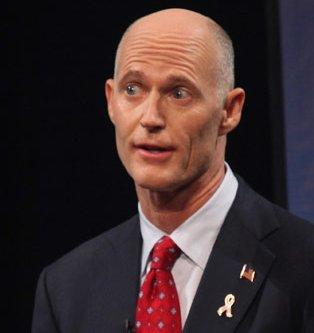
Florida Gov. Rick Scott (R) has, to be sure, seen his share of scandals. Indeed, his most notable accomplishment in public life before becoming governor was getting caught defrauding the government. It stands to reason that if voters elect an alleged criminal to run a state government, there will be consequences.
But it’s the scope of those consequences that Floridians are still dealing with. The Palm Beach Post’s Stacey Singer published a rather remarkable story over the weekend about a tuberculosis outbreak in Jacksonville — one of the worst anywhere in the U.S. in a generation — and the Scott administration’s dangerous response to the public health emergency.
The reports are a little complicated, but Adam Weinstein’s item on this summarized the story well. Much of it has to do with the AG Holley State Hospital in Lantana, Florida, one of the last public-health facilities in the country that specializes in the treatment of TB victims.
Last spring … the GOP-dominated Legislature voted to shutter the hospital as a cost-saving measure. The state’s governor, former health care executive Rick Scott, signed the bill in April and even pressed for AG Holley’s closure to be moved up six months; the facility was permanently shuttered on July 2.
But what was Scott thinking? According to the Palm Beach Post expose, AG Holley’s closure came after the Centers for Disease Control and Prevention had warned the governor and his state health office in a report that tuberculosis was making a big comeback in the state. That report apparently never made it from those state officials to legislators who had voted to close the TB hospital.
Out of 3,000 people who had close contact with contagious people in Jacksonville, only 253 people had been found and evaluated for TB infection. Three months after the CDC’s warning, Florida officials still hadn’t widely distributed the report — to the public or anyone else — and as a consequence, there are an untold number of Floridians carrying the TB strain.
A Republican state lawmaker who heads the Florida House’s health care appropriations committee said he wouldn’t have pushed to close the AG Holley State Hospital if he knew about the CDC report, which may very well be the reason it wasn’t distributed. As for the larger context, Alex Seitz-Wald’s item rings true. The fact that the outbreak began where it did and that it has so far spread mostly among homeless people, mental health patients and drug addicts who encounter each other in soup kitchens and shelters may have made the issue seem less urgent to state officials. Setting aside the dignity of all human life, there is already evidence that the disease has spread beyond the underclass and is continuing to grow, unmonitored, in the Sunshine state. The governor’s office did not comment for Singer’s story, and the state health department has stuck to its message that statewide TB cases are down over last year, suggesting the closure of the hospital was valid. (The hospital closed at the end of June.) The case underscores the real human consequences of austerity budgeting and conservatives’ drive to slash government whenever possible. Since austerity came into vogue with the Tea Party beginning in 2009 and was then put in place nationally after the Republican wave in 2010, there have been countless examples where cuts or attempted cuts impact preparedness. After the the Japanese tsunami, it was noted that Republican budget cuts targeted the agency responsible for tsunami warnings. The same was true about earthquake monitoring after a temblor struck the eastern seaboard (though funding was restored). House Majority Leader Eric Cantor also tried to hold up disaster funding for tornado and earthquake cleanup, demanding it be offset with cuts elsewhere. Republicans’ proposed budget last year would have cut funds for the CDC and food safety monitoring. Incidentally, what does Rick Scott have to say about all of this? As of yesterday, the Republican governor hadn’t said a word about the outbreak or the CDC warning, and he’s currently in Europe on a “trade mission,” accompanied by lobbyists for gambling and private-prison interests.
The place for in-depth analysis, commentary and informed perspectives. Recommended


