








Even many Americans who don’t usually keep up on day-to-day developments in Congress were glued to their screens last week, watching the Senate fight over Brett Kavanaugh’s Supreme Court nomination play out in dramatic fashion. But while the nation’s eyes were focused on the upper chamber, the House’s Republican majority was focused on a very different priority.
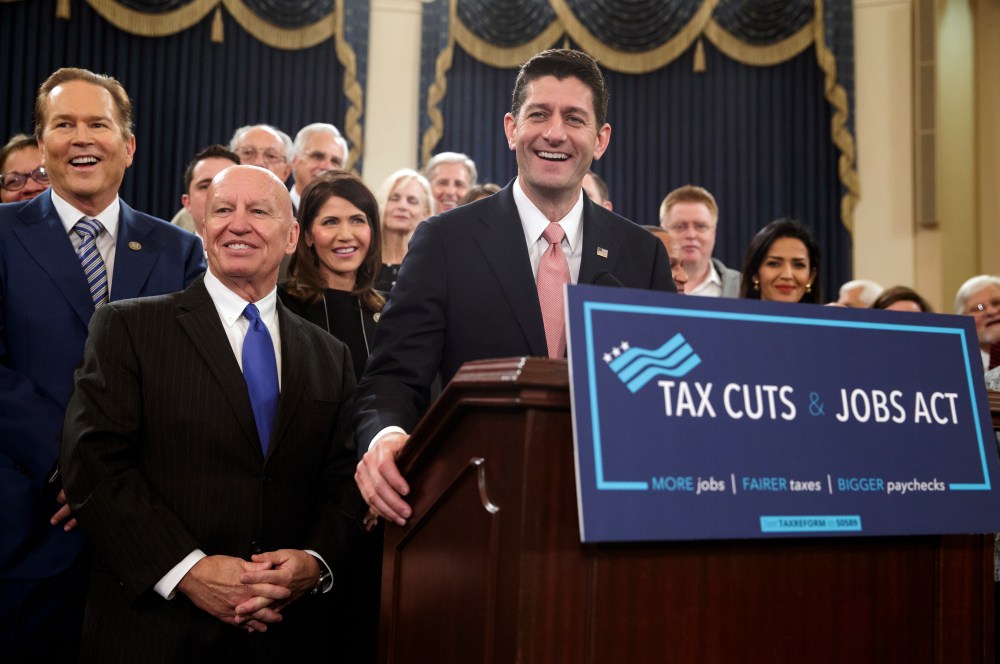
House Republicans passed a $631 billion extension of the tax cuts they enacted in 2017, reprising their biggest legislative success of the past two years as they try to avoid losing their majority in the Nov. 6 election.
The legislation, which passed on a 220-191 vote, was part of a three-bill package that Republicans dubbed “Tax Reform 2.0.” On Thursday, they passed bills to expand retirement-savings incentives and tax breaks for startup businesses, picking up some Democratic support for those narrower measures.
The roll call on Friday’s vote is online here. Note, only three House Democrats voted for the measure, and the trio included Arizona’s Kyrsten Sinema and Nevada’s Jacky Rosen — two House members who are running in very competitive Senate races this year.
So what happens now? In all likelihood, very little. The second “phase” of the Republicans’ tax plan now heads to the Senate, where it may not even receive a vote. The package is subject to a Democratic filibuster, which means the plan would need 60 votes to reach the president’s desk. No one on either side considers this plausible.
The more interesting angle is considering why the House bothered to tackle legislation that everyone expected to fail.
Circling back to our earlier coverage, after the GOP majority passed its regressive tax plan late last year, Republicans could’ve turned their attention to other priorities. Instead, after working on tax cuts, they focused on … more tax cuts.
Donald Trump told a group of supporters in St. Louis in the spring, in reference to his tax plans for 2018, “We’re now going for a Phase 2.” Pointing to House Ways and Means Committee Chairman Kevin Brady (R-Texas), the president added, “It’s going to be something very special.”
It really wasn’t.
As those who followed the fight late last year may recall, the original Republican plan created permanent tax breaks for big corporations, but temporary tax breaks for the public. “Phase 2,” to borrow the president’s phrase, prioritized making the latter permanent, too. But the effort has always been for show. If helping regular folks was an important goal, the original Republican plan would’ve been vastly more progressive, and this new “phase” wouldn’t have been timed as an obvious election stunt. Adding insult to injury, Republicans spent months on this second round of tax breaks without even trying to come up with a way to pay for the $631 billion price tag. It passed anyway. After the measure cleared the chamber, House GOP leaders announced that the chamber is done until after the midterm elections, scrapping some scheduled work days in October. The list of legislative accomplishments in this Congress is meager, and as far as pre-election messaging is concerned, it’s also not going to grow any longer.
Steve Benen is a producer for "The Rachel Maddow Show," the editor of MaddowBlog and an MS NOW political contributor. He's also the bestselling author of "Ministry of Truth: Democracy, Reality, and the Republicans' War on the Recent Past." Recommended


